
Machico
Machico is one of Madeira's earliest settlement sites, a bay-side town on the island's drier eastern coast with a fishing harbour, a sandy beach and a compact historic centre.
Machico is a town and municipality on the east coast of Madeira, the Atlantic island that forms part of Portugal. It occupies a curved bay at the mouth of a river valley roughly twenty kilometres east of Funchal, and it is one of the places where the island's colonisation is traditionally said to have begun. The town has a working fishing harbour, a sheltered beach and a small historic core whose streets still follow the line of the old settlement. Across the municipality as a whole, some twenty thousand people live in four parishes that range from dry coastal slopes to the wet, wooded north.
Location and general character
Machico municipality covers the south-eastern corner of Madeira and reaches inland up steep, terraced hillsides. It is divided into four parishes: Machico itself, Água de Pena to the west, Caniçal at the island's eastern tip, and Porto da Cruz on the cooler northern coast. The town centre sits where the Ribeira de Machico meets the sea, with the river running through the middle of the built-up area and high ground rising immediately behind it. The east of Madeira is comparatively dry and exposed to north-easterly winds, so the landscape here is greener in the ravines and barer along the ridges than in the laurel-covered interior. Madeira's airport lies a short distance west of the municipal boundary, in the neighbouring municipality of Santa Cruz.
History
The bay is widely regarded as the first landing place on Madeira of the Portuguese navigators João Gonçalves Zarco and Tristão Vaz Teixeira, who reached the island around 1419 and are said to have come ashore here before exploring further. The name Machico is tied to an older legend: that of Robert Machin, an Englishman who, in a story repeated by later chroniclers, was driven to the island with his companion Ana d'Arfet while fleeing England. Whatever the truth of the tale, the sheltered anchorage made the spot one of the first permanent settlement sites, and Machico received its charter from Infante Dom Henrique in 1451, a document that gives it a strong claim to being the earliest chartered town on the island. Wheat, sugar cane and wine from the surrounding terraces were loaded from the beach, and the settlement grew along the river. The town's history has also been shaped by water: the ribeira has repeatedly flooded riverside streets, and its channel has been progressively walled and straightened. In the seventeenth century, when raids by privateers were a genuine threat, small coastal defences were added to guard the bay.
Architecture and townscape
The historic centre is compact and easily walked. Streets climb from the harbour towards the parish church of Nossa Senhora da Conceição, which has fifteenth-century origins, a carved Manueline doorway and a heavily gilded interior. Higher up, the chapel of São Roque stands on a slope above the rooftops. At the water's edge, the Forte de São João Baptista is a modest seventeenth-century fortification built to command the bay. The Solar do Ribeirinho, a former manor house, now serves as a municipal museum space, holding archaeological material from the area alongside temporary exhibitions. Domestic buildings mix dark basalt masonry with whitewashed or brightly painted render, and several retain wooden balconies and traditional tiled roofs.
Natural surroundings
Above the town, terraced slopes carry bananas, vines and remaining patches of sugar cane, while higher ground gives way to laurisilva woodland. Pico do Facho, a hill of about 320 metres directly above Machico, once served as a lookout where beacons were lit to warn of approaching ships, and it now offers a broad view over the bay and the airport runway. The Levada do Caniçal, a twentieth-century water channel, follows the hillside eastwards and provides a level walking route. Beyond Caniçal, the Ponta de São Lourenço forms the easternmost point of Madeira: a narrow, wind-scoured peninsula of reddish rock and low scrub, protected as a nature reserve and markedly drier than the rest of the island.
Local culture and everyday life
Fishing still shapes daily life around the harbour, where small boats land their catch, and agriculture continues on the terraces above the town. Caniçal was a whaling centre until the last station closed in 1981, and the museum there documents that industry and its aftermath. Religious observance remains visible in the calendar: the feast of Nossa Senhora da Conceição is celebrated in December, while Caniçal's Festa dos Compadres, staged around Carnival, is known for its satirical figures. Everyday life is quiet and practical, with a weekly market, small shops, cafés serving local dishes and a steady flow of residents commuting to Funchal for work.
Notable places in and around the town
- The bay and its beach, a crescent of imported golden sand backed by a promenade, with the smaller Banda d'Além cove on the eastern side.
- The parish church of Nossa Senhora da Conceição and the chapel of São Roque.
- The Forte de São João Baptista at the shoreline.
- The Solar do Ribeirinho museum.
- The Pico do Facho viewpoint above the town.
- The Museu da Baleia in Caniçal, devoted to the island's whaling past.
Nearby destinations
West of Machico, Santa Cruz has its own parish church and seafront, while the inland village of Santo da Serra, set among orchards and woodland, is reached by a winding road up from the coast. Porto da Cruz, on the northern side of the municipality, is known for the Penha d'Águia, a sheer rock outcrop that dominates the parish, and for a water-powered sugar cane mill that still produces cane spirit. Further north along the coast, Santana is famous for its small thatched houses with steeply pitched roofs. The levada and cliff paths to Ponta de São Lourenço start from Caniçal, and Funchal lies about twenty kilometres to the west along the coastal road.
Related content
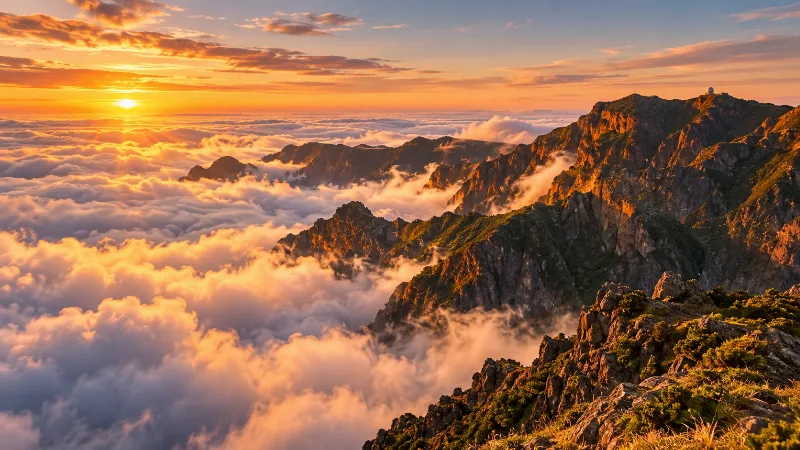
Madeira
Explore Madeira through Funchal, dramatic mountains, levada walks, subtropical gardens, volcanic coastlines and distinctive Atlantic island landscapes.
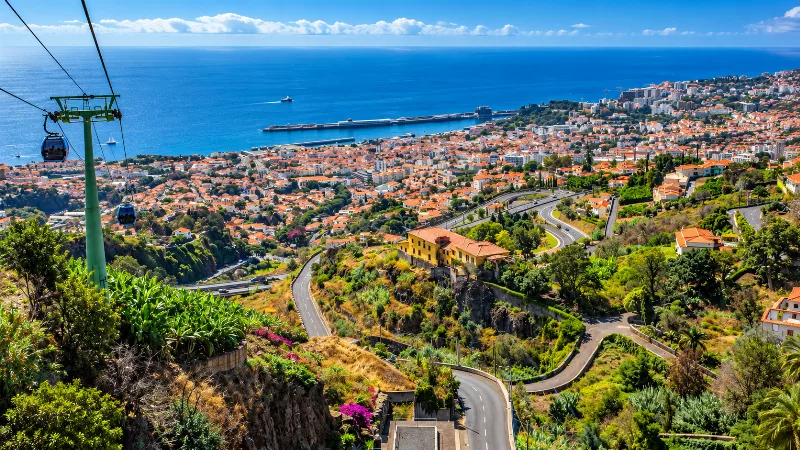
Funchal
Funchal is Madeira’s capital, combining a historic Atlantic port, steep green hillsides, gardens, markets and easy access to island landscapes.
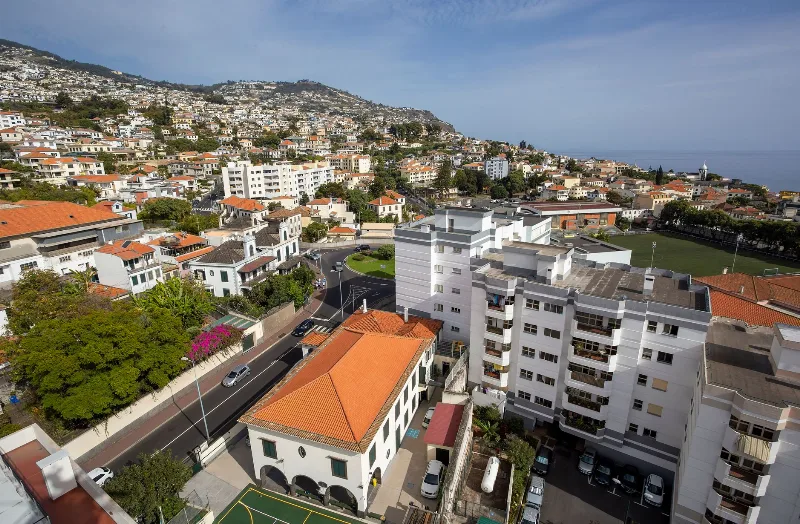
Funchal
Funchal, Madeira's capital, spreads from its Atlantic harbour up the slopes of a volcanic amphitheatre, combining a working port and historic quarters with gardens, wine lodges and access to the island's levada walks.