
Silves
Once the seat of a Moorish kingdom, Silves is a quiet hill town in the western Algarve, known for its red sandstone castle, its cathedral and the orange groves along the Rio Arade.
Silves sits in the Arade valley in the western Algarve, a hill town whose outline of red sandstone walls and a squat cathedral tower rises above the orange groves long before you arrive. It is a working Portuguese town rather than a resort, and the memory of its years as the seat of Moorish power in the region gives it a character quite distinct from the coastal settlements nearby.
Where Silves Stands
The town lies roughly fifteen kilometres inland from Portimão, at the point where the road north to São Bartolomeu de Messines begins to climb towards the Serra de Monchique. It occupies a slope on the north bank of the Rio Arade, the river that drains a broad agricultural basin before meeting the sea between Portimão and Ferragudo. The municipality is among the largest in the Algarve and stretches south to the coast at Armação de Pêra, so it contains both quiet inland hills and a busy stretch of beach. The old town itself is compact and easily walked: whitewashed houses, steep lanes, a riverside road and a small permanent population that swells on market days and during the August fair.
Moorish Capital and Christian Conquest
Under Arab rule the town was known as Shilb and formed part of Gharb al-Andalus, the Muslim west of the Iberian Peninsula. Its position on a navigable river made it a commercial centre rather than a frontier outpost, and in the eleventh century it briefly became the capital of an independent taifa kingdom. That prosperity survives in Arabic chronicles, which describe a substantial city with mosques, baths and a busy river port, and in the reputation of its poets and scholars, whose work circulated between Seville, Córdoba and the courts of North Africa.
The Christian conquest was neither quick nor settled at the first attempt. Sancho I took the town in 1189 with the help of a fleet of northern European crusaders bound for the Holy Land, but the Almohads recaptured it two years later and strengthened the defences on the hill. Silves passed finally to the Portuguese crown in 1242, when the future Afonso III seized it; the main mosque became a cathedral and the town settled into the slower rhythms of a frontier bishopric. Its fortunes later faded as the Arade silted up and ocean-going trade moved downstream to Portimão, while the earthquake of 1755 brought down roofs and damaged several churches.
Red Sandstone and Gothic Stonework
The castle is the town's defining structure and the largest in the Algarve, a long curtain of reddish sandstone pierced by towers and entered through a gate below the cathedral square. Most of what stands today reflects Almohad work of the twelfth and thirteenth centuries, built over earlier foundations. Beneath the courtyard lies a vast vaulted cistern, once filled by rainwater channelled from the roofs and terraces, which gave the garrison its own supply during a siege. The walls now enclose a garden planted with native trees, and the walkway along the battlements looks out over the river and the roofs below.
The cathedral, begun in the thirteenth century on the site of the former mosque, is a sober Gothic building with heavy buttresses and a plain west front; later centuries added chapels and tombs, and the interior holds the graves of bishops and local grandees. Nearby, the church of the Misericórdia carries a Renaissance doorway of carved stone, and the medieval bridge across the Arade rests on foundations older than the present arches. Close to it stands the Cruz de Portugal, a decorated limestone cross of the late fifteenth century that is regarded as one of the finest monuments of its kind in the region.
The Arade Valley and Its Groves
Water defines the landscape around Silves. The river floods a wide, flat floor of alluvial soil, and small irrigation channels divide the land into plots of citrus, chiefly oranges but also lemons and tangerines, whose scent carries across the roads in spring when the trees flower. Further from the water, carob, olive and fig grow on terraces, and cork oak covers the drier slopes towards the hills. Upstream, the Arade and Funcho dams hold water for irrigation and supply, creating narrow reservoirs in the hills that are visited for walking and picnics rather than swimming.
Wildlife follows the river. Herons, egrets and kingfishers work the margins, otters have been recorded in quieter stretches, and the reed beds shelter warblers and rails. Closer to the coast, behind the beach at Armação de Pêra, the shallow Salgados lagoon forms a wetland of importance for migrating and wintering birds, with boardwalks and hides for those who want to watch without disturbing them.
Daily Life and Local Culture
Silves keeps a calendar of its own rather than following the tourist season. Carnival in February or early March fills the streets with parades and satirical floats, and the town is known across the Algarve for the scale of the event. In August, during the Feira Medieval, the area around the castle is given over to stalls, crafts and costumed re-enactments that recall the medieval town, while summer weekends bring smaller parish festivals with food, music and processions. The municipal market, the cafés around the Praça do Município and the riverside bars serve the everyday life of the town, where conversation often turns to oranges, cork and the weather.
Notable Places to See
Most of the historic interest lies within a few minutes of the cathedral square, and a single day is enough to see it without hurrying.
- Castelo de Silves – the walled enclosure, towers and great cistern described above, open to visitors.
- Sé de Silves – the Gothic cathedral, with its tombs and quiet interior.
- Museu Municipal de Arqueologia – finds from the town's long occupation, including an intact Islamic-period well discovered during building work.
- Ponte Velha and Cruz de Portugal – the old bridge over the Arade and the carved cross beside it.
- Igreja da Misericórdia – a sixteenth-century church with a finely carved portal.
- Riverside walks – paths along the Arade, with views back up to the castle walls.
Nearby Destinations
Portimão, twenty minutes away, is the nearest large town and the natural point of access, with its own museum and the long beach at Praia da Rocha. North of Silves, the road climbs to São Bartolomeu de Messines and on into the Serra de Monchique, where the forested slopes and the summit of Fóia offer cooler air and wide views to the coast. To the south and east lie the resort towns of Lagoa, Carvoeiro and Armação de Pêra, the last of these within the municipality of Silves, with cliff paths and sheltered coves along the limestone shore. Alvor, at the mouth of the Alvor estuary, and the reservoir country around the Arade dam are both within easy reach by car, making the town a useful base for exploring the western Algarve away from the busiest stretches of coast.
Related content
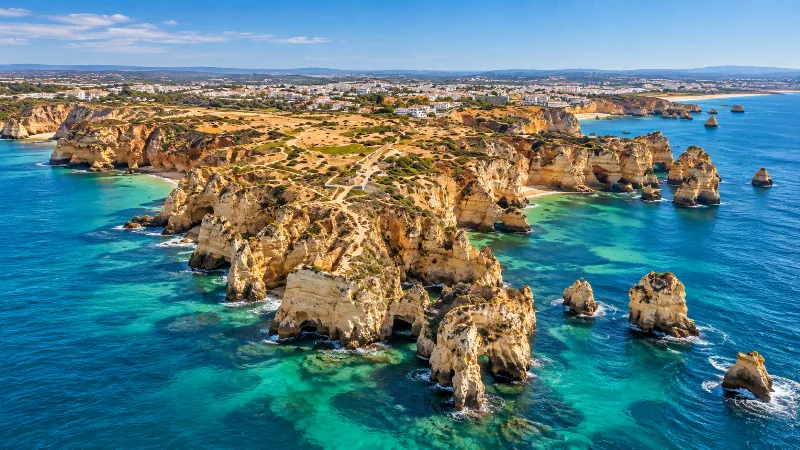
Algarve
Explore the Algarve through sandy beaches, limestone cliffs, Faro, Ria Formosa, coastal trails, historic towns and southern Portuguese landscapes.
Exploring the Historic Town of Silves
Explore exploring the historic town of silves with a practical guide to notable places, regional landscapes, local heritage and travel planning in Portugal
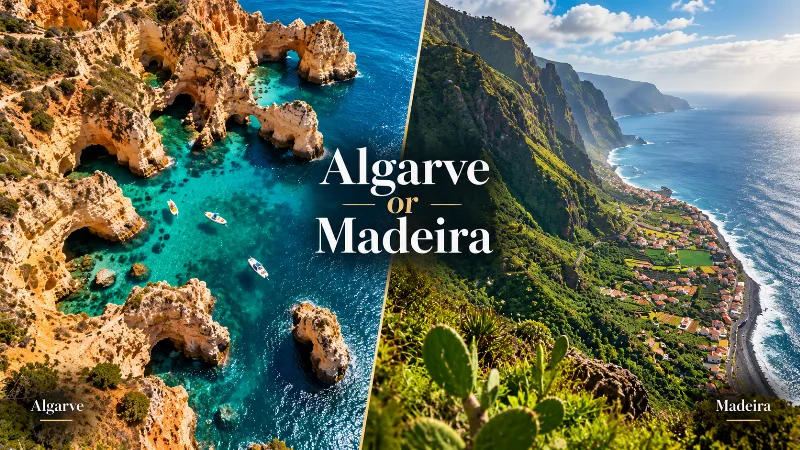
Algarve or Madeira: Which Is Better for Your Trip?
The Algarve and Madeira both offer warm-weather escapes, but they differ greatly in beaches, scenery, hiking, driving, towns and overall travel style.