
The Cork Oak Woodlands of Alentejo
The cork oak woodlands of Alentejo form a distinctive Portuguese landscape known as the montado, where trees, grazing animals and a nine-year cycle of bark harvesting have shaped the land for centuries.
The cork oak woodlands of Alentejo spread across the rolling interior of southern Portugal, where widely spaced evergreen trees stand above grazed pasture and thin, stony soil. This is one of the most characteristic landscapes in the country, and it is largely a human creation: the trees are tended, the ground beneath them is farmed and grazed, and the whole system depends on a cycle of harvesting that lasts for generations.
What Makes a Montado
The Portuguese word for this landscape is montado, derived from monte, meaning a wooded hill or rough pasture. A montado is not a forest in the closed-canopy sense. The trees are deliberately spaced so that light reaches the ground, allowing grass, herbs and shrubs to grow between them. The dominant species is the cork oak, Quercus suber, often mixed with holm oak, the azinheira, which tolerates drier ground and provides acorns in autumn.
Beneath the trees, the understorey is typically low and fragrant: rockrose, gum cistus, wild lavender, thyme and wild asparagus, with patches of cereal or fodder crops in deeper soils. Sheep and cattle graze the pasture, while the dark Alentejo pigs move through the oaks in autumn to feed on fallen acorns. Honey, game birds and firewood add to the produce of the same plot of land, which is why the system has survived so long.
The Nine-Year Cycle of Cork Harvesting
Cork is the outer bark of Quercus suber, a layer rich in suberin that makes it elastic, insulating and unusually resistant to fire. The first stripping takes place when a tree is around twenty-five years old, and the cork removed then is rough and uneven, suitable only for granulation. After that, the bark is harvested roughly every nine years. Trees are worked in the dry months of late spring and summer, when the bark lifts cleanly from the trunk.
Harvesting is skilled manual work. Teams using small axes cut along the trunk and ease the bark away in large curved planks, leaving the pale reddish inner surface exposed. Each trunk is then painted with a number recording the year of the harvest, so that future crews know at a glance which trees are ready and which must be left alone. A well-managed cork oak may be stripped a dozen or more times and can live for 150 to 200 years. Even after fire, many trees survive by sprouting again from the base.
Wildlife of the Cork Oak Woodlands
The mosaic of trees, open pasture and scrub supports a remarkable range of species. Birds of prey hunt over the plains, and the montado is noted for vultures, kites and eagles, along with hoopoes, bee-eaters and shrikes. Open ground between the trees suits ground-nesting birds such as the little bustard, while old and damaged oaks provide nesting holes for owls and bats. Invertebrates are abundant in the leaf litter and in standing dead wood, and the flowering understorey in spring draws large numbers of bees.
A Working Landscape Through the Seasons
The Alentejo montado changes character dramatically over the year. In spring, the pasture turns green, cistus and rockrose flower white and pink among the trunks, and shepherds are out with their flocks. By high summer the grass has bleached to a pale gold, hay has been cut and the freshly stripped trunks glow rust-red against the dust. Autumn brings the first rains, the acorn crop and the movement of pigs between the estates, while winter settles into long grey light, low mist and occasional frosts.
Cork in Alentejo Culture
Cork has shaped the local economy for well over a century, and Portugal is among the world's leading producers. Small towns across the region grew up around warehouses, weighing stations and the trade in bark, and many local families still work in the industry. The material is used for wine stoppers, insulation, flooring, fishing floats and even components for aerospace engineering, but in Alentejo it remains bound to the rhythm of the trees and the annual summer harvest.
Seeing the Woodlands
The cork oak plains are best appreciated from the quiet roads that link towns such as Évora, Estremoz, Mora, Portel and Reguengos de Monsaraz, where the landscape opens out into gentle hills dotted with trees as far as the horizon. Most estates are private working farms, but public roads, waymarked trails and viewpoints give generous views of the montado. Visitors travelling through the region in early summer may see the harvest itself, with teams working the trees beside the road and fresh cork stacked in dark, bark-dusted piles.
Related content
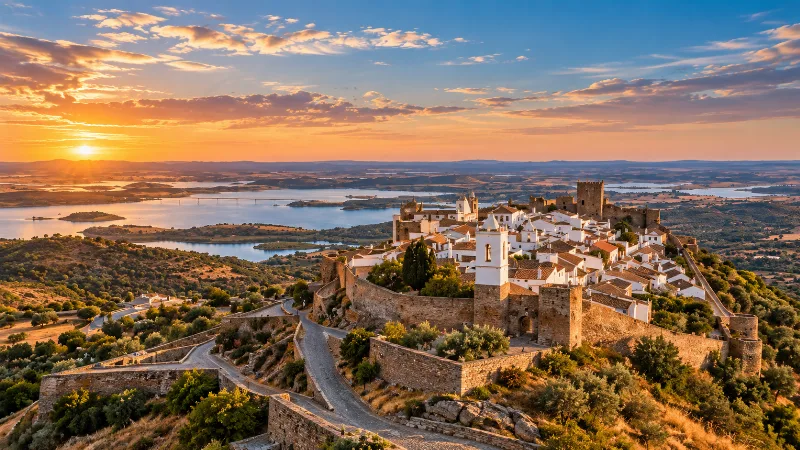
Alentejo
Discover Alentejo through Évora, whitewashed towns, cork-oak landscapes, vineyards, regional food and the broad rural interior of southern Portugal.
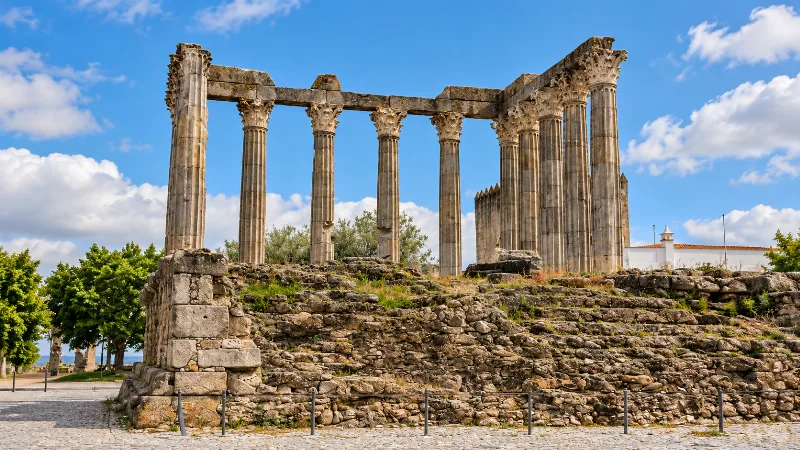
Évora
Évora is a historic Alentejo city of Roman remains, whitewashed streets, medieval walls, churches and a slower inland Portuguese rhythm.
Best Places to Visit in the Alentejo
Explore best places to visit in the alentejo with a practical guide to notable places, regional landscapes, local heritage and travel planning in Portugal.