
Coimbra University and the Joanina Library
Coimbra's historic university occupies the summit of the old town, where students in black capes cross a courtyard that leads to the Joanina Library, one of Europe's most ornate baroque interiors.
Coimbra rises from the eastern bank of the Mondego in central Portugal, its historic centre arranged in tiers of pale limestone, narrow lanes and terracotta roofs. Near the summit of the upper town stands the University of Coimbra, one of the oldest universities in continuous operation in Europe, founded in 1290 and finally settled in the city in 1537. Set within its buildings is the Biblioteca Joanina, a baroque library whose gilded halls are among the most distinctive interiors in Portugal.
A Hilltop University of Royal Foundation
The institution began as a studium generale established by King Dinis, and for more than two centuries it moved between Lisbon and Coimbra before settling permanently in the city. Over time it became the intellectual centre of the Portuguese world, and its presence shaped everything around it: colleges, churches, printing houses and lodging houses spread down the slope, while the academic calendar still sets the rhythm of daily life in the Alta, the upper town.
The historic buildings, together with the neighbouring Rua da Sofia, were inscribed on the UNESCO World Heritage list in 2013. They remain a working university rather than a museum, which gives the quarter its particular atmosphere of ceremony and ordinary study existing side by side.
The Paço das Escolas and the University Tower
The heart of the complex is the Paço das Escolas, a paved courtyard entered through the Porta Férrea, an iron gate decorated with figures from Portuguese history. Above it stands the eighteenth-century tower, built between 1728 and 1733, whose clock and bells once regulated the whole city as much as the students. From the top, on a clear day, the view takes in the Mondego valley and the hills beyond.
Around the courtyard are the ceremonial rooms most visitors come to see. The Sala dos Capelos, lined with portraits of Portuguese kings, is used for doctoral defences and the investiture of honorary degrees. The Chapel of São Miguel, with its painted ceiling, eighteenth-century organ and walls of blue and white azulejos, is a compact example of Portuguese baroque decoration at its most controlled.
Inside the Joanina Library
The Biblioteca Joanina was built between 1717 and 1728 during the reign of King João V, financed in part by the wealth of Brazil. Its architect, João Carvalho Ferreira, designed a restrained exterior; the interior is anything but. Three floors are stacked within the building, with the noble floor at the top, an intermediate reading level and a ground floor once used for storage and archives.
On the noble floor, two tiers of bookcases in exotic woods stand against the walls, their edges gilded and their shelves arranged in a symmetrical order that reads almost like an architectural façade in miniature. The ceiling is painted with allegorical scenes in trompe-l'œil frames, giving the room an illusion of greater height, while the floor and doorways use contrasting stone to mark thresholds between spaces.
The collection contains a substantial holding of early printed books and manuscripts, including many volumes from the sixteenth to the eighteenth centuries and works relating to Portuguese overseas expansion. A small colony of bats lives in the building and is deliberately protected, since the animals feed on the insects that would otherwise damage the bindings; the reading tables are covered with leather cloths at night to keep the furniture clean.
Gardens, Aqueduct and the Lower Town
Behind the university buildings, the Botanical Garden was laid out from 1772 as part of the reforming programme of the Marquês de Pombal. Its terraces and shaded walks hold species collected from Brazil, Africa and Asia, and the garden remains a quiet counterpoint to the stone courtyards above. Nearby, the Aqueduct of São Sebastião carries its arches along the edge of the old town.
Walking down towards the river brings other layers of the city into view: the Romanesque Sé Velha, the Renaissance and baroque Sé Nova higher up, and the Monastery of Santa Cruz in the Baixa, where the first Portuguese kings are buried. The Mondego itself, with its riverside paths and green margins, gives Coimbra a softer edge to balance the steepness of the historic centre.
Academic Traditions and the Sound of Coimbra Fado
Student life has produced a visual language of its own. Black woollen capes, worn over everyday clothes, carry coloured ribbons whose tone identifies the faculty of the wearer, and these ribbons are sewn and torn in ceremonies marking the beginning and end of a degree. Coimbra fado grew out of this student world in the nineteenth century, sung by men in capes and accompanied by the Coimbra guitar, an instrument tuned differently from the Lisbon variety and heard mostly in the city's own repertoire.
These traditions, together with the university's processions and formal academic dress, are part of a heritage that visitors encounter without searching for it: in the courtyards, along the stairways and in the sound of guitars drifting from doorways on warm evenings.
Related content
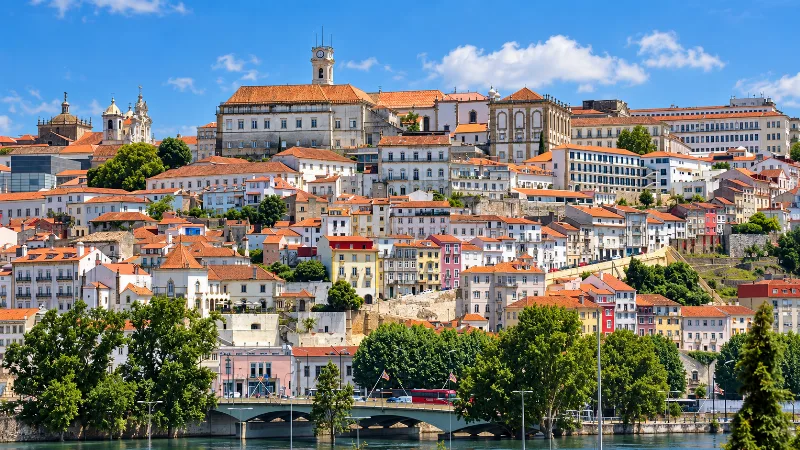
Coimbra
Coimbra combines Portugal’s oldest university traditions with a compact historic centre, river views, medieval streets and a student atmosphere.
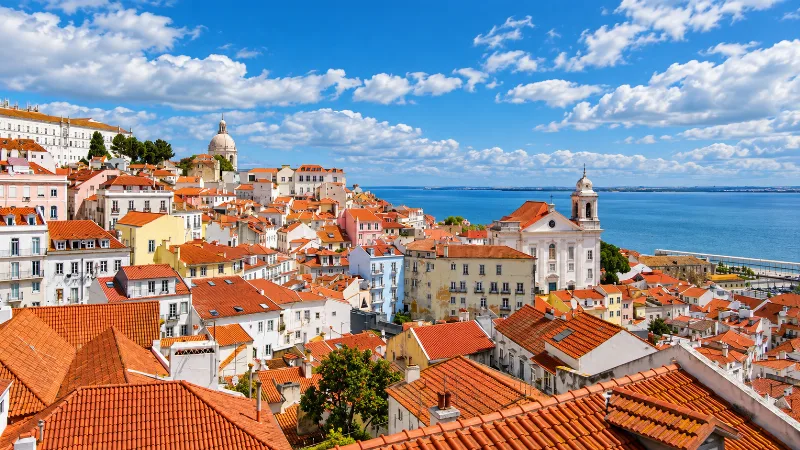
Lisbon
Portugal’s capital combines historic neighbourhoods, river views, tiled façades, viewpoints and an energetic everyday city life.
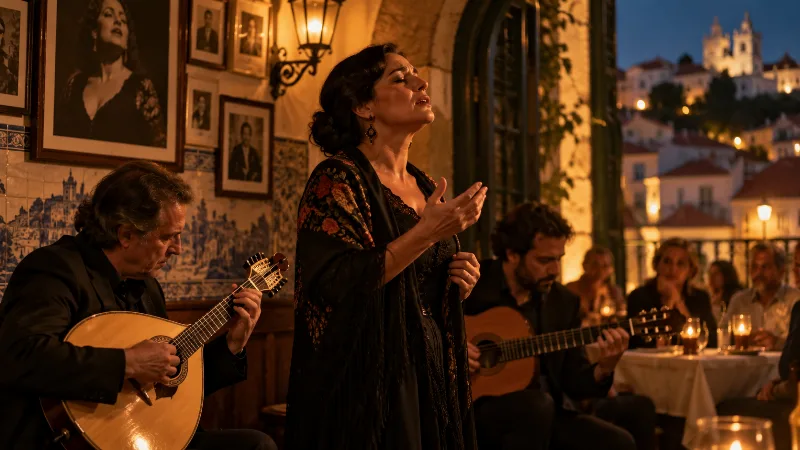
Fado
Fado is one of Portugal’s most distinctive musical traditions, closely associated with Lisbon and Coimbra and shaped by themes of memory, longing and everyday life.
Fado and Lisbon's Alfama Neighbourhood
Fado is Portugal's most recognisable song form, and Alfama, the oldest quarter of Lisbon, remains its spiritual home. Here is how the music and the lanes where it is sung belong together.