
Portalegre
A hill town in the Alto Alentejo where the plains meet the Serra de São Mamede, Portalegre is known for its medieval walls, Baroque churches and handwoven tapestries.
Portalegre is a city in Portugal's Alto Alentejo, built on a sloping shelf of land where the wide southern plains begin to climb into the Serra de São Mamede. It is the capital of its own district and stands roughly seventy kilometres from the Spanish frontier, close enough to Badajoz for cross-border journeys to be part of ordinary routine. The town is chiefly known for its handwoven tapestries, a craft still practised in a former Jesuit college at the heart of the city.
Setting and General Character
Portalegre occupies a natural platform that links the flat peneplain of the Alentejo to the granite, schist and quartzite slopes of the mountain range behind it. The historic core sits on the higher ground within the line of the old walls, while the modern town spreads downhill towards the Rossio and the avenues beyond. Because of its height, the city is noticeably cooler and wetter than Évora or Beja, and the surrounding fields are thick with olive groves rather than the bare wheat country found further south.
The municipality is large in area but thinly populated, and it stretches far beyond the built-up centre, taking in a substantial part of the serra and sharing its highest point with neighbouring Marvão. As the administrative centre of the Alto Alentejo, Portalegre has a hospital, a polytechnic institute, district services and a busy weekday market, which give it a steadier, more workaday rhythm than the smaller whitewashed towns nearby.
A Border Town's History
The site was sparsely settled in the twelfth century, and Portalegre is first recorded in 1129 as a village within the municipality of Marvão. It became a municipal seat in 1253 and received a charter from Afonso III in 1259, later confirmed by a Manueline charter in 1511. King Dinis ordered the building of the fortress and walls around 1290, and the town's enclosed shape still follows that medieval outline. A diocese was created in the sixteenth century, with Julião de Alva as its first bishop, and Portalegre was raised to city status in 1550 under João III.
Proximity to the frontier brought repeated trouble. The town was occupied in 1704 during the War of the Spanish Succession and again in 1801 during the War of the Oranges, and it saw movement of troops during the Peninsular War. Its economy long rested on wool and silk, but the Methuen Treaty of 1703 opened the Portuguese market to English cloth and damaged local silk weaving. In the later eighteenth century the Pombaline reforms saw a royal wool factory installed in the former Jesuit College of São Sebastião, a building that would later house tapestry production.
Architecture and the Walled Centre
The castle stands on the highest part of the town, retaining its square keep, stretches of battlemented wall and two flanking towers, and it gives a clear view over the cathedral roofscape and the plain. Close by, the cathedral of Nossa Senhora da Assunção was begun in 1556 on the orders of Bishop Julião de Alva. The interior is largely Renaissance and Mannerist, with painted altarpieces and seventeenth-century tiles, while the twin-towered west front was added in the eighteenth century in a Baroque manner that sits oddly and handsomely against the older body of the church.
Below the castle, the convent of São Bernardo was founded in 1518 and later given Baroque ornament; its church interior is lined with blue-and-white azulejos dated 1739, and its two cloisters show both Renaissance and Manueline-Gothic work. The Rua do Comércio runs down through the old perimeter past the fourteenth-century Portas de Alegrete gate, passing the eighteenth-century Igreja da Misericórdia and the older Igreja do Espírito Santo. Several aristocratic houses survive from the town's prosperous era, among them the Amarelo and Achaioli palaces, with wrought-iron balconies and tiled staircases, and a group of sixteenth-century windows on Rua Azevedo Coutinho is protected as a national monument.
The Serra de São Mamede
The natural park covering the range was established in 1989 and protects a landscape of ridges, wooded valleys and old farmsteads. Its summit reaches 1,025 metres, the highest ground south of the Tagus, and the massif acts as a barrier to moist Atlantic air, producing rainfall and humidity well above the surrounding lowlands. That extra water allows Atlantic and Mediterranean vegetation to grow side by side: oak and chestnut woodland in the northern part of the park, cork oak and holm oak further south.
Bonelli's eagle, the symbol of the park, nests in the crags, and griffon vultures and kites are regularly seen on the thermals. Wild boar and deer have returned as habitats have recovered. Five waymarked walking routes cross the protected area, and the road up to the summit passes through cork and chestnut country with long views towards the Spanish border.
Tapestry, Wool and Everyday Life
Portalegre's reputation rests on the Manufactura de Tapeçarias, established in the mid-1940s in the old College of São Sebastião. Its weavers work from painted cartoons supplied by Portuguese and international artists, producing numbered pieces in a technique peculiar to the town, in which the weft is worked over the outline rather than in a flat interlocking weave. The Guy Fino Tapestry Museum, opened in 2001 in the Amarelo Palace beside the walls, holds a collection spanning the seventeenth century to the present and explains the process.
Wool, cork and ceramics have long supplemented textile work, and the covered municipal market remains a practical meeting point for the surrounding farms. Local cooking follows Alentejo patterns: lamb, migas and garlic-based soups, cured pork and sheep's cheese from the hills. The writer José Régio taught at the town's secondary school and spent decades collecting religious and popular art here; his former home is now a museum.
Notable Places in the City
The municipal museum occupies the former diocesan seminary, begun in the late sixteenth century and remodelled in 1765, and displays ceramics, textiles, furniture and sacred silver. The José Régio house-museum keeps the poet's personal collection, which includes more than four hundred crucifixes, the oldest dating from the fifteenth century. At the Rossio, the fountain, the Misericórdia church and the old college buildings form the social centre of the lower town. On the road out towards Castelo de Vide stands the sanctuary of Senhor Jesus do Bonfim, built from 1720, and the sanctuary of Senhor Jesus dos Aflitos at Fortios remains a pilgrimage site with a large set of votive offerings.
Nearby Destinations
The fortified village of Marvão, perched on a quartzite crag a short drive north-east, and Castelo de Vide, with its castle and old Jewish quarter, are the most rewarding excursions from the city. Alegrete preserves ruined walls and a castle keep, while Alter do Chão has a fourteenth-century castle and an eighteenth-century stud farm founded under King João V. The Roman city of Ammaia, near São Salvador de Aramenha, has been excavated within the natural park boundary, and Crato, Monforte and the fortress town of Elvas, with its long aqueduct, lie within easy reach by road.
Related content
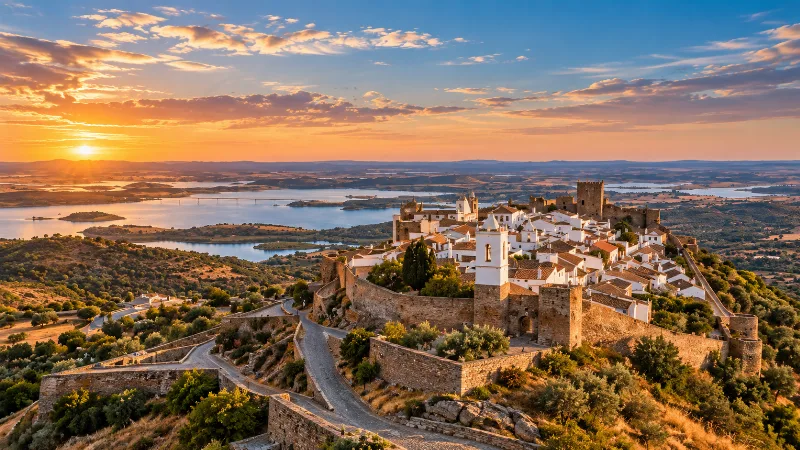
Alentejo
Discover Alentejo through Évora, whitewashed towns, cork-oak landscapes, vineyards, regional food and the broad rural interior of southern Portugal.
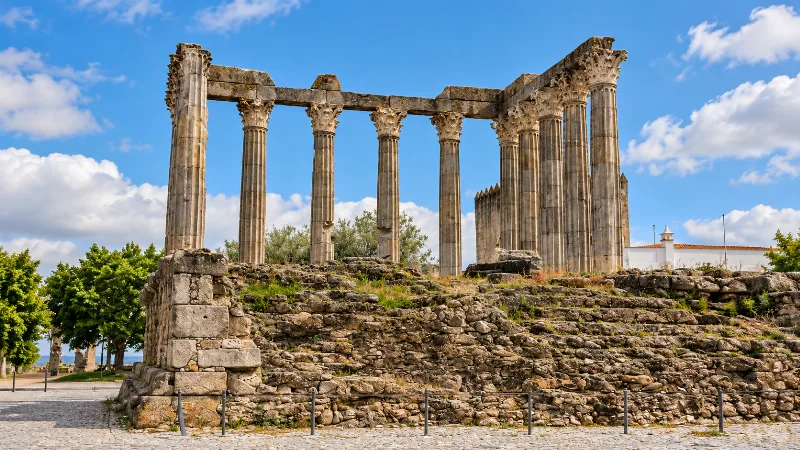
Évora
Évora is a historic Alentejo city of Roman remains, whitewashed streets, medieval walls, churches and a slower inland Portuguese rhythm.
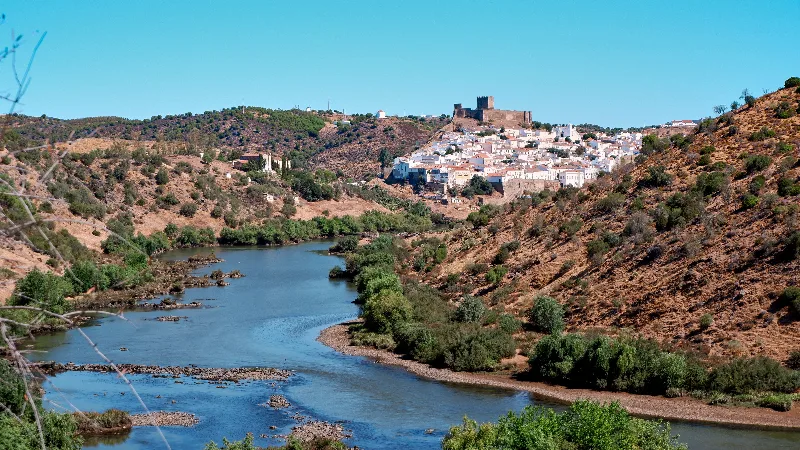
Beja
Beja is a hilltop city in the Baixo Alentejo, once the Roman town of Pax Julia, whose marble-grey castle keep rises above a plain of wheat, olive groves and cork oak. Its old convent now holds one of southern Portugal's richest regional museums.