
Santana
Santana is a town on Madeira's north coast, known for its steep-roofed thatched houses and for the mountains that rise directly behind it. It is a working Portuguese town rather than a resort, surrounded by terraced fields and laurel forest.
Santana is a town and municipality on the north coast of Madeira, the Portuguese island in the Atlantic that lies roughly 600 kilometres west of Morocco and about 1,000 kilometres south-west of Lisbon. It is best known for its traditional thatched houses, whose steep triangular roofs have become one of the island's most familiar images, and for the mountain country that rises immediately behind it. The town is small and workaday rather than resort-like, with a centre arranged around a square, a parish church and a modest cluster of shops, cafés and municipal buildings. Beyond it lie terraced fields, wooded ravines and high ground that belongs to the central massif of the island.
Location and general character
Santana occupies a stretch of Madeira's wetter, greener northern flank, where the trade winds meet the mountains and produce frequent cloud and rain. The municipality runs along the coast from Faial in the east to Arco de São Jorge in the west and includes the parishes of Santana, Faial, Ilha, São Roque do Faial, São Jorge and Arco de São Jorge. The town itself stands on a shelf of comparatively gentle ground at roughly 400 metres above sea level, above the Ribeira de Santana and below the steep upper slopes. Funchal lies about 40 kilometres to the south, reached either by the old north coast road, the ER101, or by faster expressway sections built from the early 2000s onwards, which considerably shortened a journey that was once slow and winding. The municipality has a resident population of roughly seven to eight thousand people, dispersed across small settlements and hillside terraces rather than concentrated in the town. Housing is a mixture of older stone and timber buildings, post-war block and concrete homes, and a smaller number of restored or reconstructed thatched houses.
History
The north coast was settled during the fifteenth and sixteenth centuries, as colonists moved outwards from Funchal and the more sheltered south. Santana takes its name from Saint Anne, to whom the parish church is dedicated. Early agriculture on these slopes depended on wheat, which Madeira exported in the sixteenth century, and later on sugar cane and vines, along with subsistence crops grown on narrow terraces cut into the hillsides. Because the coast is exposed and the interior difficult to cross, the northern settlements remained comparatively isolated for centuries; produce and people often moved by boat from small quays rather than by road. Local administration was reorganised in the 1830s, during the liberal reforms that reshaped municipal government across Portugal, and Santana acquired its own council at that time. Emigration to Brazil, Venezuela, South Africa and the Channel Islands drew people away in the nineteenth and twentieth centuries, and remittances from abroad are still visible in some of the town's larger houses. From the late twentieth century, tourism and improved roads changed the local economy, and the thatched house shifted from being an ordinary dwelling to a symbol of the island's rural past.
Architecture and the thatched houses
The traditional building known as the casa de colmo is the reason most visitors know Santana. Its outline is a steep triangle: the walls follow the line of the roof, so that the front of the house is almost entirely gable, and the thatch is laid thickly in overlapping courses of rye straw and local grasses. This pitch is practical rather than decorative, shedding the heavy rain that the north coast receives for much of the year. Inside, the ground floor holds the living and cooking space, often with an open hearth, while the triangular upper volume serves as a loft for hay, grain, tools and stored produce. Small windows keep out wind and damp. Thatch was gradually replaced by tile and corrugated sheeting from the mid-twentieth century as materials and building regulations changed, and relatively few originals survive. A small group near the centre of Santana has been preserved or rebuilt, some of it used for craft displays and as a modest museum of rural life, while the rest of the town consists of conventional Portuguese housing.
Natural surroundings
Above Santana the land climbs quickly towards Madeira's central massif. Pico Ruivo, at 1,862 metres the island's highest summit, is usually approached from Achada do Teixeira, a short drive up the mountain road from the town. Much of the upper slope is covered by laurel forest, the laurisilva, a relic of vegetation that once covered much of southern Europe and has been a UNESCO World Heritage Site since 1999. Queimadas Forest Park, with its moss-covered laurel and cedar trees and a small thatched forest building, marks the beginning of the levada path to Caldeirão Verde, a green pool inside a steep amphitheatre of rock. The municipality is also cut by deep ravines, the ribeiras that carry water from the peaks to the sea, and by cliffs that drop almost vertically to a narrow shoreline. Above the parish of Faial, the wedge-shaped rock of Penha d'Águia stands out as a landmark visible along much of the coast.
Local culture and everyday life
Farming still shapes the rhythm of the municipality. Smallholdings produce bananas, vines, potatoes, cabbages and other vegetables on terraces that are worked largely by hand, and the local market sells what the surrounding parishes grow. Crafts such as weaving and wickerwork continue on a small scale, often alongside tourism. The religious calendar matters here: the Festa dos Compadres, held around carnival time, is a distinctive local celebration built around satirical effigies and the mocking of public figures, while the summer feast of Santa Ana brings processions, music and food stalls to the town. Everyday food is the food of the island — bolo do caco flatbread, scabbard fish, beef skewers and honey cake — served in plain cafés rather than in grand restaurants. Many residents work in the public sector, in construction or in Funchal, commuting along the coast road, and the town has a school, a health centre and a small industrial estate as well as its tourist-facing businesses.
Notable places
- The preserved thatched houses near the town centre, where several examples stand together with craft workshops and displays on rural life.
- The parish church of Santa Ana, which anchors the main square and reflects the rebuilding that followed earlier damage and later alterations.
- The Parque Temático da Madeira, a themed park on the edge of town covering the island's history, crafts and natural environment.
- The glass-floored viewpoint at Guindaste, in the parish of Faial, which projects over the cliffs and looks back along the coast.
- Achada do Teixeira, the high saddle used as the starting point for the walk to Pico Ruivo and for views over both sides of the island.
Nearby destinations
Santana works well as a base for the north coast. To the west, São Vicente has volcanic caves, a small chapel built into rock and a black-sand shoreline, while further on Porto Moniz is known for its natural lava pools. Between them, the road passes Boaventura and Ponta Delgada, both quiet parishes with terraced slopes and cliff-top views. To the east, Faial and its neighbouring hamlets lead on towards Porto da Cruz and the eastern end of the island. Inland, the mountain road climbs to Achada do Teixeira and, in the other direction, crosses towards Funchal through the higher ground, offering a very different landscape from the coast within an hour's drive. The villages of São Jorge and Arco de São Jorge, with vineyards on narrow cliff terraces, mark the western edge of the municipality and connect Santana to the rest of Madeira's northern shore.
Related content
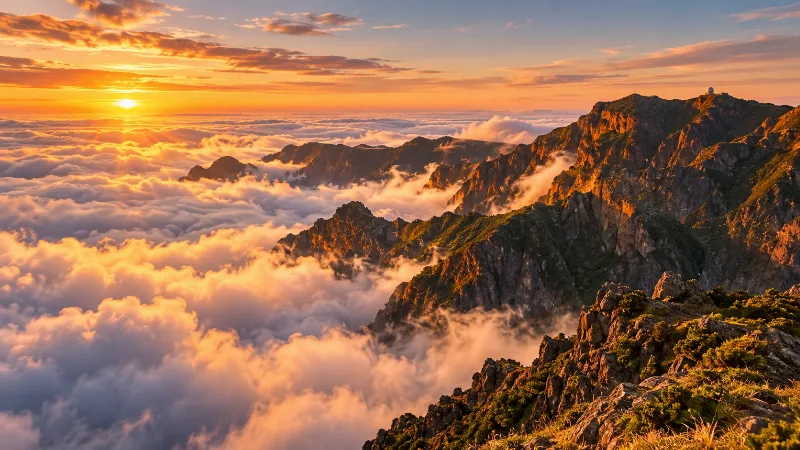
Madeira
Explore Madeira through Funchal, dramatic mountains, levada walks, subtropical gardens, volcanic coastlines and distinctive Atlantic island landscapes.
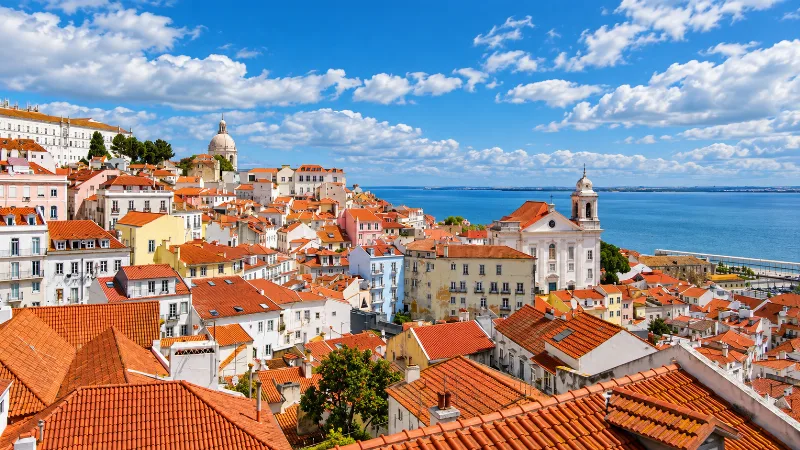
Lisbon
Portugal’s capital combines historic neighbourhoods, river views, tiled façades, viewpoints and an energetic everyday city life.
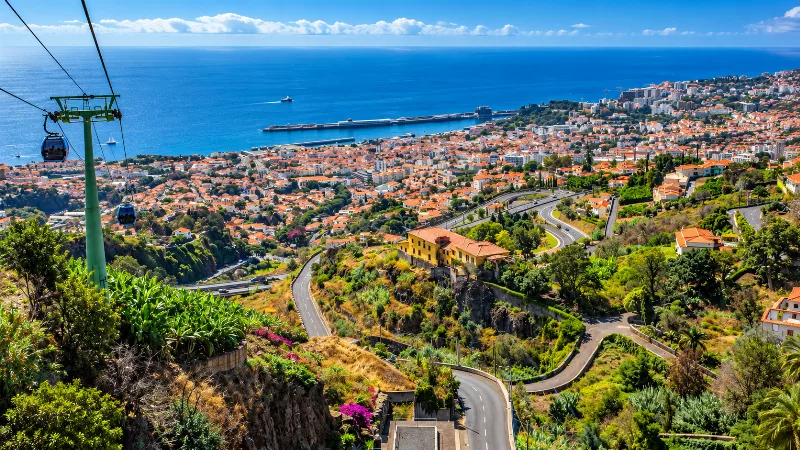
Funchal
Funchal is Madeira’s capital, combining a historic Atlantic port, steep green hillsides, gardens, markets and easy access to island landscapes.
Machico
Machico is one of Madeira's earliest settlement sites, a bay-side town on the island's drier eastern coast with a fishing harbour, a sandy beach and a compact historic centre.