
Évora's Roman Temple and Historic Aqueduct
Évora's first-century Roman temple and its sixteenth-century aqueduct are two of the Alentejo's most enduring monuments. Together they show how a provincial city was built, supplied and defended across many centuries.
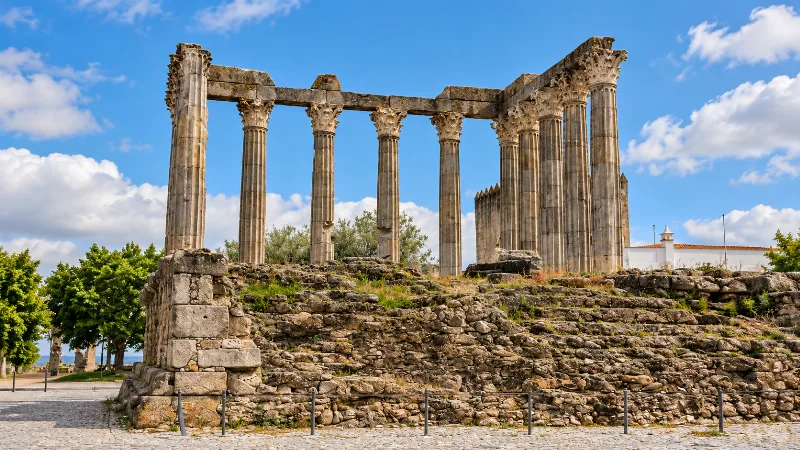
Évora's Roman temple stands on a quiet square in the upper part of the old town, a short distance from the cathedral and from the former Jesuit buildings that now belong to the university. Its fourteen granite columns, still resting on the original podium, make it the best-preserved Roman structure in Portugal and one of the defining images of the Alentejo. A few minutes away, the arches of the Água de Prata aqueduct pass between houses and gardens, bringing water into the city as they have done since the sixteenth century.
The Roman Temple of Évora
The temple was built in the first century AD, when the town was a Roman settlement known as Ebora. It occupied a raised platform at the edge of the forum, on ground high enough for the building to be seen from much of the surrounding town. The design follows classical conventions: six columns across the façade, a colonnade running around the cella, and Corinthian capitals carved in marble above shafts of local granite. The original dedication is not known with certainty, and the popular name 'Temple of Diana' belongs to a later tradition rather than to any inscription; most scholars associate the building with the imperial cult.
Why the Columns Are Still Standing
Few Roman buildings in the Iberian Peninsula survived the medieval period intact, and the temple owes its preservation to a change of use. The gaps between the columns were filled with masonry and the interior was converted into a slaughterhouse, later becoming a storehouse. Enclosed in this way, the granite was protected from rain, from frost and from the temptation to reuse dressed stone elsewhere. The additions were cleared in the 1870s under the direction of the Italian architect Giuseppe Cinatti, who freed the columns and restored the temple to something closer to its Roman appearance. Marks of that work can still be seen on the shafts.
The Água de Prata Aqueduct
Évora's aqueduct was constructed in the 1530s during the reign of King João III, and its design is associated with the architect Francisco de Arruda, whose work elsewhere in the Alentejo included fortifications and water systems. The channel runs for approximately eighteen kilometres from springs to the north-west of the city, following the natural lie of the land rather than cutting through it. For much of that distance it is a modest covered conduit, hidden among cork oak and olive groves; only in certain places does it rise into the tall arcades that people usually picture when they hear the word aqueduct.
Arches Among the Houses
The most distinctive stretch lies inside the city, where the aqueduct crosses a built-up area rather than open country. Houses were later built into the spaces between the arches, so that doorways and windows open directly beneath the stonework, and the structure has become part of the street pattern instead of standing apart from it. Along the Rua do Cano the water channel itself runs above the roadway, and it is possible to walk beneath it for part of the way. The line of the conduit continues to the fountains it was designed to serve, including the sixteenth-century fountain in the Praça do Giraldo.
Water and Public Life
Before the aqueduct, Évora depended on wells and on water carried in from outside the walls, a constraint that shaped daily life in a city on high ground. The new supply changed public space as much as it changed domestic routine. Fountains became meeting points, and their carved marble basins, such as those in the Praça do Giraldo and at the Portas de Moura, are small monuments in their own right, combining practical function with Renaissance ornament. The aqueduct also made possible gardens, small industries and public washing places that had previously been difficult to maintain.
Other Roman Remains in Évora
The temple was not an isolated building but part of a substantial Roman town. Beneath the town hall, building work in the 1980s revealed a bath complex with pools and a heating system, now preserved and open to visitors, which gives a clear sense of Roman engineering at domestic scale. Sections of the Roman wall were absorbed into later defences, and the city museum holds sculpture and inscribed stones from the period. Together these fragments show how the Roman settlement was laid out, and how much of it lies beneath the streets that visitors walk today.
Exploring Both Monuments on Foot
The temple stands on the Largo Conde de Vila Flor, and the walk from there towards the aqueduct passes the cathedral and a network of streets framed by whitewashed houses, wrought-iron balconies and tiled roofs. The square around the temple is at its quietest early in the day, while the western light of late afternoon falls directly across the columns and brings out the texture of the granite. Following the line of the aqueduct northwards takes in a different side of the city, where the arcade dominates the streets and the scale of the sixteenth-century engineering becomes apparent. The two monuments are close enough to be seen in a single unhurried morning, and each makes better sense in the light of the other: one a survival from Roman Portugal, the other a reminder that the city continued to solve the same practical problem of water for another fifteen hundred years.
Related content
Évora
Évora is a historic Alentejo city of Roman remains, whitewashed streets, medieval walls, churches and a slower inland Portuguese rhythm.
Alentejo
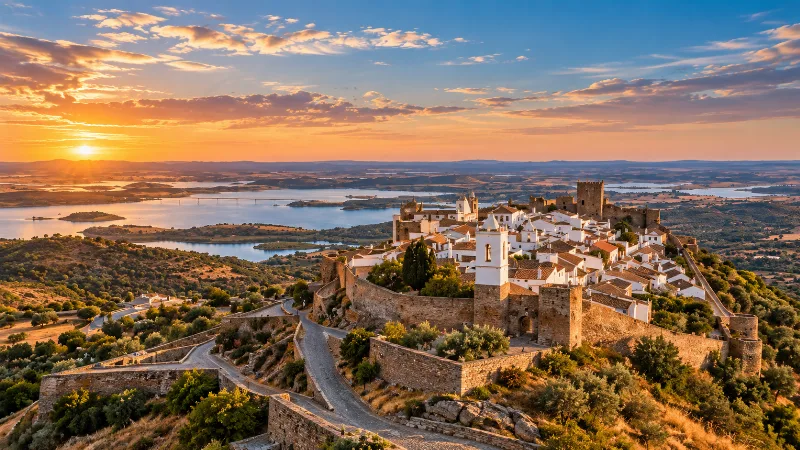
Discover Alentejo through Évora, whitewashed towns, cork-oak landscapes, vineyards, regional food and the broad rural interior of southern Portugal.
Exploring the Historic Centre of Évora
Explore exploring the historic centre of évora with a practical guide to notable places, regional landscapes, local heritage and travel planning in Portuga
Beja
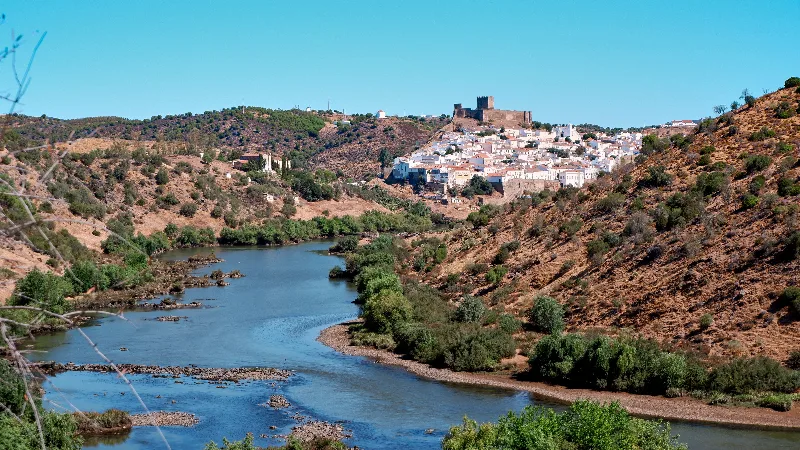
Beja is a hilltop city in the Baixo Alentejo, once the Roman town of Pax Julia, whose marble-grey castle keep rises above a plain of wheat, olive groves and cork oak. Its old convent now holds one of southern Portugal's richest regional museums.