
Porto's Ribeira Waterfront and Historic Bridges
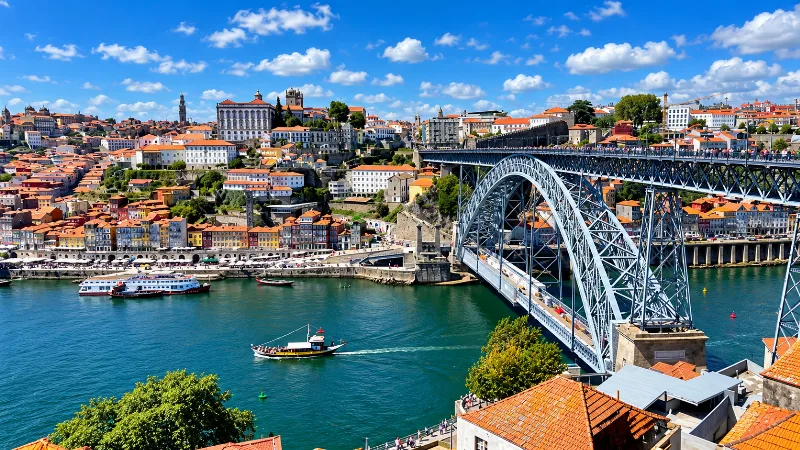
Porto's Ribeira is the old riverside quarter on the north bank of the Douro, a dense grid of arcaded streets and tiled façades watched over by a succession of iron and concrete bridges.
Porto's Ribeira occupies the curved north bank of the Douro, just upstream from where the river meets the Atlantic. The name simply means "riverside", and the district has been the city's working waterfront for centuries, its quays used by fishing boats, river craft and merchant shipping long before tourism arrived. Today the Ribeira forms part of the Historic Centre of Porto, inscribed on the UNESCO World Heritage List in 1996, and it remains the most direct way to understand how the city grew: uphill from the water, street by street, towards the cathedral and the higher terraces above.
A waterfront shaped by the Douro
The Ribeira sits low beside the river, squeezed between the water and a steep escarpment. Its layout reflects that constraint. Buildings rise four or five storeys in tall, narrow blocks, with arcades at ground level that once sheltered goods and now shelter pedestrians. Behind the first row of houses, lanes climb sharply through the parish of Sé towards the upper town, while to the west the riverside continues into Miragaia, a quieter stretch associated with the old shipbuilding and fishing communities.
The river itself governs the atmosphere. At high tide in winter the Douro can run fast and brown; in summer it slackens and reflects the light. Traditional barcos rabelos, the flat-bottomed sailing boats once used to carry port wine casks downstream, are still moored along the quays as a reminder of that trade.
Streets, façades and squares
Praça da Ribeira is the natural centre of the quarter, a square opening directly onto the river with a small fountain and a row of arcaded houses behind it. From here, narrow streets such as Rua da Ribeira Negra lead inland beneath overhanging upper floors, some of them faced with azulejo tiles, others painted in the ochre, rust and pale blue that characterise the old waterfront.
Several buildings show their age plainly: worn granite lintels, iron balconies, tiled roofs pitched steeply to shed Atlantic rain. Close by, the church of São Francisco and the Palácio da Bolsa, with its neo-classical interiors, represent the wealth that the river trade generated in the eighteenth and nineteenth centuries. The Miradouro da Vitória, a short climb inland, gives a clear view back over the rooftops to the water.
The iron bridges over the Douro
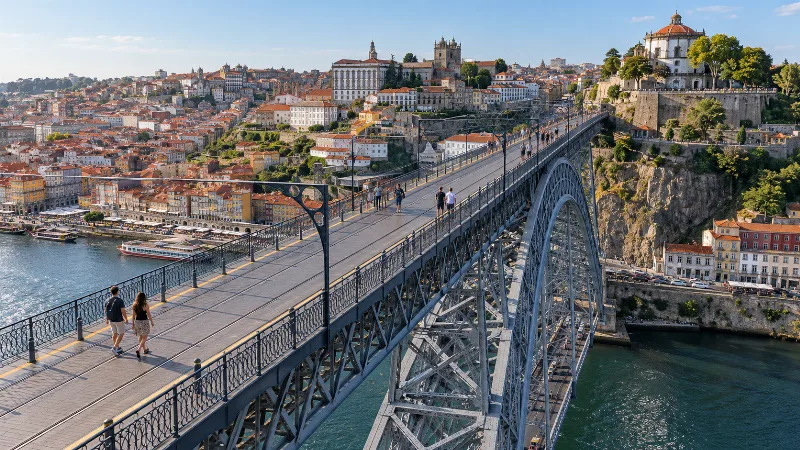
Porto's bridges are as much a part of the waterfront as the buildings. The Dom Luís I Bridge is the best known: a double-deck iron structure completed in 1886 to a design by the engineer Théophile Seyrig, with a single sweeping arch spanning 172 metres between Porto and Vila Nova de Gaia. Its lower deck carries local traffic and pedestrians close to the water; the upper deck runs high above the river and now carries the metro line as well as foot passengers.
Upstream, the Maria Pia Bridge opened in 1877, engineered by Gustave Eiffel with Seyrig, and served the railway for more than a century before closing in 1991. Its slender arch is noticeably lighter than that of its successor. Further east again, the São João railway bridge, opened in 1991, and the modern Infante Dom Henrique Bridge, completed in 2003 with a wide concrete arch, show how the same crossing has been re-engineered for each generation.
Crossing to Gaia and looking back
Walking the upper deck of the Dom Luís I Bridge towards Vila Nova de Gaia takes only a few minutes and gives one of the finest views in the city: the Ribeira's terraces to the north, the bridge's own ironwork overhead, and the row of port wine lodges along the Gaia bank. The lower deck offers a slower, closer crossing, with the river directly beneath the parapet.
Boat trips leave from both banks and pass under the bridges in sequence, which is the simplest way to see how the arches relate to one another. On foot, the riverside path links the Ribeira with Miragaia and the mouth of the Douro, while the Gaia quay provides the classic view back across the water, particularly in the late afternoon when the south-facing façades catch the light.
Festivals and daily life
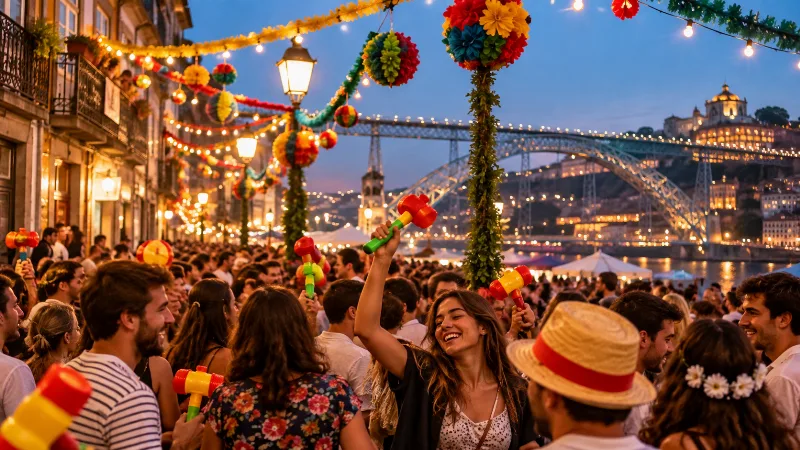
The Ribeira is at its liveliest during the Festas de São João in June, when the streets fill with revellers, paper lanterns and the famous plastic hammers, and fireworks are launched over the Douro near the bridges. At other times the quarter is quieter in the early morning, when deliveries arrive and the cafés open, and busiest in the evening, when the arcades glow and the sound of the river carries up between the buildings.
Related content
Porto
Porto is a compact northern city of steep streets, granite architecture, riverfront views, historic districts and strong local character.
São João
São João is Porto’s major midsummer celebration, filling the city with street gatherings, music, decorations, food, fireworks and long-standing local traditions.
Walk Across Porto’s Dom Luís I Bridge
Cross the Douro between Porto and Vila Nova de Gaia, combining the bridge’s upper deck, Jardim do Morro and the riverside streets.
Things to See in Porto
Explore things to see in porto with a practical guide to notable places, regional landscapes, local heritage and travel planning in Portugal.
Exploring the Historic Centre of Porto
Explore exploring the historic centre of porto with a practical guide to notable places, regional landscapes, local heritage and travel planning in Portuga
Best Regions to Visit in Portugal
Discover Portugal's most popular travel regions, from the historic cities of Lisbon and Porto to the beaches of Algarve, the countryside of Alentejo and the Atlantic islands.