
The Ria de Aveiro Lagoon and Moliceiro Boats
The Ria de Aveiro is a wide Atlantic lagoon whose shallow channels frame the city of Aveiro, and whose painted moliceiro boats have become one of central Portugal's best-known sights.
The Ria de Aveiro is a broad coastal lagoon on the Atlantic edge of central Portugal, opening to the sea just beyond the city that shares its name. Shaped by tides, river silt and Atlantic weather, it forms a watery landscape of channels, mudflats, sandbanks and salt marsh that stretches inland from the coast and gives the surrounding towns a character quite unlike the rest of the country. The lagoon is shallow enough in places for reeds and eelgrass to break the surface, yet broad enough to feel like an inland sea when the wind picks up.
How the Ria de Aveiro took shape
The lagoon extends roughly 45 kilometres inland from the coast and reaches some 11 kilometres across at its widest point. Fresh water arrives mainly from the Vouga river and smaller streams, while salt water enters through the bar near Barra and São Jacinto, where a channel has been maintained for navigation. Over the centuries, sediment carried down by the rivers and moved along the coast by currents built up a sandy barrier, gradually enclosing the estuary behind it. The present opening to the sea is comparatively recent, cut in the early nineteenth century to give vessels a reliable passage. The result is a tidal system where the water level rises and falls twice a day, alternately flooding the marshes and exposing glistening banks of mud where birds feed.
The canals at the heart of Aveiro
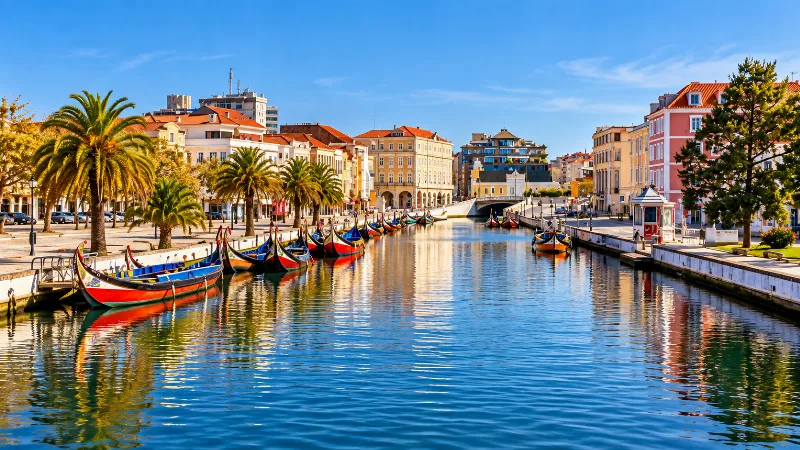
Within the city itself, the lagoon is channelled into a set of waterways that give Aveiro its particular rhythm. The Central Canal is the most visible, crossed by footbridges and lined with buildings decorated in tiles and wrought iron. The Canal das Pirâmides, the Canal de São Roque and the Canal dos Santos Mártires complete the quartet, each threading between streets, warehouses and small squares. Along these banks stand former salt stores, merchant houses with decorative facades, and the low, working streets of the old fishing quarter. Because the canals are tidal, the water, the reflections and the boats moored along them change through the day.
Moliceiro boats: from harvest to heritage
The moliceiro takes its name from moliço, the aquatic weed and eelgrass once gathered from the lagoon bed and used to fertilise fields and gardens in the surrounding countryside. The boats were built for that work: flat-bottomed to ride over shallows, with a gently curved prow and an elegantly upswept stern, and long enough to carry a heavy load of weed. Crews would cut the vegetation with long poles and haul it aboard, then row or punt the loaded craft back to land.
What distinguishes these vessels today are the painted panels on their sides. Brightly coloured and often humorous, they illustrate scenes of daily life, local trades, religious images or gentle caricatures, framed by decorative borders. Each boat is decorated individually, so no two are identical. As the moliço trade faded during the twentieth century, the craft were adapted to carry passengers, and they now offer short cruises through the canals and out onto the open lagoon. Some still appear in local festivities, and the boats remain a working symbol of the city.
Salt pans, reeds and birdlife
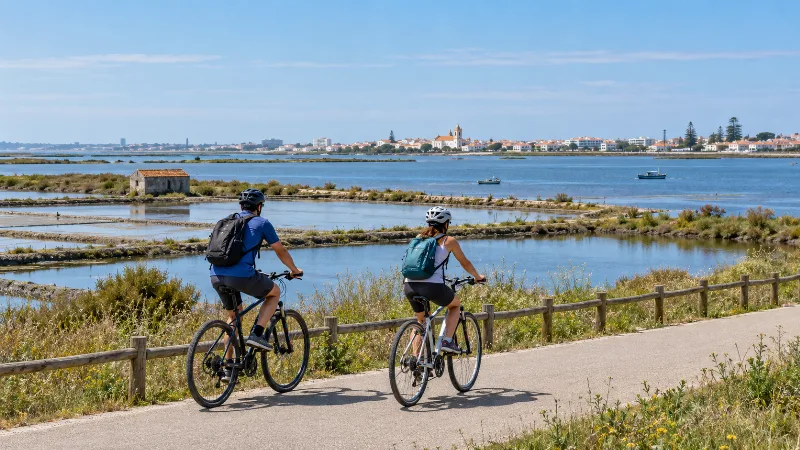
Away from the urban canals, the lagoon becomes a patchwork of habitats. Traditional salt pans, known as salinas, are still worked in places, their low walls and evaporation ponds forming geometric patterns beside the water. Reed beds fringe many channels, and expanses of salt marsh turn from green to gold with the seasons. This variety attracts a rich bird population: waders probe the mudflats at low tide, terns and gulls patrol the channels, and ducks, grebes and spoonbills gather in the quieter reaches, with larger numbers present in the cooler months. Near the mouth of the lagoon, the dunes of São Jacinto protect a reserve of sand-loving plants and juniper, sheltering behind them a stretch of coast where the Atlantic meets the sheltered water.
Appreciating the lagoon on the water
Boat trips depart from the centre of Aveiro and follow the canals before emerging into the wider lagoon, where the scale of the landscape becomes apparent. Passengers see salt pans, reed islands and the low horizon of the marshes, and can watch the traditional craft at work on the water. For those who prefer to stay ashore, the canal banks offer level walking, and viewpoints along the edges of the lagoon look out over the shallows. Further south, the beaches of Costa Nova and Barra face the open sea, while the lagoon behind them remains calm and sheltered. Taken together, the waterways and the painted boats give Aveiro a landscape that is both practical and quietly beautiful, shaped by generations of people living with the tide.
Related content
Aveiro
Aveiro is a small coastal-region city with canals, Art Nouveau details, colourful boats and easy access to lagoons and Atlantic landscapes.

Central Portugal
Discover Coimbra, Aveiro, Serra da Estrela, Atlantic landscapes, mountain villages and the varied historic and natural scenery of central Portugal.
Aveiro's Art Nouveau Houses and Azulejo Façades
Aveiro's historic centre holds one of Portugal's densest groupings of Arte Nova houses, where curved stonework, iron balconies and patterned azulejo tiles line a handful of central streets.
Ride a Bicycle Along Aveiro’s Lagoon
Explore the landscapes of Ria de Aveiro by bicycle, with waterside routes, salt-pan scenery and a ride planned around your preferred distance.