
Bom Jesus do Monte Sanctuary in Braga
The Sanctuary of Bom Jesus do Monte rises above Braga on a wooded hillside, reached by one of Portugal's most celebrated baroque stairways and crowned by a neoclassical church.
The Sanctuary of Bom Jesus do Monte stands on the wooded slope of Monte do Espinho, a short distance east of Braga in northern Portugal. For more than two centuries it has been the city's principal pilgrimage destination and one of the most recognisable religious landscapes in the country. Its defining feature is a monumental stairway that climbs the hillside in a series of zigzag flights, linking a sequence of chapels, fountains and terraces before ending at a neoclassical church on the summit.
A sanctuary on a wooded hillside
The site occupies the upper part of a hill that rises above the valley of the Rio Este, looking back towards Braga. The approach through the trees gives the sanctuary a sense of separation from the town below, and the incline is gradual enough that the whole complex reveals itself piece by piece. Because the buildings are arranged on a slope rather than on flat ground, the architecture is inseparable from the landscape: walls, staircases and viewing platforms follow the contours of the hill, and the forested park that surrounds them keeps the sanctuary enclosed in green.
Earlier religious structures stood here before the present complex took shape. Building work on the current church began in the late eighteenth century to designs by the architect Carlos Amarante, and the stairway and its chapels were developed over the same period and afterwards, giving the sanctuary a coherence that comes from a long, relatively consistent campaign of construction.
The baroque stairway
The stairway is the heart of Bom Jesus do Monte and the reason it is known well beyond the Braga region. Instead of a single straight ascent, the route is broken into flights that switch direction as they rise, so that visitors turn and level out repeatedly rather than climbing in one continuous effort. The effect is theatrical: each flight frames a view, a chapel facade or a fountain, and the summit church remains partly hidden until the final stages.
The staircase is not simply a means of reaching the top. Its landings are treated as architectural spaces in their own right, decorated with statues, niches and water features that draw on allegorical themes. Sections of the route are associated with the five senses and with the theological virtues of faith, hope and charity, so that the physical climb carries a symbolic meaning alongside its practical purpose.
Chapels, fountains and the Via Sacra
Scattered along the ascent and through the surrounding woodland are small chapels that together form a Via Sacra, or sacred way. These modest buildings house sculpted tableaux depicting scenes from the Passion, and they were intended to be visited in sequence as part of a devotional walk. Their scale is deliberately domestic; they read as points of pause rather than as grand monuments.
Water is a recurring element throughout the complex. Fountains, basins and channels are built into the stairway and terraces, fed by springs on the hill, adding sound and movement to the stonework. Granite is the dominant material, used for steps, retaining walls, balustrades and statues, and its grey tones contrast with the whitewashed and painted surfaces of the chapels and church.
The church at the summit
The church that crowns the sanctuary marks a shift in style from the baroque stairway below. Its facade is restrained and symmetrical, with paired columns, a pediment and a relatively sober arrangement of openings. The interior follows a similar approach, with a single nave and decoration concentrated around the altar rather than spread across every surface. From the terrace in front of the church, the view opens over the city of Braga and the surrounding countryside, and the formal gardens nearby offer a more enclosed place to walk.
The funicular and the wooded park
A funicular connects the lower part of the site with the sanctuary above, running on a steep incline beside the stairway. It is water-powered, using counterweights rather than a cable drawn by an engine, and it dates from the late nineteenth century, making it one of the oldest installations of its kind in the Iberian Peninsula. For many visitors it provides a practical alternative to the climb, particularly on warm days.
The park around the sanctuary is planted with mature trees and crossed by paths that extend well beyond the main stairway. These quieter routes allow the complex to be seen from a distance and give a sense of the wider estate, which has long served as a place of recreation for the people of Braga as well as a destination for pilgrims.
Pilgrimage and local tradition
Bom Jesus do Monte remains an active place of worship, and its calendar is still shaped by religious observance, particularly around Holy Week and the summer months when processions and gatherings take place. The combination of devotional architecture, water, stone and woodland has made the sanctuary a defining image of the Braga area, and it continues to function simultaneously as a pilgrimage site, a public park and a monument of European significance.
Related content
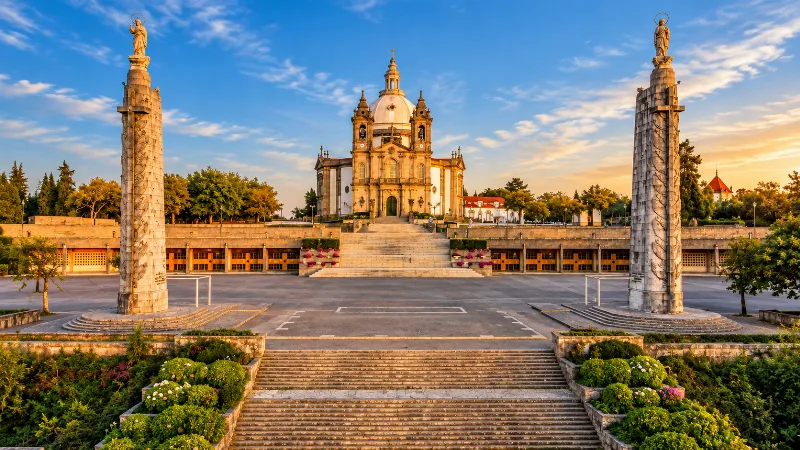
Braga
Braga is a historic northern city known for religious heritage, elegant squares, baroque architecture and a lively modern centre.
Things to See in Braga
Explore things to see in braga with a practical guide to notable places, regional landscapes, local heritage and travel planning in Portugal.
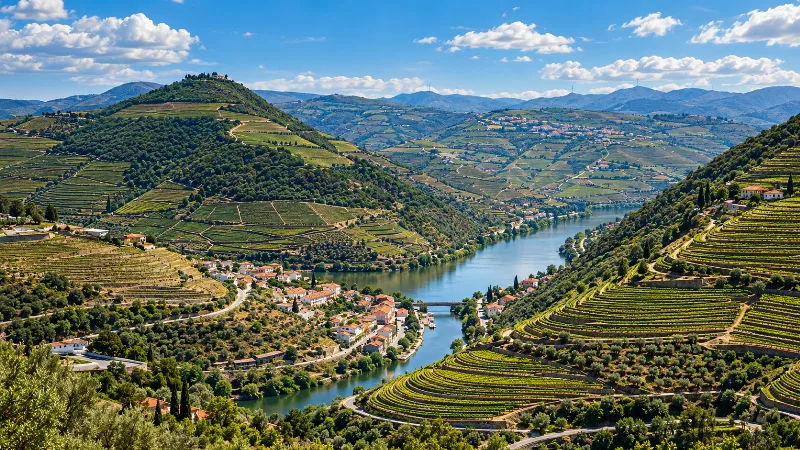
Northern Portugal
Explore Porto, the Douro Valley, Braga, Guimarães, Peneda-Gerês and the green landscapes, food traditions and historic cities of northern Portugal.
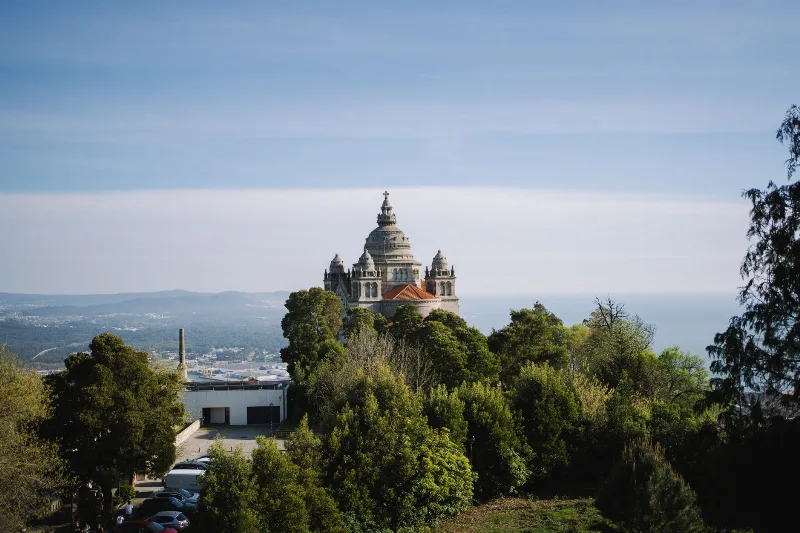
Viana do Castelo
A compact Atlantic city at the mouth of the Lima in northern Portugal, known for its medieval streets, its seafaring past, the sanctuary on Monte de Santa Luzia and the gold-embroidered costumes paraded each August.
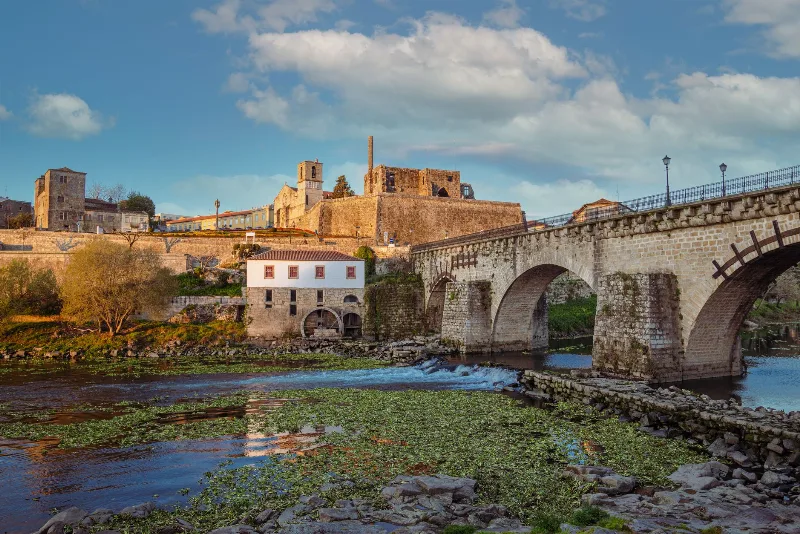
Barcelos
A Minho town built around a medieval bridge and a long-running Thursday fair, Barcelos is the home of Portugal's rooster legend and a living centre of popular craft.