
Barcelos
A Minho town built around a medieval bridge and a long-running Thursday fair, Barcelos is the home of Portugal's rooster legend and a living centre of popular craft.
Barcelos lies in the valley of the Cávado in northern Portugal, roughly 50 kilometres north of Porto and 20 from Braga, in the heart of the old province of Minho. It is a working provincial city rather than a holiday resort: textile firms and small workshops on the outskirts, maize and vines on the surrounding hills, and a compact granite centre that grew where the old road from Porto to Ponte de Lima crossed the river. The name travels further than the town itself, largely because of the painted ceramic cockerel sold in souvenir shops across Portugal, and because of a weekly market that has used the same square for more than six centuries.
A municipal seat on the Cávado
Barcelos is both a city and a municipality. The municipality covers about 379 square kilometres and, with 61 parishes, has the largest number of them of any in the country; the 2021 census recorded around 116,750 residents, of whom roughly one in five lives in the urban parishes around the historic centre. It is bordered by Viana do Castelo and Ponte de Lima to the north, Vila Verde and Braga to the east, Vila Nova de Famalicão to the south-east, Póvoa de Varzim to the south-west and Esposende to the west.
The city itself is small in scale. Its oldest streets run back from the river through the Largo do Apoio and along the Rua Direita to the Largo da Porta Nova, where the civic centre shifted in the seventeenth and eighteenth centuries. Beyond this core, the municipality is a patchwork of villages, hamlets and small industrial estates, linked by a dense network of roads. The landscape is green and intensively farmed, with granite walls, small plots, and houses of stone or rendered brick that become more scattered as the land rises away from the river.
From royal charter to county and duchy
There is evidence of settlement here from prehistory onwards, and the crossing of the Cávado gave the place strategic value long before it acquired a name. Barcelos received a royal charter from Afonso Henriques in the 1160s, which turned it into a crown town, and its position on the medieval road between Porto and Ponte de Lima brought rapid growth. In 1298 Denis I granted the town and its title to his steward João Afonso, creating the county of Barcelos.
The county's importance peaked in the following century. Nuno Álvares Pereira became its seventh count in 1385, and the town passed as a dowry when his daughter Beatriz married Afonso, an illegitimate son of John I. That connection produced the period of building that still defines the centre: the bridge over the Cávado, raised between about 1325 and 1330, the walls of 1406 to 1420, of which the Torre da Porta Nova survives, the enlargement of the parish church and the palace of the counts, begun in the early fifteenth century by Afonso, eighth count of Barcelos and first Duke of Bragança. The palace was abandoned from the seventeenth century and was further damaged in the 1755 earthquake, leaving the ruins that stand today. Barcelos was raised to city status in 1928.
Granite, Gothic and Baroque in the old town
The historic centre is a textbook of northern Portuguese building in local granite. The Igreja Matriz de Santa Maria Maior keeps a robust Romanesque outline with Gothic additions from the fourteenth century, when it was enlarged; inside, carved Romanesque capitals sit alongside eighteenth-century tiled panels showing scenes from the life of the Virgin and gilded Baroque side altars. A little way off stands the pelourinho, a late fifteenth- or early sixteenth-century granite pillar of hexagonal shaft and decorated cage, set in a small garden.
In the Largo da Porta Nova the mood changes to the Baroque. The Templo do Bom Jesus da Cruz, begun in 1704 to a design attributed to João Antunes and opened for worship in 1710, is a centrally planned building of octagonal interior under a heavy granite dome about ten metres across, with eighteenth-century tiles by the Lisbon artist João Neto. Nearby, the Campo da Feira is laid out with a stone fountain of 1621, and the terraced Passeio dos Assentos, built between 1780 and 1783, was designed to give the fair a formal backdrop. Narrow streets around the Largo do Apoio still hold the Solar dos Pinheiros and the fourteenth-century house associated with Nuno Álvares Pereira.
River, hills and green countryside
The Cávado is the defining natural feature, wide and slow by the town, with wooded banks and a series of small weirs upstream. The municipality also drains into the Neiva and the Fragoso, and its terrain is a series of low granite hills cut by small valleys. Woodland of pine, eucalyptus and oak covers the steeper ground, while the flatter land carries maize, vegetables and the trellised vines of the Vinho Verde region, trained on tall granite posts and overhead frames. Hedges, stone terraces and irrigation channels give the countryside its close, cultivated texture.
To the west the land opens towards the coastal plain and the dunes around Esposende, and to the north-east it rises towards the hills above Pereira, where the Santuário de Nossa Senhora da Franqueira stands on a high point with a broad view over the Cávado basin and, on clear days, towards the sea. The river corridor itself is used for walking and fishing, and the old bridge remains the most direct link between the city and the parish of Barcelinhos on the opposite bank.
Market, craft and festival
Every Thursday the Campo da Feira fills with stalls for the Feira de Barcelos, one of the oldest and largest open-air markets in Portugal. A royal concession of 1412 formalised an event that may reach back to the thirteenth century, and it still mixes farm produce, livestock, clothing, tools, baskets, brass cowbells, carved wood, embroidery and linen with the pottery for which the town is known. Trade begins before dawn and continues into the afternoon, with a long tradition of bargaining.
The pottery ranges from the glazed earthenware known as louça de Barcelos, with its cream ground and yellow and brown dots, to the figurative pieces called figurado: small, knowingly comic figures of farmers, musicians, clergy and Nativity characters. Rosa Ramalho, a potter from Barcelinhos who worked until the 1970s, is the best known of the makers who gave this style wider recognition, and the town's pottery museum holds a collection of regional ceramics. Barcelos was admitted to the UNESCO Creative Cities Network in 2017 in the crafts and folk art category.
The other great date in the local calendar is the Festa das Cruzes, held between late April and early May, with 3 May as the municipal holiday. It commemorates a cross of dark earth said to have appeared on the fairground in 1504, and it is celebrated with flower-petal carpets inside the church, decorative arches built by each parish, a flower battle through the streets, fireworks and a procession of parish crosses. The festival was added to the national inventory of intangible cultural heritage in 2024. The town's best-known story, though, is the rooster: a pilgrim bound for Santiago de Compostela, wrongly condemned to hang, declared that the roasted bird on the judge's table would crow to prove his innocence, and it did. The tale is told in several European versions, but the colourful Barcelos bird has become a national emblem of justice and good luck.
Places to seek out
The main monuments are close together and can be seen on foot, though the surrounding parishes reward a car or a bicycle.
- Ruins of the Paço dos Condes – the roofless palace of the counts and dukes of Bragança, laid out as an open-air archaeological museum since the 1920s and containing a stone cross linked to the rooster legend.
- Igreja Matriz de Santa Maria Maior – the fourteenth-century parish church, with Gothic portal, carved capitals and Baroque interior.
- Ponte Medieval and Torre da Porta Nova – the fourteenth-century bridge and the surviving tower of the town walls.
- Templo do Bom Jesus da Cruz and Campo da Feira – the granite-domed Baroque church, the 1621 fountain and the square that hosts the Thursday fair.
- Museu de Olaria – the regional pottery museum, installed since 1963 in the Casa dos Mendanhas, with a wide collection of local and national popular ceramics.
- Largo do Apoio and Rua Direita – the medieval heart of the town, with granite houses, solares and narrow lanes running down to the river.
Nearby destinations
Barcelos is well placed for the rest of the Minho. Braga, with its cathedral and Bom Jesus sanctuary, is about 20 kilometres to the east; Guimarães, the country's first capital, lies some 40 kilometres away; Ponte de Lima and its Roman bridge are around 30 kilometres to the north. The coast at Esposende, Fão and Ofir is roughly 20 kilometres west, with the dunes and pinewoods of the Parque Natural do Litoral Norte beyond it. Viana do Castelo, Vila Nova de Famalicão and the Romanesque church of São Pedro de Rates are all within easy reach, and Porto is about 50 kilometres south. Walkers on the central Portuguese route to Santiago de Compostela cross the old bridge from Barcelinhos and continue north through the parish of Tamel, so the town sees a steady passage of pilgrims for much of the year.
Related content
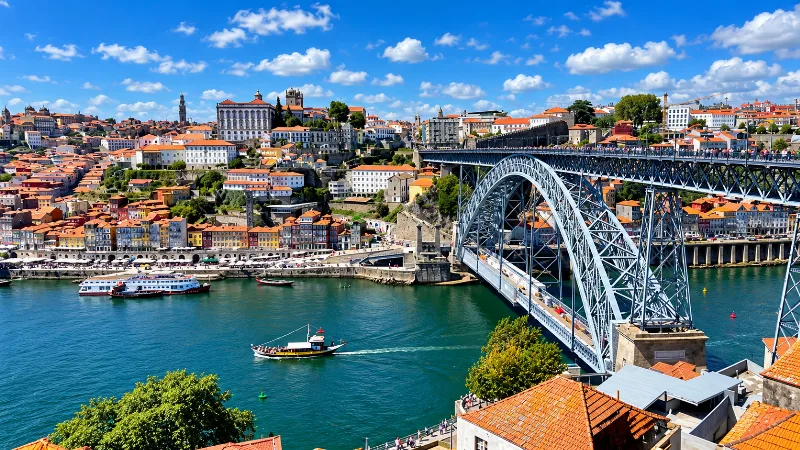
Porto
Porto is a compact northern city of steep streets, granite architecture, riverfront views, historic districts and strong local character.
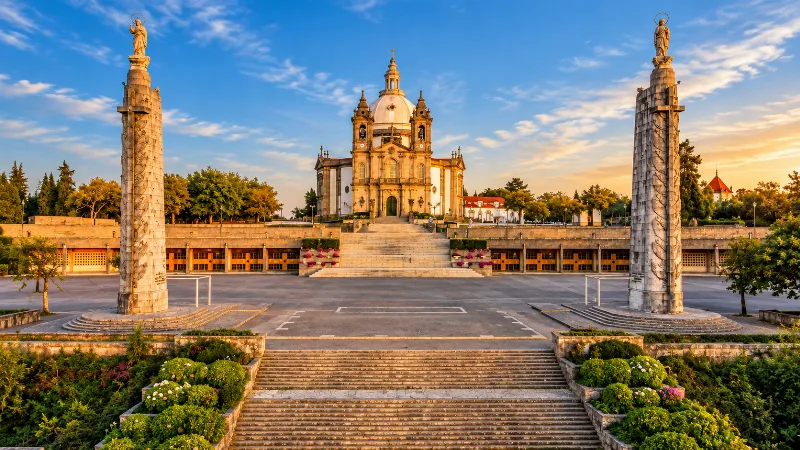
Braga
Braga is a historic northern city known for religious heritage, elegant squares, baroque architecture and a lively modern centre.
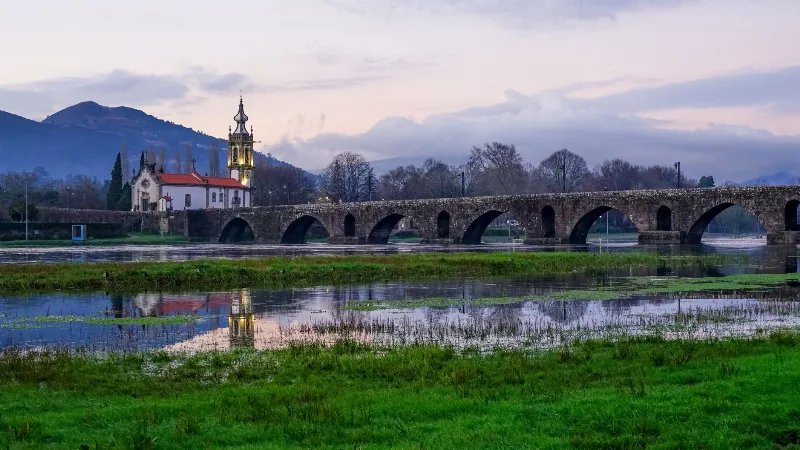
Ponte de Lima
Ponte de Lima straddles the River Lima in Portugal's Minho, where a Roman and medieval bridge, granite streets and riverside gardens shape one of the north's oldest settlements.
Barcelos Rooster and Portuguese Folk Art
The painted clay cockerel from northern Portugal is more than a souvenir: it carries a medieval legend, a living pottery tradition and a widely shared message of good fortune.