
Ílhavo
Ílhavo is a lagoon-side city in central Portugal whose identity was shaped by the North Atlantic cod trade, porcelain making and the shifting sands of the Ria de Aveiro.
Ílhavo is a city and municipality in the district of Aveiro, in the Centro region of Portugal, set on the eastern shore of the Ria de Aveiro about eight kilometres south of Aveiro itself. The municipality covers some 75 square kilometres and is divided into four parishes: São Salvador, which contains the old town, and the three Gafanhas — Nazaré, Encarnação and Carmo — which occupy the sandy strip between the lagoon and the Atlantic. That division gives the area two distinct characters. Inland, Ílhavo is a compact town of low houses, small squares and a monumental parish church; to the west, the Gafanhas are elongated settlements strung along roads and waterways, ending at the resorts of Barra and Costa Nova. Around 39,000 people live in the municipality.
A town between the lagoon and the ocean
Ílhavo belongs to a low, flat coastal plain built from river silt and marine sand. The Vouga and its tributaries feed the lagoon, while tides push through a narrow bar to the sea, keeping the water brackish and the channels constantly shifting. Because of this, the town has always faced two ways: towards the sheltered water, where boats, salt works and small-scale fishing supported daily life, and towards the open ocean, which offered both danger and income. Roads follow the channels rather than cutting across them, and bridges are few. The result is a landscape of water, reed beds and sandy tracks in which the sea is never far away, even when it cannot be seen.
From rural parish to deep-sea port
The parish is documented from the sixteenth century onwards, and worship has taken place on the site of the present church for roughly five hundred years. For most of its history Ílhavo was an agricultural parish of the Aveiro hinterland, and the dunes of the Gafanhas were thinly settled. Two nineteenth-century developments altered that. The first was industry: the Vista Alegre porcelain works, founded in 1824, brought skilled workers, housing and a school to the edge of the parish. The second was the cod fishery. Crews from the Gafanhas sailed to the Grand Banks of Newfoundland and to Greenland, at first in wooden sailing vessels and later in steel trawlers. In the twentieth century the port of Aveiro, whose fishing terminal lies at Gafanha da Nazaré, became the home base of the fleet known as the White Fleet. The trade contracted from the 1970s as northern fishing limits closed, and the last trawlers stopped sailing in the 1990s.
Limestone churches and a porcelain village
The Igreja Matriz de São Salvador dominates the town centre. Its first stone was laid in 1774 and it was consecrated in 1785, built largely at the expense of parishioners in local Ançã limestone, with three aisles, Tuscan columns and twin bell towers framing the façade. At Vista Alegre, the chapel of Nossa Senhora da Penha de França was built in the 1690s for D. Manuel de Moura Manuel, Bishop of Miranda; it is mannerist in plan with baroque elements on the exterior, and holds his tomb, carved by the French sculptor Claude Laprade. Around it grew one of Portugal's earliest industrial settlements, laid out from 1826 with terraced workers' houses, a theatre, a school, a refectory and a private fire brigade. In Costa Nova, the former haylofts known as palheiros are now holiday houses painted in bold vertical stripes, while a handful of Art Nouveau façades survive in Ílhavo itself.
Reed beds, dunes and surf
The ria is shallow and intricate, a maze of channels, sandbanks and salt marsh that supports waders, gulls and migrating birds in large numbers. Its margins are fished for eels, clams and mullet, and the reed beds are still cut in places. West of the water lies a belt of dunes held together by marram grass and pine, and beyond that the long Atlantic beach that runs from Barra to Costa Nova. The coast here is exposed: winter storms move sand, and heavy stone breakwaters protect the entrance to the lagoon and the harbour. The difference between the calm inner water and the surf on the ocean side is one of the defining features of the municipality.
Working life and local custom
Sea work shaped the calendar and the vocabulary of the place. Devotion to the Senhor Jesus dos Navegantes, an image kept in the parish church, remains strong among fishing families, and a maritime religiosity centre behind the church displays religious objects connected with voyages. Each August the Codfish Festival fills the gardens at Jardim Oudinot in Gafanha da Nazaré, combining cookery with music and exhibitions. In the villages, bread from Vale de Ílhavo is still baked in wood-fired ovens, and households cook salt cod in many forms alongside lagoon fish and shellfish. Model boat making and ceramic painting, both linked to the sea and to Vista Alegre, continue as small-scale crafts.
Museums and landmarks
The Museu Marítimo de Ílhavo, founded in 1937 and rehoused in a prize-winning building opened in 2001, explains the cod campaigns through a full-size fishing boat that visitors can board, displays of tackle, and a gallery devoted to the lagoon's painted wooden craft. A cod aquarium opened in 2013. Moored at Jardim Oudinot is the ship-museum Santo André, a 71-metre side trawler built in the Netherlands in 1948, which sailed until 1997 and opened to the public in 2001. The Casa Gafanha, a prosperous farmer's house of 1929, covers everyday life in the Gafanhas during the twentieth century, and the Vista Alegre museum traces two centuries of porcelain production. Above the beach at Barra stands the Farol da Barra, completed in 1893 and, at 62 metres, the tallest lighthouse in Portugal.
Places within reach
Aveiro, with its canals and Art Nouveau streets, is a short drive or a local train journey north. Across the lagoon, São Jacinto and Murtosa are reached by road around the northern end of the water and offer dune reserves and quiet quays. Southwards, the municipalities of Vagos and Mira continue the same coastal pattern of beach, pinewood and farmland, with the Vouga valley opening inland towards Águeda. Porto lies about 75 kilometres to the north, making Ílhavo a practical stopping point between the Douro and the Beiras.
Related content
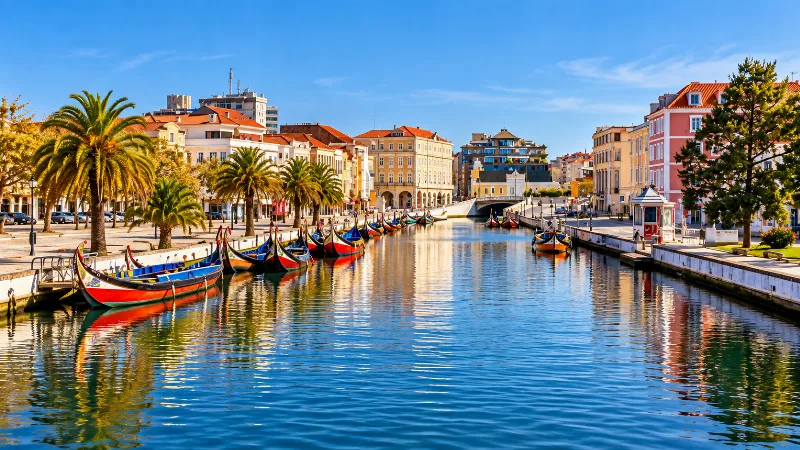
Aveiro
Aveiro is a small coastal-region city with canals, Art Nouveau details, colourful boats and easy access to lagoons and Atlantic landscapes.
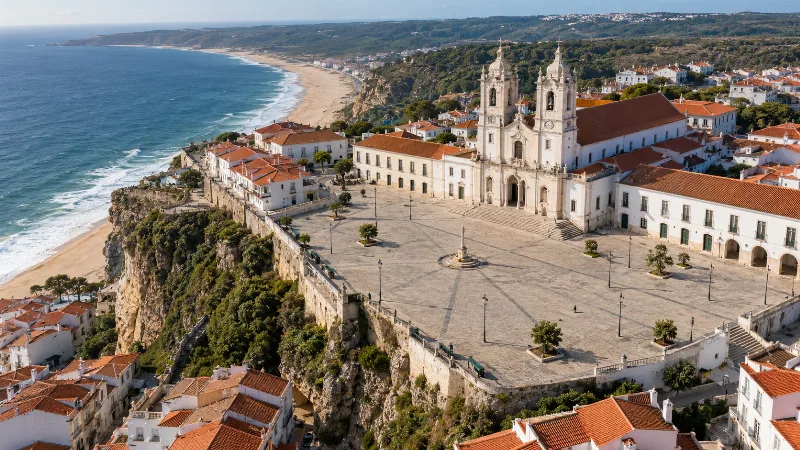
Nazaré
Nazaré is an Atlantic fishing town known for its broad beach, clifftop Sítio district, maritime traditions and the large winter waves at Praia do Norte.
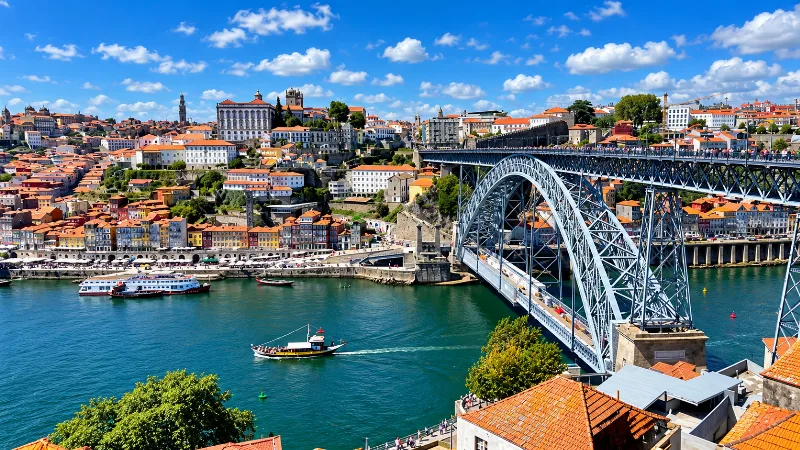
Porto
Porto is a compact northern city of steep streets, granite architecture, riverfront views, historic districts and strong local character.
Nazaré's Sítio Cliff and Fishing Quarter
Nazaré is built on two levels: a working fishing quarter beside the Atlantic and, high above it, the clifftop district of Sítio with its sanctuary, viewpoints and long sea views.