
Nazaré's Sítio Cliff and Fishing Quarter
Nazaré is built on two levels: a working fishing quarter beside the Atlantic and, high above it, the clifftop district of Sítio with its sanctuary, viewpoints and long sea views.
Nazaré lies on the Atlantic coast of central Portugal, in the district of Leiria, and is unusual among Portuguese seaside towns in being arranged on two quite separate levels. The beachfront settlement, known locally as the Praia, spreads across the flat ground beside the sand, while the district of Sítio occupies a high promontory roughly a hundred metres above the sea. A steep road, a long flight of steps and a funicular railway connect the two, and this division — ordinary fishing streets below, a windblown viewpoint and sanctuary above — gives the town much of its character.
The Sítio: A Clifftop Above the Atlantic
The Sítio is reached by climbing the escarpment, and the change of atmosphere on arrival is immediate. The streets of the upper district are narrow and largely pedestrian, lined with whitewashed houses trimmed in blue or ochre, small shops and a handful of quiet squares shaded by a few trees. Because the plateau is compact, it can be explored comfortably on foot in an hour or two, though most visitors linger longer for the outlook alone. The clifftop has the slightly exposed feel common to Portuguese headlands: wind-scoured pavements in traditional calçada stone, gulls overhead, and the constant sound of surf breaking a long way below.
The Sanctuary and the Legend of Nazaré
The upper town's focal point is the Sanctuary of Nossa Senhora da Nazaré, a substantial seventeenth-century church with a baroque façade and an interior decorated with panels of blue and white azulejos illustrating the town's founding legend. According to tradition, a wooden image of the Virgin was brought to the coast by a monk in the early medieval period. The better-known episode concerns Dom Fuas Roupinho, a local nobleman who, while hunting near the cliff edge in 1182, rode through thick fog towards the drop and called on the Virgin for help; his horse is said to have halted on a rocky outcrop at the brink. A small chapel, the Ermida da Memória, marks the spot close to the cliff, and a September pilgrimage continues to draw visitors to the sanctuary each year.
Views from the Miradouro do Suberco
The main viewpoint, the Miradouro do Suberco, looks directly down on the beachfront district, its rooftops and the curve of sand. To the north the coastline runs towards Praia do Norte, the exposed beach known for its exceptionally large winter waves, which are generated by the offshore Nazaré Canyon, a deep submarine valley that funnels swell towards the shore. From the clifftop the scale of that water is easy to appreciate, and late afternoon light over the bay is one of the most photographed sights on this stretch of coast.
The Fishing Quarter Below
Down on the level ground, the older part of Nazaré retains the tight, irregular pattern of a fishing settlement. Lanes run between low houses faced in tiles or white render, nets and floats are stacked against walls, and the smell of salt and grilled fish drifts from small kitchens. The beach itself still functions as a workplace rather than only a leisure space, with boats drawn up on the sand, tractors and equipment standing between the sunbathers. The seafront avenue provides the natural boundary between the streets and the water, and a short walk inland reveals the everyday shops, bakeries and cafés that serve the resident community.
Arte Xávega and the Working Beach
Nazaré keeps alive the practice of arte xávega, a form of beach-seine fishing in which nets are set from boats offshore and then hauled in by teams of people pulling from the sand. Historically the catch was brought ashore with the help of oxen; today the work is done with winches and tractors, but the method itself is unchanged in principle. The narrow wooden boats, painted in bold colours, are a familiar sight along this coast, and watching a haul being landed remains one of the most distinctive things to see in the town.
Local Dress and Everyday Custom
The women of Nazaré are associated with a striking traditional costume, most notably the layered skirts — commonly described as seven — worn one above another over a checked or striped pattern. The costume survives mainly at festivals and in cultural displays, but it reflects a wider attachment to local identity that is visible in the way the fishing community marks its calendar, from religious processions to gatherings on the beach.
Fish on the Table
Food in Nazaré follows the catch. Caldeirada, a slow-simmered fish stew layered with potatoes, peppers and onion, is a staple of the region, as are grilled sardines, dried and salted fish, and simple plates of shellfish. The cooking is unfussy and relies on the freshness of what comes off the boats, which is why the plainest-looking establishments near the harbour and the beach tend to serve the most representative food.
Related content
Things to Do in Nazaré
Explore things to do in nazaré with a practical guide to notable places, regional landscapes, local heritage and travel planning in Portugal.
Portugal's Most Beautiful Fishing Villages
Explore portugal's most beautiful fishing villages with a practical guide to notable places, regional landscapes, local heritage and travel planning in Por
Costa Vicentina Coastal Path and Atlantic Cliffs
The Costa Vicentina is a wild Atlantic shoreline of dark schist cliffs, broad beaches and waymarked trails, where walking routes link quiet Alentejo fishing villages with protected natural parkland.
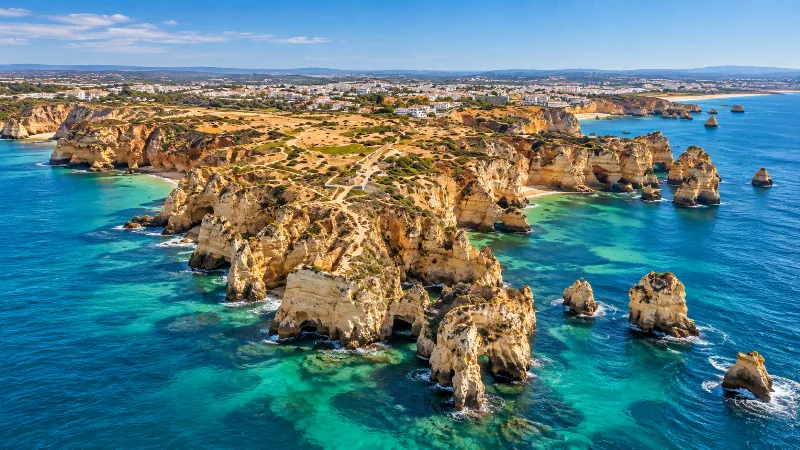
Algarve
Explore the Algarve through sandy beaches, limestone cliffs, Faro, Ria Formosa, coastal trails, historic towns and southern Portuguese landscapes.
Ria Formosa Lagoon and Barrier Islands in the Eastern Algarve
The Ria Formosa is a tidal lagoon stretching along the eastern Algarve coast, sheltered by a chain of low sandbar islands and fringed with salt marshes that draw wading birds and shellfish gatherers alike.
Traditional Portuguese Markets and Local Culture
Explore traditional portuguese markets and local culture with a practical guide to notable places, regional landscapes, local heritage and travel planning