
Ribeira Grande
Ribeira Grande is a town on São Miguel's north coast in the Azores, known for black basalt architecture, a sixteenth-century parish church and a valley setting between rivers and farmland.
Ribeira Grande occupies the north coast of São Miguel, the largest island of the Azores, roughly twenty kilometres east of Ponta Delgada. It is the second most populous municipality on the island, yet its centre keeps the scale of a country town: a compact grid of whitewashed houses outlined in dark volcanic stone, set where the Ribeira Grande and its smaller tributaries descend from the hills to the Atlantic.
Location and general character
The municipality runs from the coastal cliffs inland into steep uplands, and takes in the parishes of Matriz, Conceição, Ribeira Seca, Santa Bárbara and Ribeirinha, among others. The historic core sits on a shelf of level ground above the river mouth. Two squares organise the town: Praça Hintze Ribeiro, with its shaded garden and civic buildings, and Largo Gaspar Frutuoso in front of the parish church. Narrow streets connect the older riverside quarter with later development on the slope above. Because the town faces north and opens onto the ocean through a valley, it receives a good deal of Atlantic weather; rain is common, the hills behind are intensely green, and water channels and small cascades run down towards the sea even in dry months.
History
Portuguese settlement took hold here in the late fifteenth century, drawn by deep volcanic soils and plentiful water. The place was raised to the rank of vila in 1507, the same year in which construction of the parish church began, and it grew quickly into one of the more important centres of São Miguel. Wheat underpinned the early economy, and oranges were later shipped abroad in quantity. In 1563 a combined seismic and volcanic emergency centred on the Fogo volcano caused severe damage across the town and the neighbouring parish of Ribeira Seca, and the eruption left behind the crater now filled by Lagoa do Fogo. Recovery was slow and spanned more than a century of rebuilding. Ribeira Grande was elevated to city status in 1981.
Architecture
The town's buildings are inseparable from its geology. Basalt, the dark, fine-grained rock produced by fluid lava flows, appears everywhere: in door and window surrounds, corner stones, pavements, walls and bridges. Trachyte, a paler stone from the Fogo area, was reserved for carved detail and is visible in church façades and decorative blocks, often heavily weathered by salt and rain. The contrast of black stone against lime-washed walls gives Ribeira Grande a look distinct from mainland Portugal, and local historians have long applied the term estilo micaelense to the seventeenth-century houses of the town, with their heavy projecting frames, stair windows and ornamental gables. The Town Hall, with its double external staircase, stone balustrade and adjoining bell tower, is a good introduction to the manner, as is the eight-arch road bridge of the late nineteenth century, built entirely in basalt.
Natural surroundings
Immediately outside the built-up area the land turns to pasture, divided by high stone walls and hedges, with maize plots and small orchards on the flatter ground. The rivers that give the town its name rise in the uplands to the south, and old watermills and levadas recall their former use for grinding grain and irrigating fields. Above the town, the ground climbs towards the Fogo volcanic massif, whose caldera lake lies within easy reach. To the east, hot springs and fumaroles at Caldeiras da Ribeira Grande discharge mineral water that has been used for bathing for generations. The north coast here is exposed and energetic, with dark sand beaches and reliable surf, while the cliffs support seabirds and the odd glimpse of dolphins offshore.
Local culture and everyday life
Dairy farming and small-scale agriculture remain the backbone of the municipality, and the rhythm of the town still follows the agricultural calendar to a degree. Parish life is visible in the numerous festas, in the Holy Spirit traditions common throughout the Azores, and in the processions that fill the streets around the church squares. Ribeira Grande also has a modest but genuine cultural infrastructure: a nineteenth-century theatre, a municipal museum housed in a basalt building, and a museum devoted to Azorean emigration in the converted fish and meat markets. Cafés around the main squares serve as meeting places, and the town's compact centre makes most of it walkable within half an hour.
Notable places
The Igreja Matriz de Nossa Senhora da Estrela is the town's principal monument. Begun in 1507, damaged in 1563 and largely rebuilt between 1728 and 1736, it presents a mannerist façade with baroque ornament, a three-aisled interior of square pillars, gilded altarpieces and a Flemish sixteenth-century triptych of Saint Andrew. The Igreja da Misericórdia, faced in trachyte, and the former Convento de São Francisco, whose church opened in 1613 and later served as a hospital, stand nearby. Traces of the vanished Mosteiro de Jesus, founded in 1536, survive in the town centre. A carved Manueline window with a Renaissance frieze, decorated with a bird and two dragons, is the best-known fragment of early civil architecture, and a series of stone Passion chapels marks the old processional route.
Nearby destinations
Ponta Delgada, the island capital, is a short drive west along the coast. Inland, the crater and walking trails of Lagoa do Fogo offer some of the island's finest views, while the hot springs at Caldeiras are a few minutes from the town centre. The fishing port of Rabo de Peixe lies to the west, and the beaches at Santa Bárbara attract surfers from across the island. Further afield, Sete Cidades and Furnas can be reached within an hour, making Ribeira Grande a practical base for exploring the whole of São Miguel.
Related content
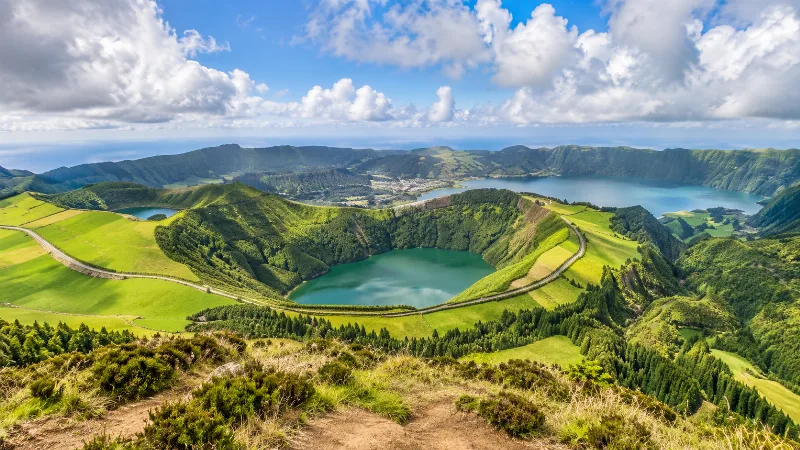
Azores
Discover the Azores through volcanic islands, crater lakes, green landscapes, Atlantic coastlines, hiking, wildlife and distinctive island communities.
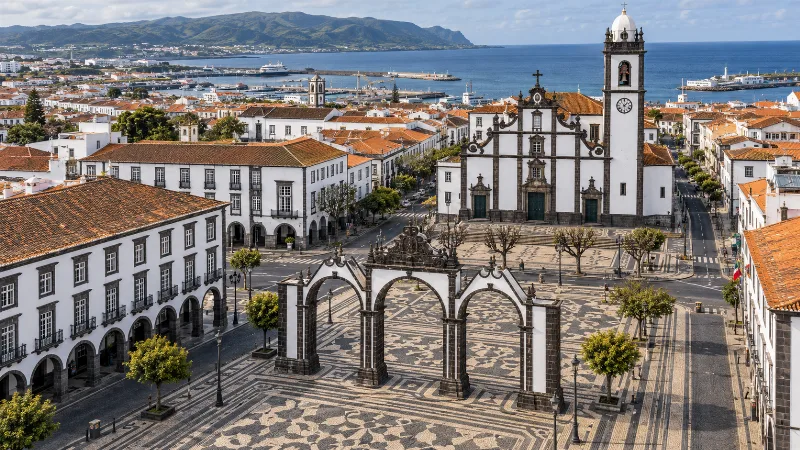
Ponta Delgada
Ponta Delgada is São Miguel’s main city, combining an Atlantic waterfront, volcanic-stone architecture, historic churches and access to the island’s lakes and geothermal landscapes.
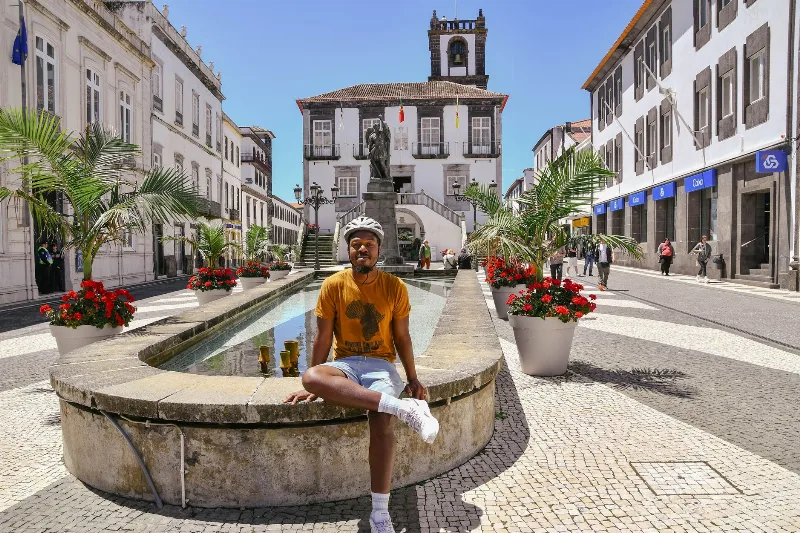
Ponta Delgada
The Azores' largest city spreads across a basalt terrace above a south-facing bay on São Miguel. This guide covers its harbour history, religious architecture, festivals and the volcanic hills that surround it.
Things to Do in Ponta Delgada
Explore things to do in ponta delgada with a practical guide to notable places, regional landscapes, local heritage and travel planning in Portugal.
Ribeira Brava
Ribeira Brava is a small town on Madeira's southern coast, built where a deep river valley opens onto the Atlantic. Its parish church, coastal fort and terraced banana slopes give it a character distinct from the busier resorts further east.
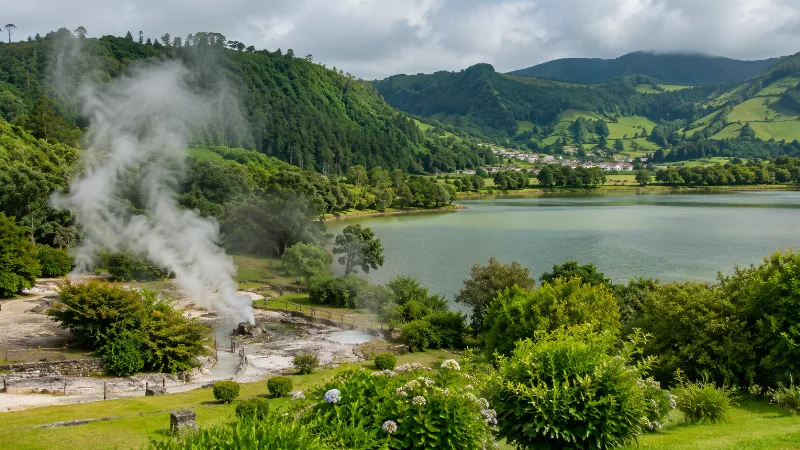
Furnas – Volcanic Springs and Lakeside Scenery
Furnas is a volcanic valley on São Miguel, known for steaming geothermal areas, mineral springs, gardens and a lake surrounded by green slopes.