
Torres Vedras
Torres Vedras is an agricultural town in Portugal's Oeste region, known for its hilltop castle, its long wine-growing tradition and the Lines of Torres Vedras, the fortifications that halted Napoleon's army north of Lisbon.
Torres Vedras is a town and municipality in the Oeste region of central Portugal, in the district of Lisbon, set in the valley of the River Sizandro roughly 50 kilometres north of the capital. The municipality runs from rolling farmland and vineyards inland to a stretch of Atlantic coastline of about 20 kilometres, and its name is inseparable from one of the largest systems of field fortifications ever built in Europe.
Location and general character
The municipality covers around 407 square kilometres and is made up of rural parishes, small industrial villages and coastal settlements; roughly 80,000 people live across it, with the town itself accounting for something like a quarter of that figure. Torres Vedras functions as an administrative and service centre for the surrounding countryside, combining local government, schools and health services with food processing, metalworking and a busy retail sector. The Linha do Oeste railway and the main road corridor between Lisbon and the north run through the municipality, which has long made the town a practical stopping point rather than a place passed by unnoticed. Its low skyline, with the castle hill rising above tiled roofs, still announces a settlement shaped by agriculture and by the defence of the capital.
History
Afonso Henriques took the town from Moorish control in 1148, and Afonso III granted it a charter in 1250, later confirmed by Manuel I in 1510. During the medieval period Torres Vedras belonged to the queens of Portugal, a status that brought royal visits, building work and a certain political weight. Eleanor of Portugal, daughter of King Edward, was born here in 1434 before her marriage to Frederick III of the Holy Roman Empire, and the town hosted councils and diplomatic receptions in the fourteenth and fifteenth centuries. It also endured sieges and contested loyalties, including the 1384 investment by the Master of Aviz and, much later, a takeover by John IV's forces in 1640. The earthquake of 1755 caused damage in the centre, and in 1846 the town gave its name to a battle of the Patuleia civil conflict, fought around the fort of São Vicente. The railway arrived in 1886, electricity in 1912 and piped water in the 1920s, and Torres Vedras was elevated to city status in 1979.
The Lines of Torres Vedras
Between November 1809 and 1810, on the orders of Arthur Wellesley, then Viscount Wellington, British and Portuguese engineers under Lieutenant-Colonel Richard Fletcher built a network of forts, redoubts and batteries across the hills north of Lisbon. The Lines of Torres Vedras eventually numbered about 150 works and were laid out in successive belts from the Tagus to the Atlantic, using steep ground, scarped slopes, blocked roads and dammed streams as much as masonry. The first line ran from Alhandra to the mouth of the Sizandro, and the town sat within it, with the castle adapted as a redoubt and the hilltop Forte de São Vicente, which held 39 guns and space for some 2,000 men, guarding the road to Lisbon. When Masséna's army reached the Lines in October 1810 it found a scorched and emptied landscape, and after several weeks without a decisive engagement the French withdrew, beginning their retreat from Portugal in March 1811. The civilian population paid a heavy price in hunger and disease. Many earthworks have eroded, but surviving sections, military roads and signposting now form a waymarked historical route across six municipalities, a project recognised with a European heritage award.
Architecture
The historic centre is compact and largely eighteenth- and nineteenth-century in appearance, with low buildings faced in tile, colour-washed render and occasional stone detailing. Churches dominate the townscape: Santa Maria do Castelo within the castle walls retains Romanesque features from the twelfth century and a tiled interior, while São Pedro keeps a Manueline portal, and the Misericórdia church, built between 1681 and 1710, shows a restrained Baroque front. The former Convent of Nossa Senhora da Graça, rebuilt from 1544 after earlier buildings were lost to floods on the Sizandro, now houses the municipal museum. Water engineering is part of the town's identity too: the Gothic Chafariz dos Canos, in existence by 1331 and rebuilt in 1561, is fed by a stone aqueduct that still crosses the edge of the centre. Away from the main streets, narrow lanes, small squares and old commercial frontages give the town a working, unpolished character rather than a museum-like one.
Natural surroundings
The Sizandro valley carries deep alluvial soils that support intensive horticulture alongside vineyards, with beans, potatoes and fruit grown on small plots divided by dry-stone walls and reed hedges. To the south and east, low clay hills are covered by a patchwork of pine, eucalyptus and scrub, part of it included in the local protected landscape of the Serras do Socorro e Archeira, which covers just over 1,200 hectares and is crossed by waymarked paths. The limestone ridge of the Serra de Montejunto rises beyond the municipality's north-eastern boundary, its protected landscape shared with neighbouring councils. Westwards, the coast alternates sandy bays with low, soft cliffs between the Assenta and Porto Novo, including the beaches of Praia Azul, Santa Rita and Santa Cruz. The shoreline forms part of a Natura 2000 site noted for dune systems and salt-tolerant cliff vegetation, and its consistent Atlantic swell has made Santa Cruz a base for surfing, bodyboarding and a long-running international wave-sports festival.
Local culture and everyday life
Torres Vedras is best known in Portugal for its Carnival, held over several days in February and built around allegorical floats, masked groups and satirical figures, including the matrafonas — men dressed as grotesque matrons — and the oversized-headed cabeçudos. Drum-and-bagpipe bands known as Zés Pereiras accompany the parades, and the town's two Carnival kings are usually local personalities. The first procession of ox-drawn floats took place in 1924, and the event has been a fixture of the regional calendar ever since. Food and farming remain central to daily life: the local pastry, pastel de feijão, is a white-bean and almond tart associated with the town since the nineteenth century, and the municipality is one of the country's larger wine producers, with a protected denomination of origin for its reds and whites made from Aragonez, Castelão, Arinto and Fernão Pires, among others. Wine from the area has been shipped to Lisbon since the Middle Ages. Torres Vedras shared the title of European City of Wine with Alenquer in 2018. Local life also clusters around markets, parish festivals and sport; the town keeps a museum devoted to the cyclist Joaquim Agostinho, who grew up nearby.
Notable places
Nearby destinations
The walled town of Óbidos, the fishing port and peninsula of Peniche, and the palace-convent at Mafra all lie within about half an hour to an hour by road, while Ericeira and Lourinhã, with its Jurassic fossil sites, sit on the same coastal strip. Inland, the fort at Alqueidão above Sobral de Monte Agraço forms the strongest surviving point of the Lines outside Torres Vedras, and the towns of Arruda dos Vinhos and Alenquer continue the wine country north and east. Lisbon itself is close enough for a day's travel, which is one reason the town works well as a base for exploring the Oeste rather than as a single-stop visit.
Related content
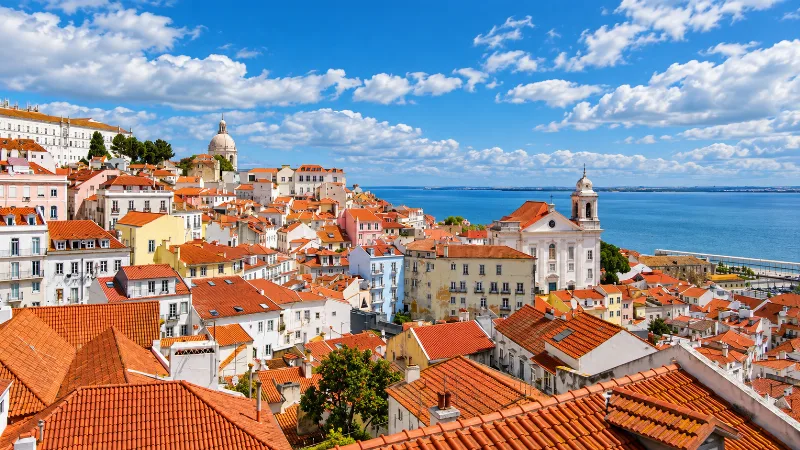
Lisbon
Portugal’s capital combines historic neighbourhoods, river views, tiled façades, viewpoints and an energetic everyday city life.
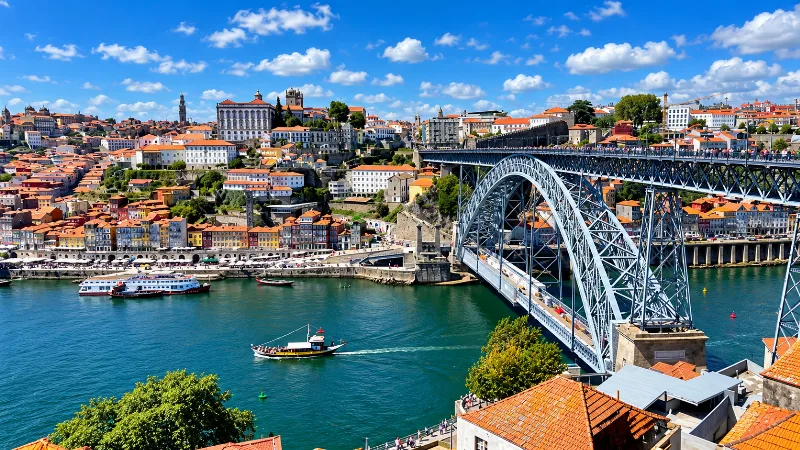
Porto
Porto is a compact northern city of steep streets, granite architecture, riverfront views, historic districts and strong local character.
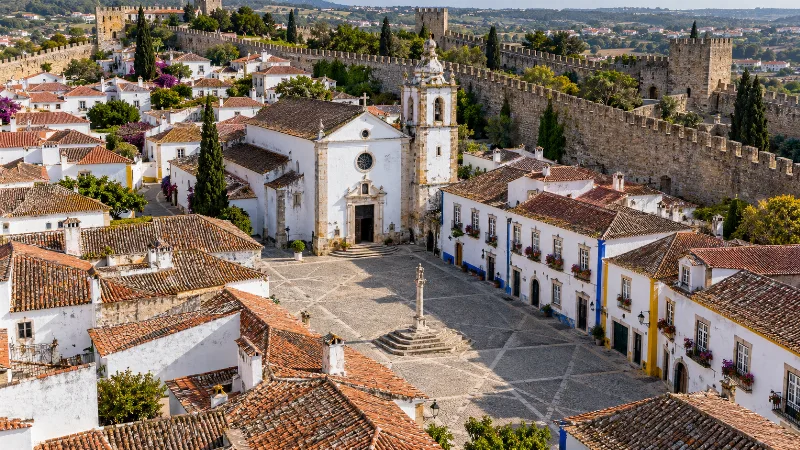
Óbidos
Óbidos is a walled hilltop town with cobbled lanes, whitewashed houses, a medieval castle and views across the surrounding countryside.
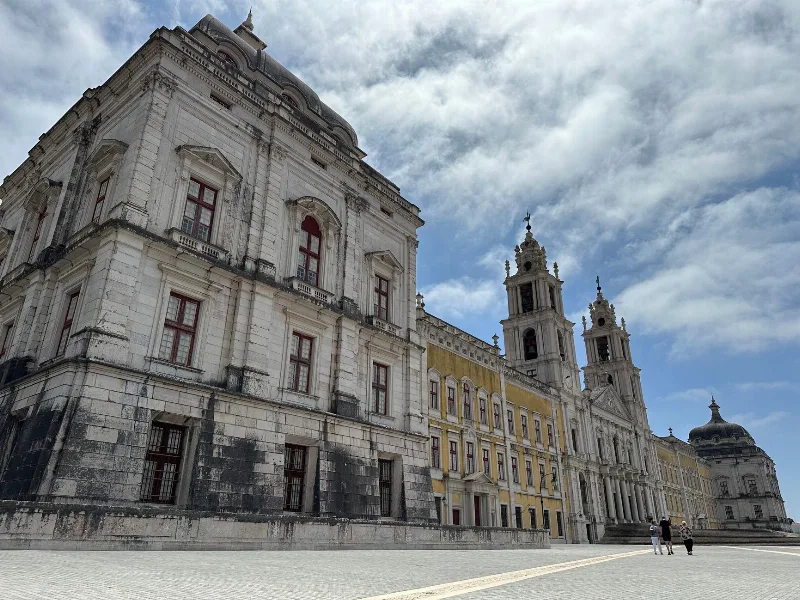
Mafra
Mafra is a Portuguese town built around an enormous Baroque palace-convent, whose basilica, library and walled royal hunting park together form a UNESCO World Heritage site.
Óbidos
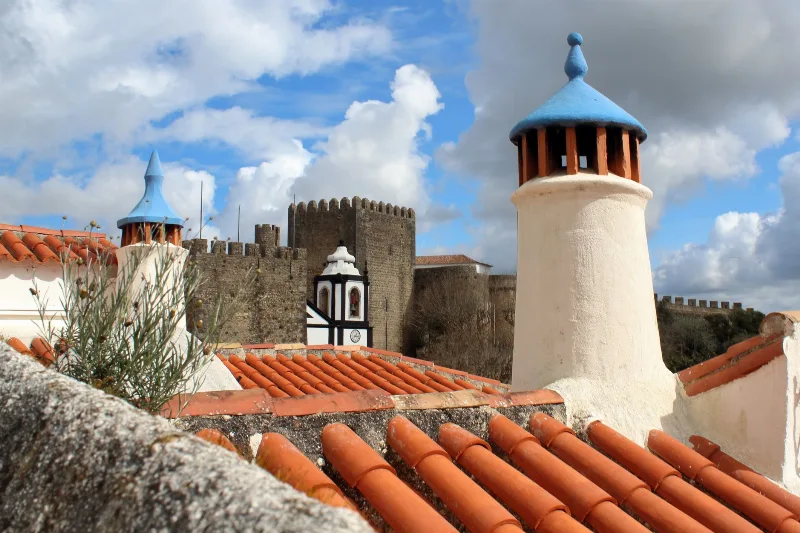
Óbidos is a small walled town in Portugal's Oeste region, built inside an intact medieval circuit of walls around a hilltop castle. Its streets, churches and sour-cherry liqueur tradition make it one of the country's most distinctive historic centres.
Lagoa de Óbidos and its Atlantic Sandbar
A shallow coastal lagoon in western Portugal, Lagoa de Óbidos is defined by the sandbar that separates it from the Atlantic and by the tidal rhythms that continually reshape it.