
Cante Alentejano: Polyphonic Singing of Alentejo
Cante Alentejano is an unaccompanied polyphonic singing tradition from Portugal’s Alentejo, kept alive by amateur choirs and local communities. This article explains its vocal roles, themes, social importance and UNESCO-recognised heritage status.
Cante Alentejano is a form of unaccompanied polyphonic singing from the Alentejo, the broad region that covers much of southern Portugal. It is performed by amateur groups, usually without instruments, and it depends on the relationship between a leading voice and a full chorus. The style is plain, resonant and deeply connected to the villages and rural communities where it developed. In 2014, Cante Alentejano was inscribed on UNESCO’s Representative List of the Intangible Cultural Heritage of Humanity, drawing international attention to a tradition that had long been sustained by local singers.
A tradition rooted in the Alentejo landscape
The Alentejo is known for wide plains, cork oak woods, olive groves, wheat fields and low whitewashed villages. Cante grew out of this environment, where work in the fields, religious festivals and community gatherings shaped the rhythm of daily life. Its songs often reflect the landscape and the social conditions of the region, including agricultural labour, family life, love, absence and emigration. The music is not tied to a single occasion; it can be heard at celebrations, in local associations and in informal gatherings, where singers may stand in a circle or around a table and begin a song without preparation.
Voices and structure
Cante Alentejano is polyphonic, but its texture is not richly orchestral; it is built from voices alone. The terms ponto and alto are used for the principal vocal roles. The ponto tends to take the leading line, setting the verse or melodic phrase, while the alto supplies a responding or supporting part. Other singers join the chorus, repeating lines and filling out the harmony. The effect can be solemn or lively, depending on the song, but it is always communal: the group listens to itself, adjusts its tuning and balances the voices by ear. There is no need for a large hall; the sound carries well in a small church, a village square or a plain room.
Words, themes and oral transmission
The words of Cante Alentejano are central to its identity. Many songs use simple verse forms and repeat a limited number of melodic phrases, allowing singers to concentrate on the text and on the blend of voices. The poetry often addresses rural life, religious devotion, love, longing and the hardships of work. Some songs remember the Alentejo as a place of silence and distance; others celebrate local saints, festivals or the pleasure of singing together. The repertoire is transmitted orally. Singers learn by listening, joining in and gradually absorbing the conventions of a group, so each choir may have its own way of shaping a familiar song.
Cante Alentejano in community life
Cante is closely associated with the social life of the Alentejo. Choral groups, often known as grupos corais, perform at festivals, romarias, fairs and cultural events, but the tradition also survives in less formal settings. A song may begin in a tasca or at a family gathering, with no stage and no audience in the conventional sense. This flexibility helps explain its endurance. The music reinforces local identity and creates a sense of belonging, yet it is not exclusive: visitors can hear Cante at public celebrations, and recordings and performances have helped make the style known beyond the region.
UNESCO recognition and continuity
The UNESCO inscription of 2014 recognised Cante Alentejano as living heritage rather than a museum piece. Recognition has supported efforts to document songs, record older singers and encourage younger people to take part. It has also highlighted the importance of the groups themselves, which depend on volunteers, rehearsal and a willingness to pass knowledge on. The tradition faces the same pressures as many community practices, including changing rural populations and the pull of other forms of entertainment, but it remains active in many towns and villages. Its strength lies in its adaptability: the style can be performed in a church, a cultural centre or a public square without losing its essential character.
Listening to Cante Alentejano
For a listener, the best way to approach Cante is to follow the voices rather than expect instrumental colour. Listen for the entry of the ponto, the response of the alto and the moment when the chorus settles into a shared sound. The lyrics may be difficult to follow for non-Portuguese speakers, but the emotional register is often clear from the pace and the weight of the harmony. Cante is music of participation as much as performance, and its power comes from the fact that ordinary singers, not professional musicians, keep it alive.
Related content
Alentejo
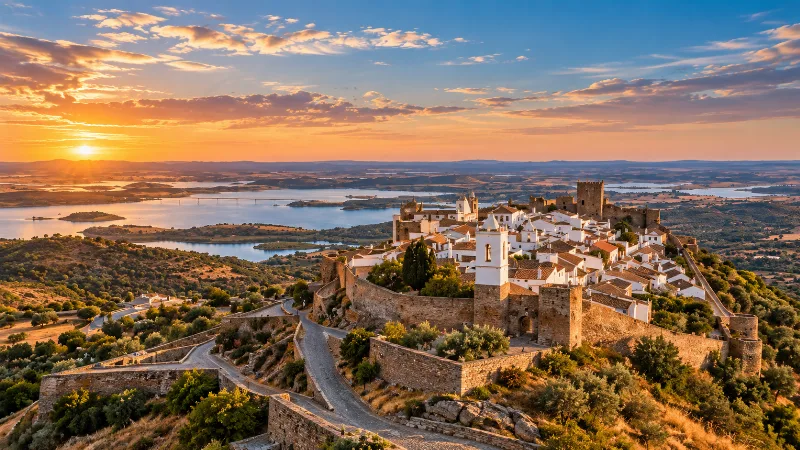
Discover Alentejo through Évora, whitewashed towns, cork-oak landscapes, vineyards, regional food and the broad rural interior of southern Portugal.
Costa Vicentina Coastal Path and Atlantic Cliffs
The Costa Vicentina is a wild Atlantic shoreline of dark schist cliffs, broad beaches and waymarked trails, where walking routes link quiet Alentejo fishing villages with protected natural parkland.
Fado and Lisbon's Alfama Neighbourhood
Fado is Portugal's most recognisable song form, and Alfama, the oldest quarter of Lisbon, remains its spiritual home. Here is how the music and the lanes where it is sung belong together.
Beja
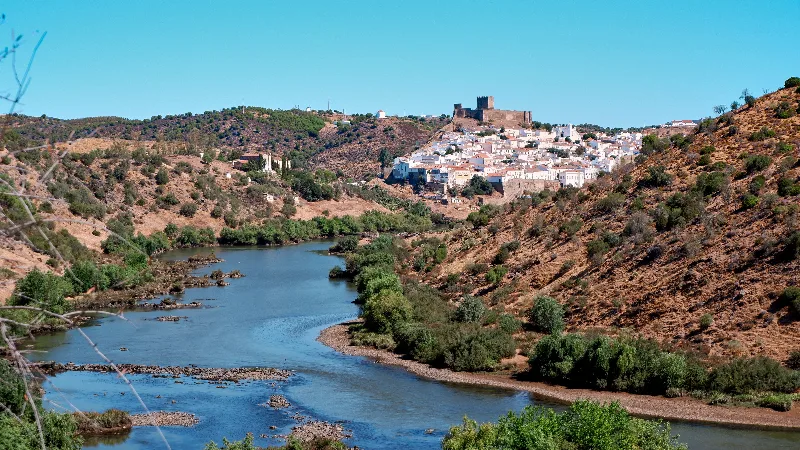
Beja is a hilltop city in the Baixo Alentejo, once the Roman town of Pax Julia, whose marble-grey castle keep rises above a plain of wheat, olive groves and cork oak. Its old convent now holds one of southern Portugal's richest regional museums.