
Alcobaça
A small town in central Portugal that grew up around one of Europe's best-preserved Cistercian abbeys, with a medieval monastic complex at its heart and a valley of orchards beyond it.
Alcobaça is a small town in the Oeste region of central Portugal, roughly 120 kilometres north of Lisbon, set in the valleys of the rivers Alcoa and Baça and within sight of limestone hills to the east. The town is inseparable from the vast Cistercian monastery that occupies its centre, a complex still largely intact and inscribed on the UNESCO World Heritage list in 1989. Beyond the monastic walls, Alcobaça is an agricultural centre whose orchards, above all its apple trees, shape the landscape and the local economy.
Location and general character
The town sits in the district of Leiria, in a shallow basin where the two rivers meet, at a point where the coastal plain begins to give way to the limestone uplands of the Serras de Aire e Candeeiros. The Atlantic lies about fifteen kilometres to the west, and the municipality stretches to the coast at São Martinho do Porto, a sheltered shell-shaped bay. Alcobaça itself is compact and mostly low-rise, with a historic centre of paved streets and nineteenth- and twentieth-century townhouses laid out around the monastery. It functions as a service centre for the surrounding parishes, with schools, a health centre, a municipal library and a busy commercial core that is largely pedestrianised near the abbey. The atmosphere is that of a working provincial town rather than a resort: cafés fill at mid-morning, delivery vans move between the fruit warehouses on the edge of town, and the monumental abbey stands slightly apart from the everyday bustle.
History
The monastery was founded in 1153, when Afonso Henriques, the first king of Portugal, granted a large tract of land to Bernard of Clairvaux and the Cistercian order. The donation followed the conquest of Santarém in 1147 and served both as a thanksgiving and as a means of settling and defending territory recently taken from Moorish control. Alcobaça was the last abbey founded during Bernard's lifetime. Monks arrived within a few years and lived at first in timber buildings; construction of the stone monastery began in 1178, and the community moved into the new complex in 1223. The church was consecrated in 1252.
Over the following centuries the abbey became one of the wealthiest and most influential houses in the kingdom. Its estates, known as the Coutos de Alcobaça, covered a wide area in which the monks organised settlements, drained marshland, introduced new crops and irrigation methods, and ran an agricultural school. A public school opened in 1269, and the monastery's library grew into one of the largest in medieval Portugal. Several monarchs chose burial here, including Afonso II and Afonso III, which underlined the abbey's standing. The 1755 earthquake caused only limited damage, though parts of the sacristy and some outbuildings were lost. French troops looted the library in 1810, and in 1834 the dissolution of the religious orders in Portugal brought monastic life to an end; the remaining manuscripts are now held in the National Library in Lisbon. After 1834 the town absorbed former monastic land and buildings, and much of the present street pattern and housing stock dates from that period and later.
Architecture
The church of Santa Maria de Alcobaça is the first fully Gothic building in Portugal and remains the country's largest church interior. It is about 106 metres long and only some 23 metres wide, with three aisles of equal height rising above twenty metres, so that the space reads as a single soaring volume rather than a nave flanked by low passages. Following Cistercian rules, the walls and piers carry almost no figurative carving; the effect depends on proportion, light and the pale stone itself. The façade mixes the original Gothic portal and rose window with statues and two towers added in the early eighteenth century. Later phases are visible throughout: a Manueline upper storey on the cloister and a new sacristy from the reign of Manuel I, the Cloister of Silence built for King Dinis between 1308 and 1311, and Baroque tiling and altarpieces.
Two matching tombs stand in the transept, those of King Pedro I and Inês de Castro, carved with an elaborate programme of reliefs and placed so that the two figures face one another. The monastic service areas are unusually well preserved. The kitchen is built over a channel of the Ribeira dos Calados, which still runs through it, and its enormous hearth and flue were designed to cook for a very large community; nearby lie the refectory and the long dormitory. Visitors can also see the chapter house and the kitchens' adjoining courtyards, giving an unusually complete picture of how a great Cistercian house functioned.
Natural surroundings
The valley floor is alluvial and fertile, and water has always been its defining resource. The monks channelled streams to irrigate fields and orchards, and the same clay and limestone soils now support dense plantations of apple trees, along with pears and other soft fruit; Alcobaça apples are sold under a protected geographical indication. To the east the land rises into the Serras de Aire e Candeeiros, a dry limestone plateau of bare rock, olive groves and scrub, riddled with caves and fossilised footprints. To the west, towards the coast, the landscape flattens into farmland, market gardens and pine woods, with the sea at São Martinho do Porto and the beaches of the silver coast beyond.
Local culture and everyday life
Alcobaça's food culture carries a clear monastic inheritance. Convent confectionery is sold in the town's pastry shops, notably cornucópias, a horn-shaped sweet filled with egg cream that originated at the convent of Cós, and the sponge cake known as pão de ló, associated with the nearby village of Alfeizerão. Fruit growing supports packing houses and small processing businesses, and there is a continuing tradition of pottery and ceramics, represented in the town by a museum devoted to local production. Religious festas, municipal fairs and summer concerts in and around the monastery punctuate the year, and the abbey itself is used for temporary exhibitions as well as for visits.
Notable places
The monastery is the obvious starting point and takes several hours to see properly, including the church, cloisters, kitchen, dormitories and the exhibition areas. Around it, the old town offers a short walk through the commercial streets and small squares facing the abbey forecourt. In the parish of Aljubarrota, a few kilometres south, the site of the 1385 battle that secured Portuguese independence is explained at an interpretation centre built on the battlefield. São Martinho do Porto, on the coast, provides a calm bay and a promenade, while the wooded hills above the town offer viewpoints over the valley and the abbey roofs.
Nearby destinations
- Nazaré, about fifteen kilometres west, a fishing town with a long beach and the clifftop site of Sítio.
- Batalha, roughly twenty kilometres north-east, whose monastery of Santa Maria da Vitória is another World Heritage Site.
- Óbidos, an enclosed medieval town with walls and a castle, around thirty kilometres south.
- Leiria, with its hilltop castle and riverside centre, to the north-east.
- Fátima and the caves of the Serra de Aire e Candeeiros, both within easy reach by road.
- Caldas da Rainha, known for its ceramics and its daily market, about thirty kilometres to the south-west.
Related content
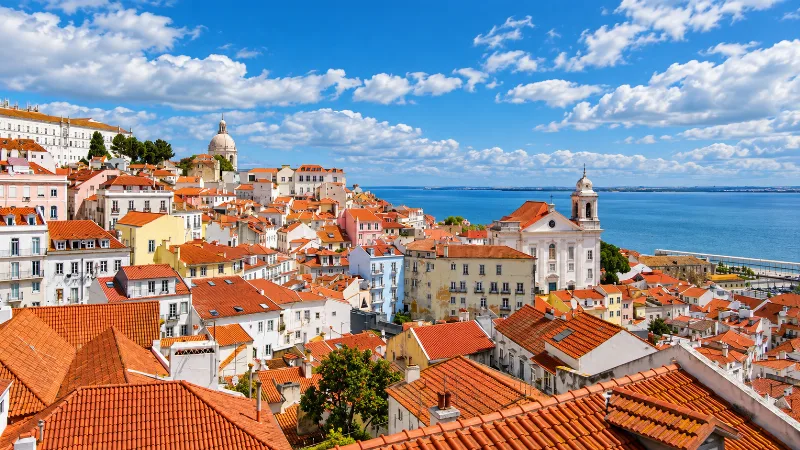
Lisbon
Portugal’s capital combines historic neighbourhoods, river views, tiled façades, viewpoints and an energetic everyday city life.
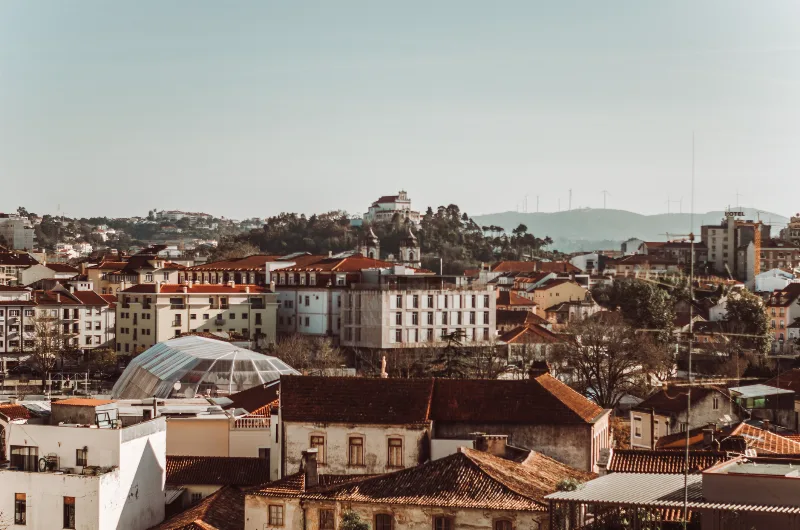
Leiria
Leiria is a central Portuguese city built around a hilltop castle above the River Lis, with a compact historic centre, a long paper-making tradition and a pine forest stretching towards the Atlantic.
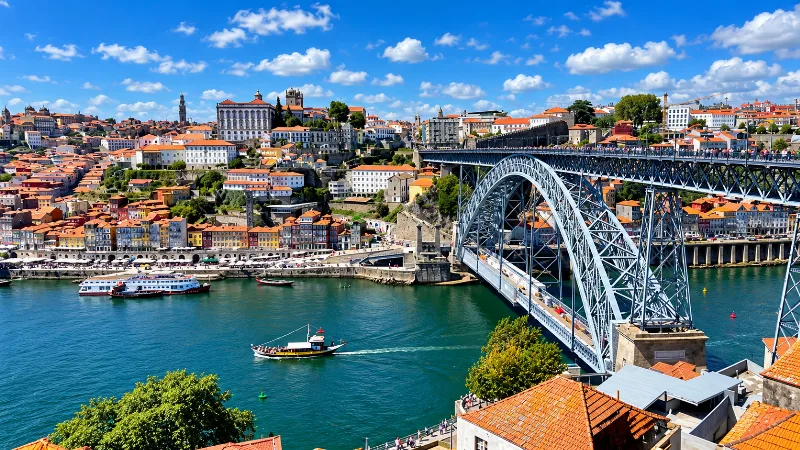
Porto
Porto is a compact northern city of steep streets, granite architecture, riverfront views, historic districts and strong local character.
Alcobaça Monastery and its Gothic Tombs
Founded by Portugal's first king and built over more than a century, the Cistercian monastery of Alcobaça shelters the country's most celebrated medieval tombs, carved for Pedro I and Inês de Castro.
Batalha Monastery and Manueline Architecture
Batalha Monastery in central Portugal was founded to commemorate a medieval victory and became a showcase of late Gothic ambition and Manueline stone carving.
Things to See in Leiria
Explore things to see in leiria with a practical guide to notable places, regional landscapes, local heritage and travel planning in Portugal.