
Leiria
Leiria is a central Portuguese city built around a hilltop castle above the River Lis, with a compact historic centre, a long paper-making tradition and a pine forest stretching towards the Atlantic.
Leiria is a city in the Centro region of Portugal, set in a shallow valley where the River Lis is joined by its tributary the Lena, about 20 kilometres inland from the Atlantic. It is the administrative centre of its district and of the wider Região de Leiria, and its skyline is still shaped by the hilltop castle that gave the settlement its early strategic importance.
Location and general character
The city occupies the floor of a broad basin bordered by low limestone hills. To the east the land rises towards the Serras de Aire e Candeeiros, while to the west it flattens into a coastal plain of farmland, pine woods and dunes before reaching the sea. The Lis runs through the middle of Leiria in a channel that has been straightened and embanked over the years, and the riverbanks are used for walking rather than navigation.
Leiria works mainly as a regional service centre. It has a hospital, secondary schools, a polytechnic institute, a municipal theatre and a busy retail core, and it draws people from the surrounding parishes and smaller towns for work, education and shopping. The city is moderately sized and its centre can be crossed on foot in about twenty minutes, though the suburbs spread well beyond the old limits.
History
The castle hill was fortified in the twelfth century, when Afonso Henriques took the site during the Christian advance southwards and encouraged settlement around it; a charter granting privileges to the town followed in the 1140s. Leiria's greatest political importance came later, under King Dinis, who at the end of the thirteenth century rebuilt the defences, added a royal palace within the walls and used the town as one of the residences of the court. The same king is traditionally credited with ordering the planting of the pine forest that still carries the town's name, a reserve of timber that became valuable for shipbuilding during the age of exploration.
Leiria was made a bishopric in 1545, which prompted the construction of a new cathedral. The earthquake of 1755 caused damage in the town and the cathedral was substantially rebuilt afterwards, so comparatively little medieval domestic architecture survives in the centre. In the nineteenth century Leiria was a quiet provincial town, and it was this setting that Eça de Queirós chose for O Crime do Padre Amaro, his satirical novel of provincial clerical life published in 1875. Industrial growth in the twentieth century, particularly in mould-making, plastics and glass in Leiria and neighbouring Marinha Grande, reshaped the local economy and pushed the built-up area well past the old walls.
Architecture and the castle
The castle stands on a rocky outcrop of limestone directly above the centre. Its circuit of walls encloses a keep, a Gothic royal palace with an arcaded loggia opening onto a courtyard, and the church of Nossa Senhora da Pena, which was remodelled in the sixteenth century. Parts of the complex were restored during the twentieth century, and the walls and towers can be walked. From the battlements the view takes in the whole valley, the rooftops of the lower town and the wooded hills to the west.
Below the hill, the historic centre is compact and mostly later in date than it looks. The Praça Francisco Rodrigues Lobo is the social heart of the city, lined with arcaded ground floors and café terraces. Nearby stand the Mannerist cathedral, rebuilt after the 1755 earthquake, the church of the Misericórdia and the former Convento de Santo Agostinho, now occupied by the municipal museum. The streets around them mix seventeenth- and eighteenth-century townhouses with later commercial buildings, and several façades carry tiled panels.
Natural surroundings
West of the city lies the Mata Nacional de Leiria, a national forest of maritime pines planted on sand dunes and long managed for timber and resin. Large areas of it burned in the fires of October 2017 and replanting has been under way since, so the woodland today is a patchwork of mature stands and young trees. Tracks through the forest connect the city with the coast, and the beaches at São Pedro de Moel, Praia da Vieira and Pedrógão are within easy reach by road.
Inland, the limestone uplands of the Serras de Aire e Candeeiros offer a different landscape of dry valleys, caves, olive groves and low scrub, with walking routes and viewpoints. The climate is Mediterranean with a strong Atlantic influence: winters are mild and wet, summers warm and dry, and sea mist sometimes reaches the city in the mornings.
Local culture and everyday life
Daily life in Leiria revolves around the market, the café terraces and the riverside walks. The municipal market sells produce from the surrounding farms, including fruit, vegetables, maize, wine and cheese, and the weekly rhythm of trading still sets the tone of the centre. Seasonal events include a medieval fair staged beneath the castle walls, concerts and theatre at the municipal auditorium, and religious processions that draw crowds from the rural parishes.
The city has a literary streak: the poet Afonso Lopes Vieira was born here in 1878 and the municipal library bears his name. Leiria is also a student town, with a polytechnic whose schools are spread across the district, and its industrial tradition in moulds and plastics has produced a specialist technical culture that is unusual for a city of this size.
Notable places
Beyond the castle and cathedral, several smaller sites repay a visit. The Moinho de Papel, a restored paper mill on the Lis, illustrates a trade documented in Leiria from the fifteenth century and once central to the town's economy. The baroque sanctuary of Senhora da Encarnação stands on the hill opposite the castle, reached by a flight of steps and giving a reciprocal view of the fortress. The Jardim Luís de Camões provides a shaded public garden close to the centre, and the riverside paths along the Lis are used year-round by walkers and cyclists.
Nearby destinations
Leiria makes a practical base for the surrounding region. The monastery of Batalha, a UNESCO World Heritage Site, is about 14 kilometres to the south, and the sanctuary at Fátima lies roughly 20 kilometres to the east. The Cistercian abbey at Alcobaça and the coastal town of Nazaré, known for its high winter waves, are both around half an hour away by car. Marinha Grande, with its glass industry, sits about 12 kilometres west at the edge of the pine forest, and the castle town of Porto de Mós lies to the south-east. Coimbra is about 65 kilometres to the north-east and Lisbon roughly 130 kilometres to the south, both reachable by motorway and by rail.
Related content
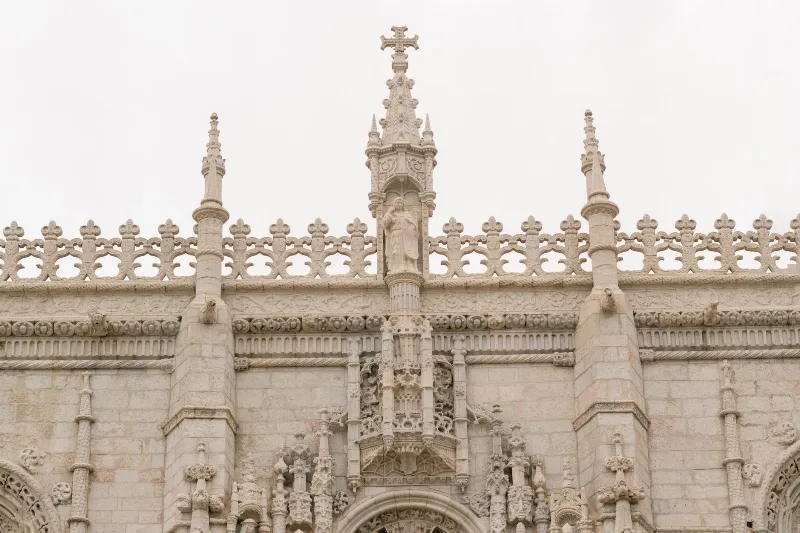
Alcobaça
A small town in central Portugal that grew up around one of Europe's best-preserved Cistercian abbeys, with a medieval monastic complex at its heart and a valley of orchards beyond it.
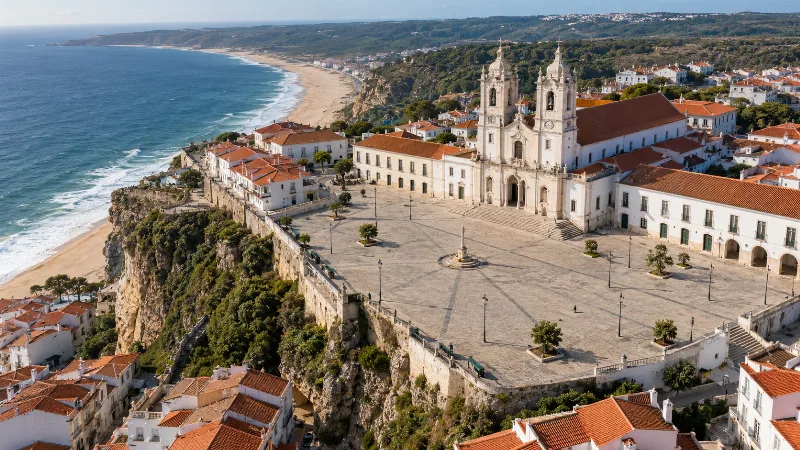
Nazaré
Nazaré is an Atlantic fishing town known for its broad beach, clifftop Sítio district, maritime traditions and the large winter waves at Praia do Norte.
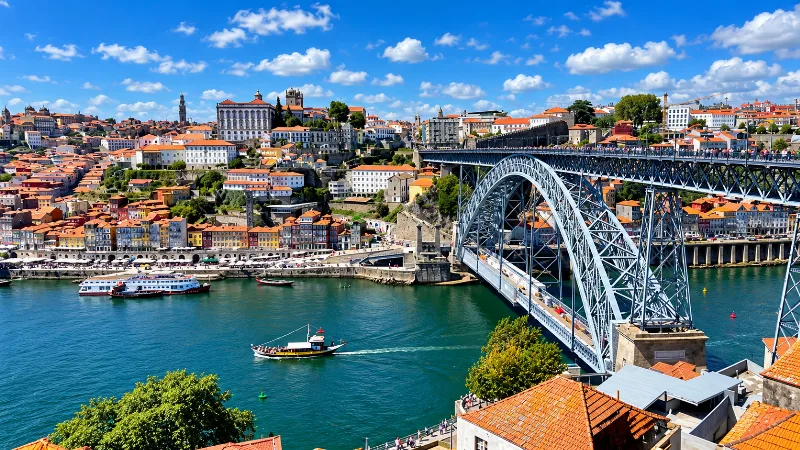
Porto
Porto is a compact northern city of steep streets, granite architecture, riverfront views, historic districts and strong local character.
Alcobaça Monastery and its Gothic Tombs
Founded by Portugal's first king and built over more than a century, the Cistercian monastery of Alcobaça shelters the country's most celebrated medieval tombs, carved for Pedro I and Inês de Castro.
Batalha Monastery and Manueline Architecture
Batalha Monastery in central Portugal was founded to commemorate a medieval victory and became a showcase of late Gothic ambition and Manueline stone carving.
Nazaré's Sítio Cliff and Fishing Quarter
Nazaré is built on two levels: a working fishing quarter beside the Atlantic and, high above it, the clifftop district of Sítio with its sanctuary, viewpoints and long sea views.