
Angra do Heroísmo
Angra do Heroísmo wraps around a sheltered bay on Terceira, where a UNESCO-listed street plan, baroque churches and a hilltop fortress record five centuries of Atlantic trade and island life.
Angra do Heroísmo sits on the south coast of Terceira, in the central group of the Azores, wrapped around a bay that early navigators found unusually well protected. Its central zone has been on the UNESCO World Heritage List since 1983, and the city remains the island's administrative, ecclesiastical and cultural centre, with a working port, a permanent resident population and a street pattern largely fixed in the sixteenth century.
Location and general character
The municipality covers 239 square kilometres and holds around 34,000 people, making it the largest concelho in the archipelago by area and the second most populous. It occupies the western part of Terceira, while the city itself is formed by a cluster of central parishes gathered behind the waterfront. Two inlets, the bay of Angra to the east and the bay of Fanal to the west, are separated by the wooded peninsula of Monte Brasil; the name Angra comes from the cove that served as the original anchorage.
The town climbs a slope above the harbour, so streets run uphill from the quays and level out on the ridge behind. Hills to the north and west shield the bay from the prevailing westerly and north-westerly winds, a detail that shaped both the siting of the port and the alignment of its roads. The climate is mild and humid, with rain spread across most of the year and frequent changes of weather; summers are warm rather than hot, and winter gales are common.
History
Terceira was granted to Jácome de Bruges in the mid-fifteenth century and settled by a mixture of Portuguese and Flemish colonists. Angra grew quickly as a port, and in 1534 João III raised it to city status and made it the seat of the diocese of the Azores. For roughly three centuries it was a compulsory calling point for fleets returning from the Indies, Africa and Brazil, and Vasco da Gama is recorded as putting in during his homeward voyage of 1499. Customs offices for the India fleets were established there, and the town became a clearing house for goods, people and ideas crossing the Atlantic.
During the succession crisis of 1580, António, prior of Crato, based his short-lived government in Angra before Spanish forces secured the island in 1583. A Castilian garrison occupied the fortress on Monte Brasil until 1641, and the city's role in expelling it earned the title Sempre Leal from João IV. Later, the deposed Afonso VI was held in the same fortress between 1669 and 1684. From 1766 until 1832 Angra served as capital of the province of the Azores. In the civil war that followed, Terceira stayed loyal to Maria II, and the city's name gained the word Heroísmo by royal charter in 1837 in recognition of that stand.
A violent earthquake on 1 January 1980 damaged much of the town. Reconstruction kept the original street grid and restored or rebuilt façades in keeping with what had stood before, which is why the centre still reads as a coherent historic whole.
Architecture
The street plan is the city's most distinctive feature: an orthogonal layout of the kind used for new towns elsewhere in the Portuguese world, but here rotated so that the main axes deflect to cope with the dominant winds. Along these streets stand two- and three-storey houses with deep eaves, tiled roofs and painted wooden balconies, often in ochre, blue or pink, many of them hinting at Brazilian building habits picked up through Atlantic exchange.
Religious architecture dominates the skyline. The cathedral, rebuilt over centuries from a sixteenth-century original, is the largest church in the archipelago; nearby are the Misericórdia and the church of the former Jesuit college, both with carved and gilded altarpieces and walls of azulejo tiles. Civic buildings include the town hall on the main square and the Palace of the Captains-General, once a Jesuit residence and now the seat of the Representative of the Republic for the Azores. The Duke of Terceira Garden, the Bettencourt Palace and the obelisk on Alto da Memória, raised to commemorate Pedro IV's landing, complete the set of monuments that define the centre.
Defensive works frame the bay. The fortress of São Sebastião closes the eastern side of the harbour, while the vast Fortress of São João Baptista, begun in the 1560s as São Filipe, stretches across Monte Brasil with walls, gates and moats enclosing much of the peninsula.
Natural surroundings
Monte Brasil is the remnant of a volcanic cone, rising to around 200 metres and now covered by a forest park with trails, viewpoints and introduced as well as native trees. From its summit the two bays, the quays and the whole historic centre are visible at once. The coastline on either side is rocky, with basalt cliffs and small coves; the fishing parishes of São Mateus da Calheta and Cinco Ribeiras have tidal pools used for swimming, and the Ilhéus das Cabras, a pair of islets offshore, are important for nesting seabirds.
Inland, the municipality reaches the Guilherme Moniz caldera and two protected geological sites: the Algar do Carvão, a lava chimney that can be descended to a chamber with silica stalactites and a rainwater pool, and the Furnas do Enxofre, a field of steaming fumaroles and sulphur vents. The Serra de Santa Bárbara, at 1,021 metres the island's highest ground, holds a reserve of laurissilva woodland and bogs, and much of the interior is pasture divided by hedges, with hydrangeas flowering along the lanes in summer.
Local culture and everyday life
Everyday life on Terceira is closely tied to the Holy Spirit tradition. Small chapels known as impérios, painted in bright colours, are maintained by local brotherhoods and open for the Pentecost festivals, when neighbours share soup, sweet bread and wine. The Sanjoaninas, held each June and documented since the sixteenth century, are the largest popular festivities in the Azores: a parade and the procession of a festival queen open several days of concerts, ethnographic displays and a bull fair.
Bullrunning is a constant presence. In the tourada à corda, a bull is led on a long rope through a village street while onlookers test their nerve and take cover behind walls; these events run from spring to autumn across the island, alongside Portuguese-style bullfights in the Angra arena. Carnival dances, philharmonic bands and religious processions fill the calendar at other times of year.
Work in the municipality is concentrated in public administration and services, dairy farming, fishing and tourism, and a campus of the University of the Azores is based in the city. Family ties to the United States and Canada are strong, and summer brings many visitors of Azorean descent. On the table, expect alcatra cooked slowly in a clay pot, grilled limpets, octopus stews, island cheese and butter, and the Dona Amélia cakes and sweet bread sold in local bakeries.
Notable places
Within the historic centre, the Angra Museum occupies the former Convent of São Francisco and covers the island's social and religious history, while the Cathedral, the Misericórdia and the Church of São Gonçalo show the range of baroque woodwork and tilework to be found locally. The waterfront, with its marina and the small Prainha quay, is the natural starting point for a walk up through the shopping streets to the main square.
Above the town, the viewpoint at Alto da Memória gives a compact view of the grid, and Monte Brasil offers longer walks through the fortress and the forest, with marked paths and picnic areas. The city's small forts and redoubts, several of them now public spaces, are reminders of a time when the harbour was one of the most heavily defended anchorages in the Atlantic.
Nearby destinations
Praia da Vitória, about twenty kilometres east, is Terceira's second city and shares the island's civil airport at Lajes. It has a long sandy bay and a historic centre of its own, and ferries from its port link Terceira with São Jorge, Graciosa, Pico and Faial. On the north coast, Biscoitos is known for natural swimming pools formed in lava rock and for its small vineyards and wine museum. Inland, the viewpoint over the Serra do Cume looks down on a patchwork of stone-walled fields inside an old caldera, and the western parishes lead towards the Serreta forest and the upper slopes of Santa Bárbara, where walking trails cross some of the island's wildest ground.
Related content
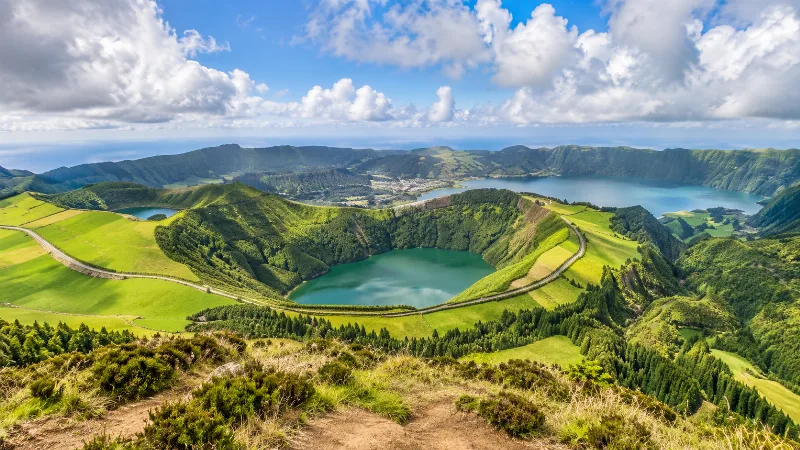
Azores
Discover the Azores through volcanic islands, crater lakes, green landscapes, Atlantic coastlines, hiking, wildlife and distinctive island communities.
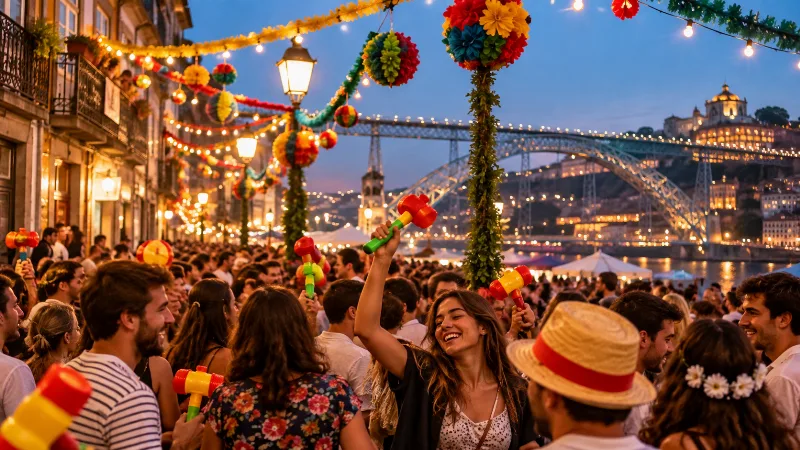
São João
São João is Porto’s major midsummer celebration, filling the city with street gatherings, music, decorations, food, fireworks and long-standing local traditions.
Angra do Heroísmo Historic Centre and its Bay Defences
Angra do Heroísmo on Terceira combines a grid of basalt-and-whitewashed streets with a ring of fortresses built to guard one of the Atlantic's most useful anchorages.
Horta
Horta, the main town of Faial in the Azores, is built around a sheltered bay that has served whalers, cable engineers and Atlantic sailors. Its compact centre, painted harbour wall and volcanic hinterland make it one of the central group's most distinctive ports.
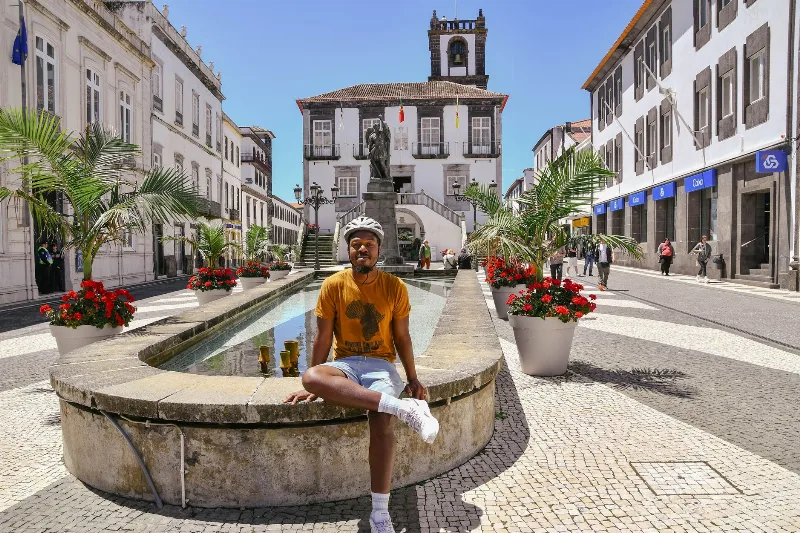
Ponta Delgada
The Azores' largest city spreads across a basalt terrace above a south-facing bay on São Miguel. This guide covers its harbour history, religious architecture, festivals and the volcanic hills that surround it.
Berlengas Archipelago Cliffs and Fortress
The Berlengas archipelago off Peniche combines granite cliffs, important seabird colonies and the historic Fortress of São João Baptista in a protected Atlantic setting.