
Caldas da Rainha
A guide to Caldas da Rainha, the Oeste town built around a fifteenth-century thermal hospital, known for its ceramics workshops, its daily fruit market and its position between the hills and the Atlantic coast.
Caldas da Rainha lies in the Oeste, the western strip of central Portugal that runs between the limestone hills and the Atlantic. It stands about 90 kilometres north of Lisbon and a short drive inland from the sea, in the district of Leiria. The name translates as 'the Queen's hot springs', and the town grew around a royal bathing hospital founded at the end of the fifteenth century. It remains a working administrative and market town rather than a resort: a place of pottery workshops, tiled cafés and a produce market that has occupied the same square since the 1400s.
Location and general character
The town sits in a shallow basin on the river Arnóia, surrounded by low hills and farmland that belongs to the Oeste's market-garden belt. Its historic core is compact, arranged around the thermal hospital and the adjoining square, with newer residential districts spreading north and east towards the railway and the A8 motorway. The Linha do Oeste reached the town in 1887 and still connects it with Lisbon, while the motorway has put the capital at roughly an hour's drive.
Caldas serves a wide rural municipality made up of small parishes, so its streets carry a mix of shoppers, commuters and people attending the hospital, the schools and the courts. The climate is Atlantic-tempered: mild, damp winters, warm dry summers, and a wind that arrives, often strongly, off the sea.
History
According to local tradition, Queen Leonor, wife of King João II, passed this way in 1484 and saw labourers bathing in warm, foul-smelling water. They told her the springs cured ailments, and after bathing herself she is said to have recovered from a long-standing wound. She ordered baths and a hospital for ordinary patients, and the Hospital de Nossa Senhora do Pópulo was founded in 1485. It is generally described as the oldest purpose-built thermal hospital still in something close to continuous use. A settlement formed around it and took its name from the springs and the queen.
Royal patronage continued for centuries. The sixteenth century brought an aqueduct to feed the baths and a church attached to the hospital, and further building followed under João V in the eighteenth century. The town's real expansion came in the 1800s, when spa holidays became fashionable among the Portuguese nobility and upper classes, and again in the early twentieth century, when the hospital administrator Rodrigo Berquó reorganised the grounds and the bathing establishment. The railway, small industry and a growing middle class turned Caldas into a city with an unusually rich cultural life for its size. During the Second World War it also became a place of refuge for foreigners fleeing persecution.
Architecture
The thermal complex is the town's architectural anchor. The Church of Nossa Senhora do Pópulo, rebuilt in the sixteenth century, pairs a Manueline doorway with a nave lined in patterned azulejos, and the adjoining Casa Real, now the Museum of the Hospital and of Caldas, preserves rooms, medical instruments, paintings, silver and ceramics connected with five centuries of treatment. Behind it lies the Parque D. Carlos I, a romantic garden laid out around the hospital with a boating lake and island, a bandstand, a small greenhouse and rows of mature plane trees.
Within the park stands the Museu José Malhoa, opened in the early twentieth century and often cited as the first building in Portugal designed specifically as a museum; it holds the naturalist painter's canvases along with sculpture and ceramics. Further north, the Ceramics Museum occupies a late nineteenth-century romantic villa. Elsewhere the centre is a mixture of tiled shopfronts, wrought-iron balconies and a handful of Art Nouveau houses from the spa's Edwardian heyday, alongside plainer concrete work from later decades. Public sculpture plays an unusually large part in the streetscape: a ceramic water garden and life-size figures on the Rota Bordaliana walking route put clay, the town's defining material, directly onto the pavement.
Natural surroundings
West of the town the land flattens into orchards, gardens and smallholdings, the source of much of the produce sold each morning in the square. Pears, apples, cabbages and soft fruit are grown in quantity, and the wider region carries extensive pine and eucalyptus woods. A quarter of an hour away the Óbidos Lagoon opens towards the sea between reed beds, dunes and the low cliffs at Foz do Arelho. South-east of Caldas rises the limestone ridge of the Serra de Montejunto, a protected area of crags, oak scrub, windmills and the ruins of a royal ice factory built to supply Lisbon.
Local culture
Mornings in Caldas revolve around the Praça da República, known to everyone as the Praça da Fruta. Stalls of fruit, vegetables, flowers, cheese and bread are set out every day of the year, which makes it the only daily open-air market in the country; it is busiest before nine and largely packed away by early afternoon. The market has a practical origin, since the diet prescribed to spa patients was heavy in fresh produce, and the surrounding farmland supplied it.
Ceramics are the other constant. Local clay and the hospital's demand for domestic ware encouraged potteries from the sixteenth century onwards, and in 1884 the caricaturist Rafael Bordalo Pinheiro founded a factory that carried the town's name abroad. His cabbage-leaf tableware, modelled frogs, lizards and crabs, and the figure of Zé Povinho, the sardonic everyman of Portuguese cartooning, are still produced and collected. A parallel tradition of bluntly humorous novelty pottery is sold openly in shops and on stalls. The town belongs to the UNESCO Creative Cities Network for crafts and folk art, holds an annual ceramics fair, and its arts and design school trains designers from across the country. Sweet specialities are conventual in origin and egg-based: cavacas, crisp glazed puffs, along with trouxas and beijinhos.
Notable places
- Praça da República – the market square, ringed by cafés and arcaded shopfronts, and the best place to watch ordinary town life.
- Parque D. Carlos I – the central garden, with its lake, bandstand and shaded paths around the hospital.
- Museu José Malhoa – paintings and sculpture by the naturalist painter born in the town, in a purpose-built gallery.
- Museu da Cerâmica – a villa collection tracing local and national pottery, with particular strength in Bordalo Pinheiro's work.
- Museu do Hospital e das Caldas – the Casa Real, documenting the spa's history and its royal foundation.
- Bordallo Pinheiro factory and Casa Museu São Rafael – working potteries and a small museum of historic pieces on the town's northern edge.
- Rota Bordaliana – oversized ceramic animals, plants and figures installed across the centre.
Nearby destinations
Óbidos, a medieval town still enclosed by its walls and aqueduct, lies about ten kilometres south and is easily reached by bus or car. Alcobaça, with its vast Cistercian abbey, is roughly half an hour north-east, and Nazaré, with its clifftop viewpoint over the Atlantic surf, is a little further on the same road. Peniche, a fishing port and the departure point for the Berlengas islands, sits on the coast to the west, while the salt pans at Rio Maior, still worked by hand, make an unusual inland detour. Lisbon is close enough for a day trip, but the Oeste itself rewards slower travel: walled towns, lagoon beaches, pine woods and pottery villages follow one another within a short radius of Caldas da Rainha.
Related content
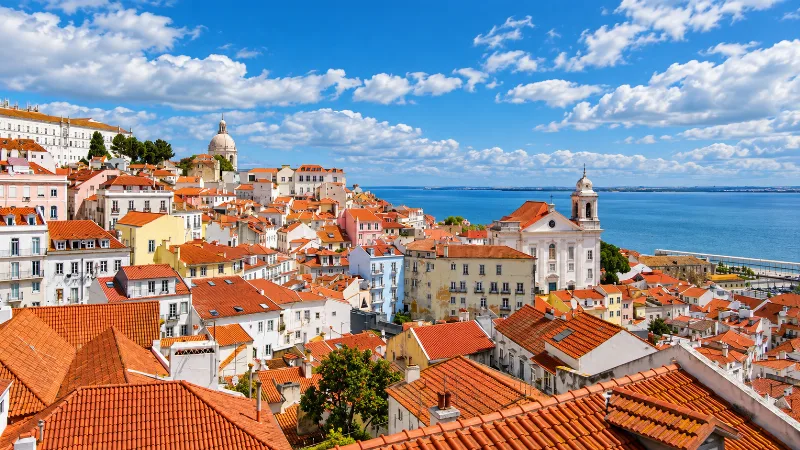
Lisbon
Portugal’s capital combines historic neighbourhoods, river views, tiled façades, viewpoints and an energetic everyday city life.
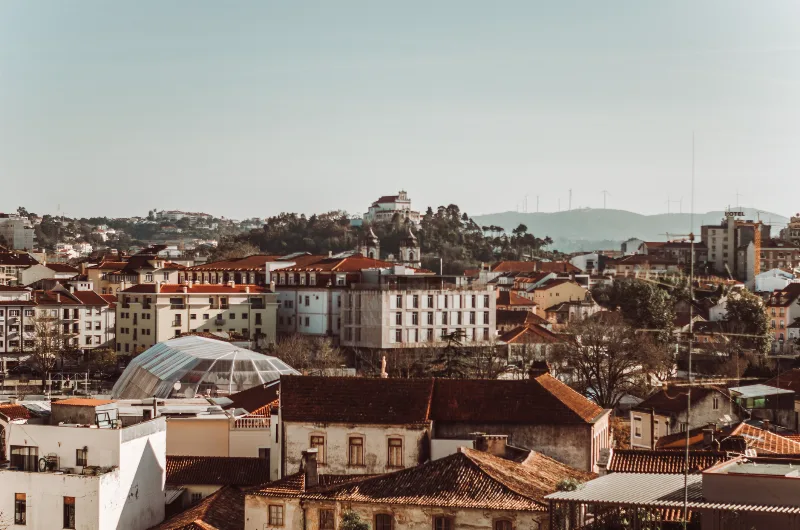
Leiria
Leiria is a central Portuguese city built around a hilltop castle above the River Lis, with a compact historic centre, a long paper-making tradition and a pine forest stretching towards the Atlantic.
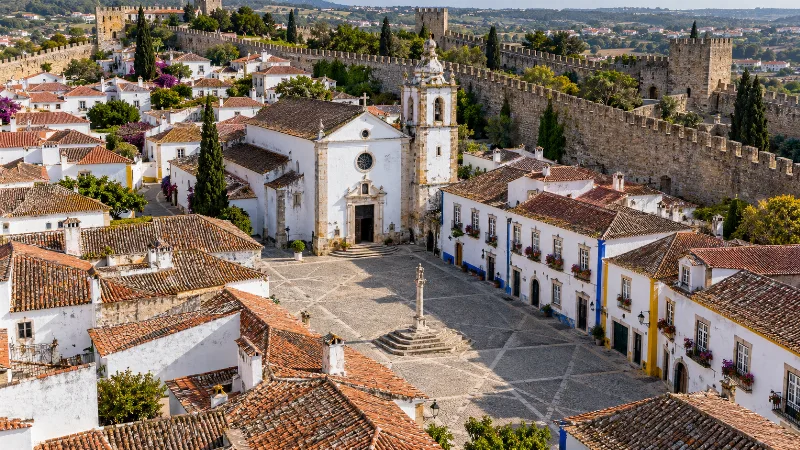
Óbidos
Óbidos is a walled hilltop town with cobbled lanes, whitewashed houses, a medieval castle and views across the surrounding countryside.
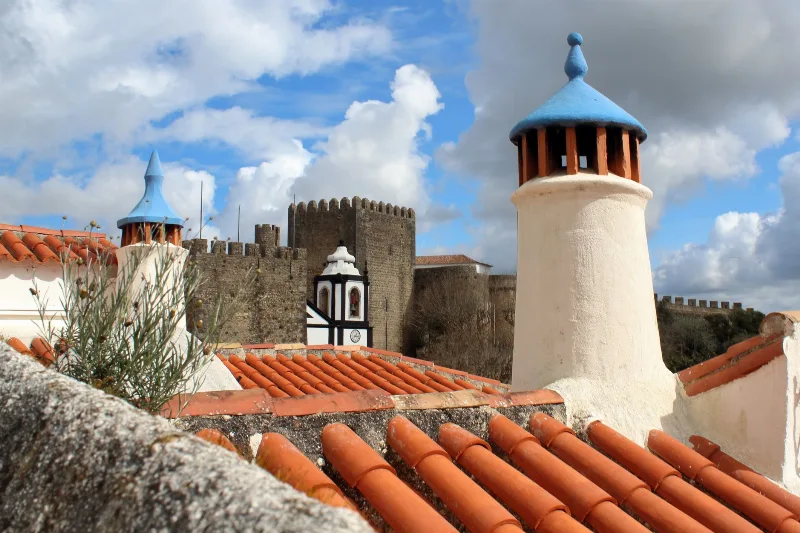
Óbidos
Óbidos is a small walled town in Portugal's Oeste region, built inside an intact medieval circuit of walls around a hilltop castle. Its streets, churches and sour-cherry liqueur tradition make it one of the country's most distinctive historic centres.
Lagoa de Óbidos and its Atlantic Sandbar
A shallow coastal lagoon in western Portugal, Lagoa de Óbidos is defined by the sandbar that separates it from the Atlantic and by the tidal rhythms that continually reshape it.
Alcobaça
A small town in central Portugal that grew up around one of Europe's best-preserved Cistercian abbeys, with a medieval monastic complex at its heart and a valley of orchards beyond it.