
Estremoz
Estremoz is a marble town in the Alto Alentejo, built around a medieval castle and a broad market square. Its whitewashed streets, clay-figure workshops and the cork oak country around it make it one of the most distinctive stops in inland Portugal.
Estremoz is a hill town in the Alto Alentejo, in the district of Évora, and one of the three places – with Borba and Vila Viçosa – at the centre of the Portuguese marble industry. The municipality covers a little over 500 square kilometres and had roughly 14,000 inhabitants at the last published census. Most of that land is olive grove, cork oak montado and open cereal plain; the town itself stands on a ridge of limestone, its houses gathered below a castle whose keep is built of white marble.
A town on two levels
The historic core divides into an upper, walled settlement around the castle and a lower town of shops and services that spreads along the slope and out towards the plain. The two are linked by steep, narrow streets that climb past churches and the houses of former noble families to the gates of the old enceinte. Below them, the Rossio Marquês de Pombal forms the civic heart: a very large, gently sloping square, paved with Portuguese cobbles and framed by arcaded buildings, cafés and the town hall. It has served in its time as a parade ground, a fairground and a burial place – a medieval cemetery was found beneath it – and it is now given over to parking, processions and the weekly market. Because Estremoz grew as an administrative and trading centre for a wide rural hinterland, its streets contain more public and institutional buildings than its size would suggest.
From frontier stronghold to royal seat
The castle has a pentagonal wall fitted to the rock beneath it, entered by two medieval gates: the Porta do Sol, also called the Porta da Frandina, and the Porta de Santarém, above which an inscription records the start of building work in the reign of Afonso III. The keep rises about 27 metres in three storeys to a battlemented terrace; because it was raised across the reigns of Afonso III, Dinis and Afonso IV it is known as the Torre das Três Coroas, the Tower of the Three Crowns. In the alcáçova beside it lived Isabel of Aragon, wife of Dinis, who died there in 1336. For a few decades the town was one of the political centres of the kingdom, and João I held a Cortes here in 1416.
Estremoz remained a military place. It was a base for Nuno Álvares Pereira before the Battle of Atoleiros in 1384, and during the Restoration War of the seventeenth century it acted as a rear base for the Alentejo army, with the Battle of Ameixial fought nearby in 1663. A second line of bastioned walls with monumental gates was built from the late seventeenth century onwards to protect the garrison town, and much of it still stands. In 1698 an explosion in the castle magazine destroyed most of the interior; the old palace was rebuilt under João V as a military store. The castle was classified as a national monument in 1910, the palace buildings now house a state-run pousada, and the keep can be climbed for a view that reaches the Serra da Estrela on clear days.
Whitewash, marble and civic architecture
Marble is used here as an everyday material rather than a luxury, appearing in door and window surrounds, thresholds, steps, benches, kerbstones and shop fronts, usually set against whitewashed walls. Inside the walls, the church of Santa Maria, the town's matriz, keeps marble retables and a nave lined with azulejos. Just outside them, the church and convent of São Francisco, with a Manueline cross standing before it, passed to the army after the religious orders were suppressed in 1834, and a cavalry regiment has been quartered there for most of the period since. The Convento das Maltesas and the Convento dos Congregados survive as teaching and cultural buildings. Among the secular buildings are the eighteenth-century Palácio dos Marqueses da Praia e Monforte, the Palácio Tocha and the small, richly decorated Teatro Bernardim Ribeiro, designed by Ernesto da Maia and opened in 1922.
The plain, the olive groves and the Serra de Ossa
North of the town the land stretches away in a wide, almost flat peneplain, broken by the low limestone and dolomite ridges that run north-west towards Sousel. To the south it rises into the Serra de Ossa, a band of schist hills that reaches about 650 metres at Alto de São Gens and is largely covered with eucalyptus and dense cork oak. The main watershed between the Tagus and the Guadiana crosses the municipality: the Ribeira de Tera drains northwards, the Ribeira da Pardiela to the south. Between them lie the landscapes that shape local farming – holm oak montado, olive groves, stone-walled fields and stretches of cereal cultivation that support farmland birds. The Veiros reservoir, created in the early 2010s on the Ribeira de Ana Loura, now stores water for irrigation in the east of the municipality.
Clay figures, markets and the working year
Estremoz is best known for its bonecos, painted clay figures modelled by hand since the seventeenth century, which traditionally show shepherds, traders, saints and scenes of Alentejo life. In December 2017 the craft was inscribed on the UNESCO Representative List of the Intangible Cultural Heritage of Humanity. The municipal museum, named after Joaquim Vermelho, holds a large collection, an interpretive centre in the Palácio dos Marqueses da Praia e Monforte explains how the figures are modelled and painted, and several workshops still produce and sell them.
The Saturday market on the Rossio mixes vegetables, cheese and cured sausage with antiques, hand-painted furniture and objects cut from local marble, and it draws buyers from across the region. The town's main festivities, in honour of the Exaltação da Santa Cruz, take place in September, while an agricultural and craft fair is held in late April at the exhibition park outside the centre. Local philharmonic bands and choirs, together with the parish associations of the surrounding villages, keep a busy calendar of processions and concerts. Employment rests on quarrying and sawing marble, on cork and olive oil, on wine and on the public services that make Estremoz a service centre for the north of the district. The Alentejo kitchen prevails in its restaurants and tascas: migas, açorda, pork dishes, sheep's cheese, olives and the robust wines of the region.
Notable places
- The castle and keep – the marble Torre das Três Coroas, the battlemented walls and the Porta do Sol, with the old royal palace alongside.
- The Rossio Marquês de Pombal – the great sloping square, its bandstand of 1888 and the arcaded streets that surround it.
- Igreja de Santa Maria – the parish church inside the walls, with marble work and tiled interiors.
- Convento e Igreja de São Francisco – Gothic and Manueline elements, the Capela de D. Fradique and the cross in the forecourt.
- Museu Municipal Professor Joaquim Vermelho – the municipal museum, strong on local clay figures and archaeology.
- Teatro Bernardim Ribeiro – a restored early twentieth-century theatre used for film, music and drama.
- Lago do Gadanha – a small ornamental lake and garden below the walls, used as a public promenade.
Nearby destinations
Within the municipality, Évoramonte is a hilltop village whose castle was restored in the twentieth century and where the concession ending the Liberal Wars was signed in 1834; Veiros, further east, has a smaller castle, a pelourinho and a parish church of interest. Beyond the municipal boundary, Borba and Vila Viçosa continue the marble country, the latter with its vast Paço Ducal and walled gardens. Évora, the regional capital, lies about 45 kilometres to the south-west, and Elvas, with its aqueduct and star-shaped fortifications, roughly 40 kilometres to the east near the Spanish border. Redondo, Arraiolos, with its long tradition of embroidery, and the hilltop village of Monsaraz are all within easy reach, as is the Guadiana valley around the Alqueva reservoir.
Related content
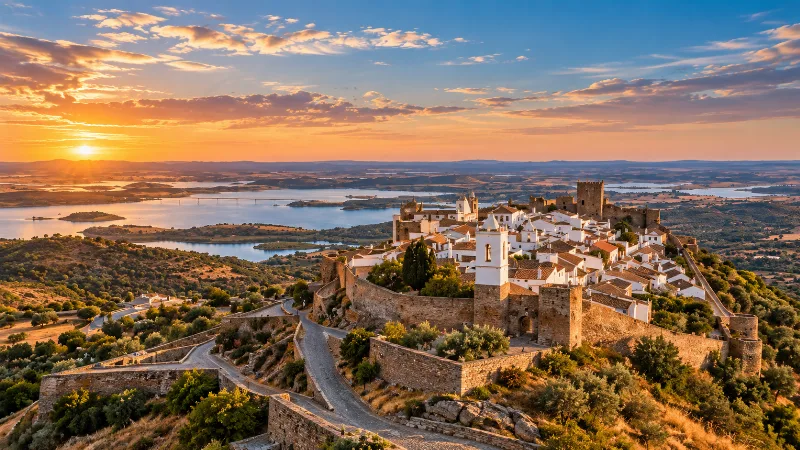
Alentejo
Discover Alentejo through Évora, whitewashed towns, cork-oak landscapes, vineyards, regional food and the broad rural interior of southern Portugal.
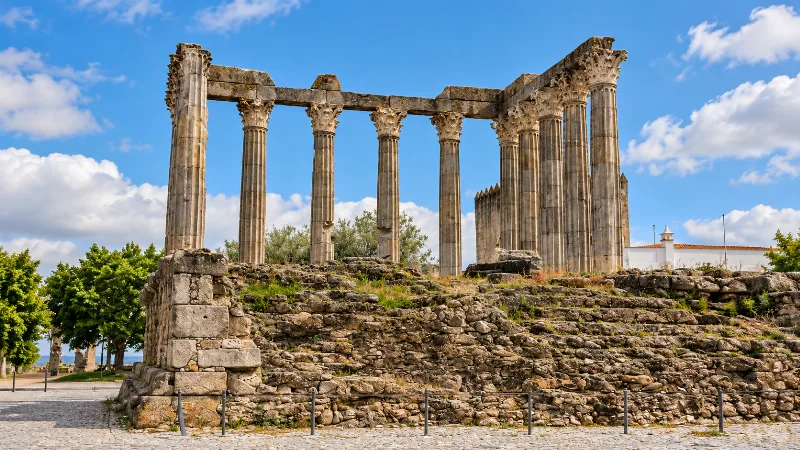
Évora
Évora is a historic Alentejo city of Roman remains, whitewashed streets, medieval walls, churches and a slower inland Portuguese rhythm.
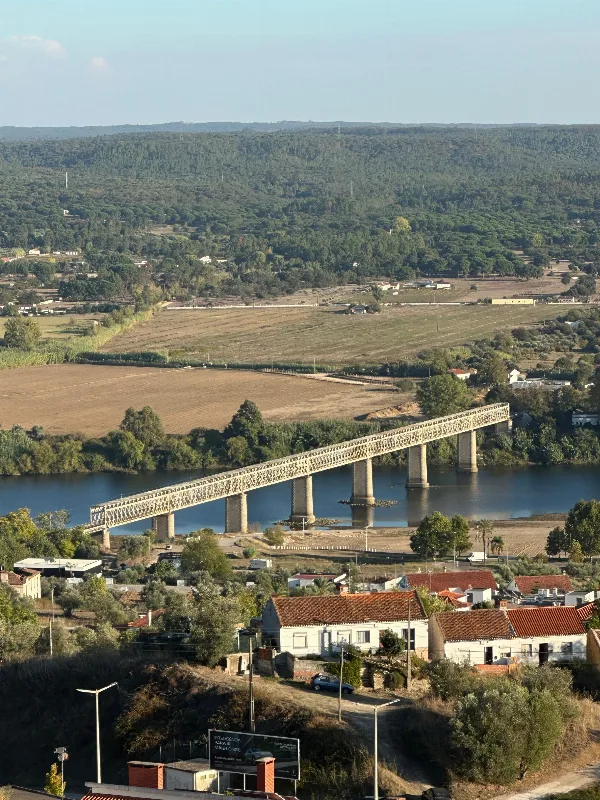
Santarém
A Ribatejo town set on a plateau above the River Tagus, Santarém is known for its cluster of Gothic churches, its medieval street plan and its long relationship with the farmland below.
Estremoz Marble Quarries and the Medieval Castle
Estremoz is a hilltop town in northern Alentejo where pale marble quarries, a medieval castle and a stone-paved old centre shape everyday life.
The Cork Oak Woodlands of Alentejo
The cork oak woodlands of Alentejo form a distinctive Portuguese landscape known as the montado, where trees, grazing animals and a nine-year cycle of bark harvesting have shaped the land for centuries.