
Estremoz Marble Quarries and the Medieval Castle
Estremoz is a hilltop town in northern Alentejo where pale marble quarries, a medieval castle and a stone-paved old centre shape everyday life.
Estremoz rises on a low hill above the rolling plains of northern Alentejo, in the district of Évora, roughly halfway between the city of Évora and the Spanish frontier. Its character comes from two elements that are hard to separate: the pale marble lying beneath the surrounding fields, and the medieval castle that still crowns the summit. Together they give the town a distinct identity among the whitewashed settlements of southern Portugal.
Marble country
Estremoz sits at the heart of a marble belt that runs through this corner of the Alentejo towards Vila Viçosa and Borba. Stone has been extracted here since Roman times, and quarrying remains part of the local economy and landscape. The marble appears in several tones — bright white, warm cream, soft pink and grey-veined varieties — and it is worked both in large open quarries and in smaller yards on the edge of town.
What sets Estremoz apart is the way the stone is used. In most places marble is reserved for churches and monuments; here it turns up in ordinary settings. Pavements, kerbstones, doorsteps, windowsills, public benches, fountains, garden walls and the plinths of street signs are all cut from local marble. Walking through the older streets gives the impression of a town quietly furnished from the ground beneath it.
The medieval castle and its keep
The fortress occupies the highest ground in the town, a position that made it part of a chain of strongholds guarding the eastern Alentejo during the medieval Kingdom of Portugal. Its walls, gates and battlements remain largely intact, and the tall keep — the torre de menagem — is visible from far out across the plain. The keep is pierced by Gothic openings and topped by a terrace that opens wide views over the town's roofs, the olive groves and the quarries beyond.
Estremoz Castle is closely associated with Queen Isabel of Aragon, wife of King Dinis, who spent periods in the town and died within the castle walls in 1336. The royal connection gave the small settlement a standing well beyond its size, and the building has remained a public monument at the centre of local life.
Streets, squares and churches
The old town spills down from the castle through steep, narrow lanes lined with whitewashed houses trimmed in blue, yellow or grey. The Largo do Rossio forms the main square, arcaded on several sides with columns of local marble, and it works as the town's shared living room throughout the day. Close to the castle gate stands the church of Santa Maria, and several former convents and chapels are scattered through the upper streets, a few of them holding tiled panels and gilded altarpieces.
The lower town, with its shops and cafés, connects the historic core to the modern roads that cross the plain. The contrast between the dense, shadowed medieval lanes and the open squares below is one of the pleasures of a visit.
The countryside around Estremoz
The land beyond the town is typical Alentejo: olive groves in long grey-green rows, cork oak montado, vineyards, wheat fields and low wooded hills to the south-west. Quarries show up in this landscape as stepped, terraced cuttings with pale vertical faces, some of them filled with still, greenish water. Quiet country roads make the area pleasant for walking and cycling, and the views back towards the town from the surrounding fields show the castle and the marble-coloured edges of the streets in a single frame.
Clay figures and marble workshops
Estremoz is known for the bonecos de Estremoz, hand-modelled clay figures inscribed by UNESCO in 2017 on the Representative List of the Intangible Cultural Heritage of Humanity. Made from local clay, shaped and painted by hand, they depict shepherds, saints, market scenes and nativity groups, and the tradition continues in small workshops around the town.
Alongside them, marble workshops produce fireplaces, tables, sculpture and restoration work, and the route linking quarries, yards and the historic centre has become a way of understanding how the town's stone has shaped both its buildings and its livelihood.
Related content
Estremoz
Estremoz is a marble town in the Alto Alentejo, built around a medieval castle and a broad market square. Its whitewashed streets, clay-figure workshops and the cork oak country around it make it one of the most distinctive stops in inland Portugal.
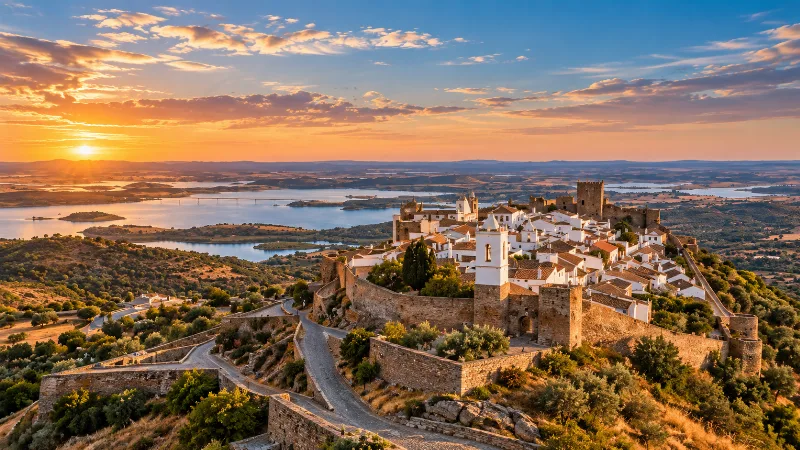
Alentejo
Discover Alentejo through Évora, whitewashed towns, cork-oak landscapes, vineyards, regional food and the broad rural interior of southern Portugal.
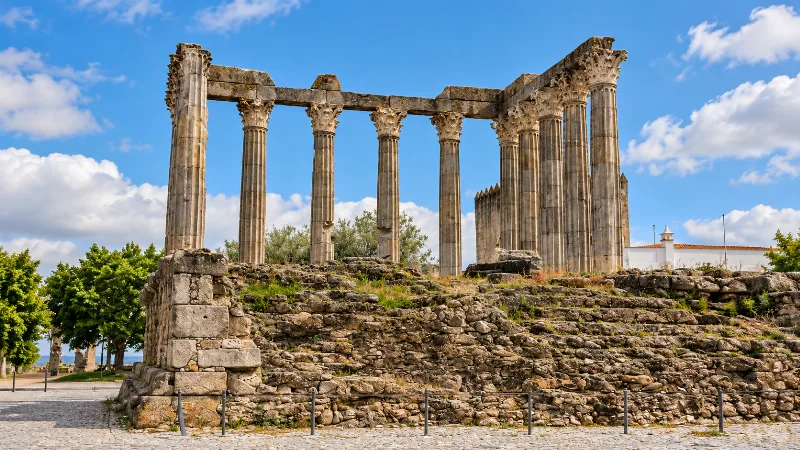
Évora
Évora is a historic Alentejo city of Roman remains, whitewashed streets, medieval walls, churches and a slower inland Portuguese rhythm.
Elvas
A hill town in Portugal's Alto Alentejo, Elvas is defined by the star-shaped defences and the long Amoreira Aqueduct that together form a UNESCO World Heritage Site. Its walled centre still holds the churches, barracks and military buildings of a border garrison.
The Cork Oak Woodlands of Alentejo
The cork oak woodlands of Alentejo form a distinctive Portuguese landscape known as the montado, where trees, grazing animals and a nine-year cycle of bark harvesting have shaped the land for centuries.
Évora's Roman Temple and Historic Aqueduct
Évora's first-century Roman temple and its sixteenth-century aqueduct are two of the Alentejo's most enduring monuments. Together they show how a provincial city was built, supplied and defended across many centuries.
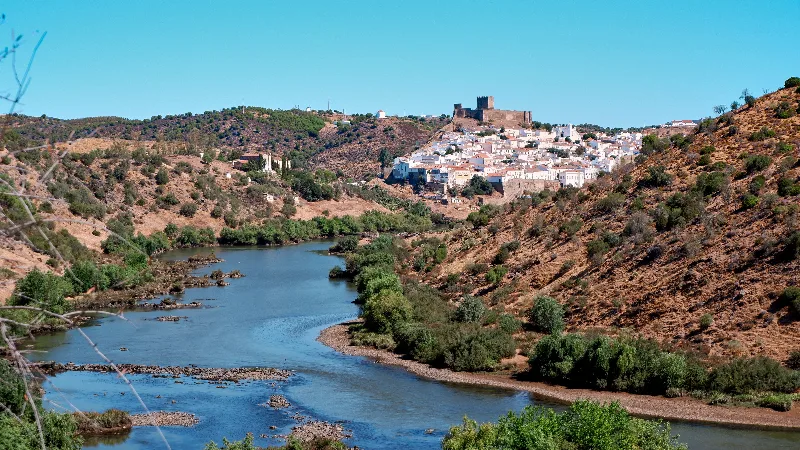
Beja
Beja is a hilltop city in the Baixo Alentejo, once the Roman town of Pax Julia, whose marble-grey castle keep rises above a plain of wheat, olive groves and cork oak. Its old convent now holds one of southern Portugal's richest regional museums.