
Monsaraz
A hilltop village in the Alto Alentejo, Monsaraz preserves its castle walls, medieval lanes and bullring above the Guadiana valley and the waters of Alqueva. The surrounding plain is rich in megalithic monuments.
Monsaraz is a small, fortified village in the Alto Alentejo, built along a granite ridge a short distance from the Spanish border. The walled upper town, the square tower of its castle and the whitewashed houses that step down towards the plain all face the Guadiana valley and the broad water of the Alqueva reservoir. Its streets are steep, narrow and often cobbled, and most of them finish at a viewpoint or against the old line of walls. The village can be crossed on foot in a quarter of an hour, yet it contains a castle, two churches, a museum, an old prison and a bullring.
Location and general character
Monsaraz belongs to the municipality of Reguengos de Monsaraz, in the district of Évora, and stands roughly fifty kilometres east-south-east of the city of Évora. The village itself has only a few hundred permanent residents, although the parish also takes in scattered farms and hamlets across the surrounding plain. It lost its status as a municipal seat in the nineteenth century, when the growing town of Reguengos, about a dozen kilometres to the north-west, became the administrative centre. Cars are left outside the walls and visitors walk in through one of the old gates. The ridge is narrow enough that a single street runs from one end of the village to the other, with lanes dropping away steeply on both sides.
History
Evidence of long occupation lies across the fields around the village: dolmens, standing stones and enclosures left by Neolithic and Chalcolithic communities that farmed the plain and buried their dead in stone chambers. The hill was also settled in later periods, but its recorded history begins with the Christian reconquest of the region in the twelfth century, when the frontier between Portugal and the Moorish south ran close by. In the thirteenth century the hill and its lands were entrusted to the Knights Templar, who are credited with building the castle, and the stronghold later passed to the Order of Christ. A royal charter followed, and the settlement grew through the sixteenth and seventeenth centuries, when its churches were enlarged and its confraternity founded.
The eighteenth and nineteenth centuries brought slower times, and the removal of the municipal administration confirmed the village's secondary role. Emigration to Lisbon and to the Americas emptied many houses during the twentieth century. Restoration work from the 1980s onwards, followed by the completion of the Alqueva dam in 2002, changed the setting considerably and brought a steady if modest flow of visitors.
Architecture and townscape
Local granite is the dominant material, often rendered and limewashed white, with door and window surrounds picked out in blue, yellow or grey. Roofs are low and covered in clay tiles, chimneys are plain, and many façades carry a stone bench beside the door, a practical response to a place where neighbours still talk in the street. The castle occupies the highest point, its walls enclosing a small yard and its keep now open to visitors, with a terrace at the top that gives the clearest view of the reservoir and the plains beyond.
The parish church of Nossa Senhora da Lagoa has medieval origins and was substantially rebuilt in the sixteenth and seventeenth centuries; inside are gilded altarpieces and painted panels. On the main street, the Misericórdia, with its carved Renaissance doorway, now holds a collection of religious art. Nearby, the old prison keeps an unusual painted frieze of the eighteenth century, applied by a prisoner and showing scenes of contemporary life. The bullring is equally individual: a square enclosure formed by the backs of houses rather than a circular arena, and often described as one of the oldest in Portugal.
Natural surroundings
The Guadiana once ran in a deep valley below the village; since the dam was completed it has spread into Lake Alqueva, one of the largest artificial lakes in Western Europe, whose shores now reach the foot of the hill. Olive groves, cork oak and holm oak woods, and fields of wheat and barley cover the land around it. The open plains are important for steppe birds, including great and little bustards, and cranes gather here in winter. Light pollution is low enough for the area to form part of the Alqueva Dark Sky reserve, recognised in 2011 as a starlight tourism destination, and the night sky is one of the reasons people travel here.
Local culture and everyday life
Farming sets the rhythm of the year: olives and olive oil, cork, wine from the vineyards around Reguengos, sheep's cheese, honey and meat from the dark-coated Alentejo pigs. The village is quiet for much of the week, with a small permanent population, a parish that organises the main religious festivals, a handful of cafés and shops selling local produce and crafts. The feast of Nossa Senhora da Lagoa, held in late summer, brings processions and families back to the streets, and a craft and food fair draws producers from the surrounding parishes. Bullfighting still takes place occasionally in the square ring, though less frequently than in the past, and pottery from the nearby village of São Pedro do Corval, especially the large olive jars, remains the best-known craft of the area.
Notable places
- The castle and keep: the walled enclosure, gate and restored tower at the top of the village, with views across the water.
- Igreja Matriz de Nossa Senhora da Lagoa: the parish church, with Gothic and later elements and richly decorated interiors.
- Igreja da Misericórdia: a sixteenth-century building with a carved portal, now a museum of sacred art.
- The old prison: a small room off the main street, painted with an eighteenth-century frieze.
- The Menhir do Outeiro: a tall granite standing stone, set upright near the village.
- The Xerez cromlech: a group of standing stones arranged in a square enclosure, a short drive away.
- The megalithic interpretation centre: displays explaining the tombs and enclosures of the surrounding plain.
Nearby destinations
Reguengos de Monsaraz, the municipal centre, has wine cellars, a market and the estate of Esporão, whose vineyards lie to the south-west. São Pedro do Corval, a few kilometres away, is a working pottery village where jars are still thrown and fired. Mourão, on the water, keeps a castle and a small old quarter, while Moura to the south has a hilltop centre and a Moorish past. Évora, the regional capital, is within an hour's drive and holds a Roman temple, a cathedral and a walled historic centre. Closer to the village, the dam and the marina at Amieira offer walking, cycling and quiet roads along the lake shore.
Related content
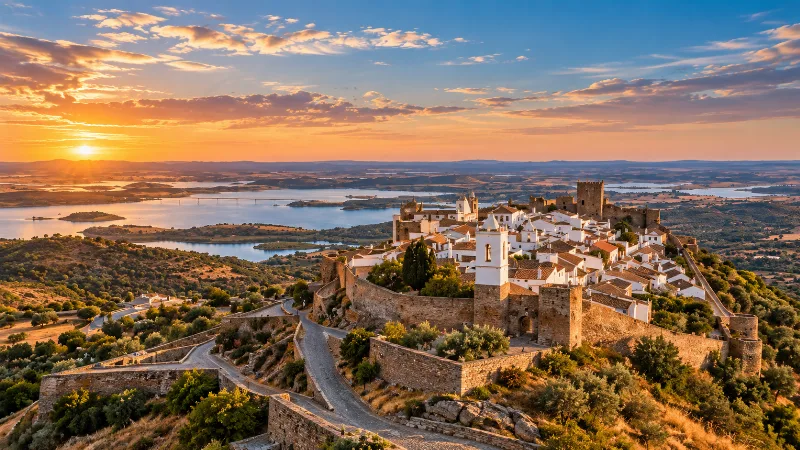
Alentejo
Discover Alentejo through Évora, whitewashed towns, cork-oak landscapes, vineyards, regional food and the broad rural interior of southern Portugal.
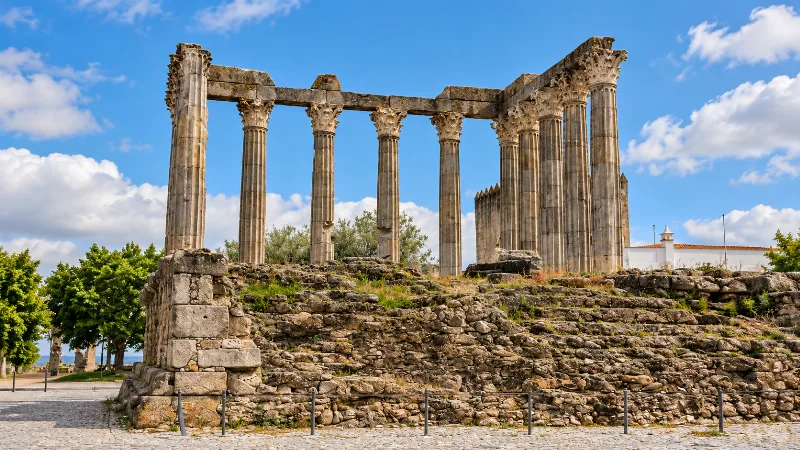
Évora
Évora is a historic Alentejo city of Roman remains, whitewashed streets, medieval walls, churches and a slower inland Portuguese rhythm.
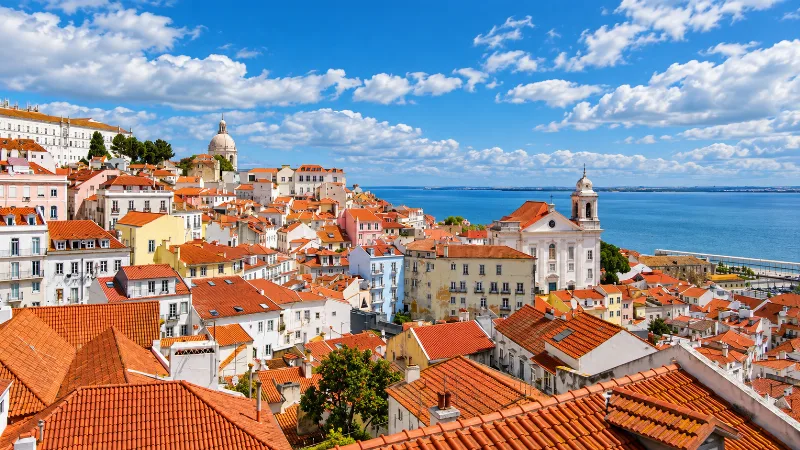
Lisbon
Portugal’s capital combines historic neighbourhoods, river views, tiled façades, viewpoints and an energetic everyday city life.
Monsaraz Hilltop Village and Megalithic Sites
Monsaraz is a fortified hilltop village in Portugal's Alentejo, surrounded by wide plains, cork oak groves and a notable cluster of prehistoric stone monuments.
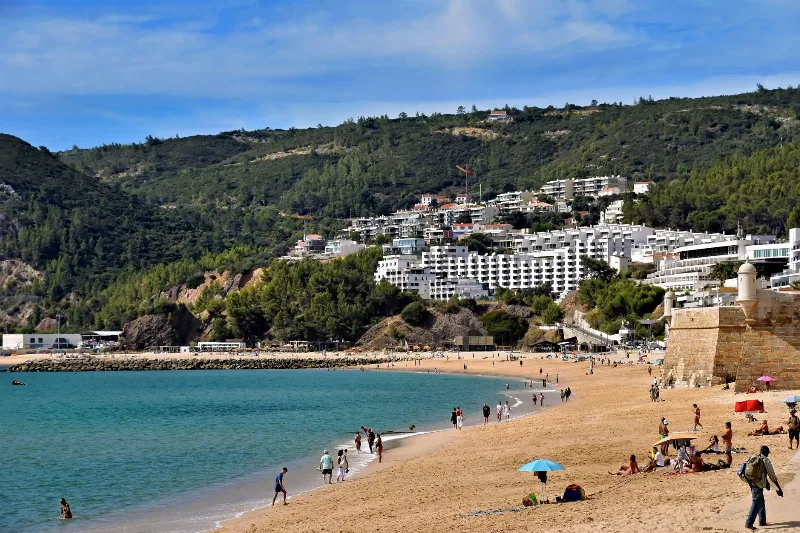
Best Regions to Visit in Portugal
Discover Portugal's most popular travel regions, from the historic cities of Lisbon and Porto to the beaches of Algarve, the countryside of Alentejo and the Atlantic islands.
The Cork Oak Woodlands of Alentejo
The cork oak woodlands of Alentejo form a distinctive Portuguese landscape known as the montado, where trees, grazing animals and a nine-year cycle of bark harvesting have shaped the land for centuries.