
Valença
Valença is a border town in the Alto Minho whose historic centre still sits almost entirely within one of Portugal's most complete bastioned fortresses, looking across the River Minho to Galicia.
Valença lies in the far north-west of Portugal, in the Alto Minho sub-region of the Viana do Castelo district, on the left bank of the River Minho. Spain is directly opposite: the Galician town of Tui faces Valença across a metal bridge, and the two settlements have grown up within sight of one another. The town is unusual in that its historic centre remains enclosed by a continuous ring of bastioned walls, so the older streets, shops and churches are still contained within a defensive perimeter rather than spreading freely outwards. Below the walls, a newer town has developed around the railway station and the main road junctions, with the everyday services of a small municipal centre.
Location and general character
The municipality covers roughly 117 square kilometres and is divided into eleven parishes, with a resident population of about 13,600 at the 2021 census. It borders Monção to the east, Paredes de Coura to the south and Vila Nova de Cerveira to the west, while its northern edge follows the river and the Spanish frontier. Valença was formally elevated to city status in 2009, although the settlement has functioned as a town for centuries. The municipality's highest ground lies inland at Alto da Recosta, close to 782 metres, and the land falls away from these granite hills towards the cultivated river terraces.
From medieval Contrasta to a bastioned fortress
The settlement began at the turn of the thirteenth century, when the crown backed a new foundation on the crossing point of the Minho; it was known at first as Contrasta and was already a walled place by the 1200s. In 1262, under Afonso III, the defences were substantially rebuilt, and the name Valença came into use. The medieval gates survived into the modern period, and a carved shield is still visible on the keystone of the northern Porta do Açougue.
Valença's present appearance owes far more to the War of Restoration. Situated on one of the few practical crossing points between the two kingdoms, the town was repeatedly exposed to Spanish attack, including attempts in 1643 and 1657, and it was briefly lost and retaken in 1654. From 1661 a French military engineer, Miguel de l'Escole, drew up a new bastioned scheme that absorbed the old village and extended the defences over two adjacent hills. Work continued for half a century and was recorded as finished in 1713 by the architect Manuel Pinto de Vilalobos. The fortress held during the Napoleonic invasion of 1809 but changed hands in the Liberal Wars, and it was classified as a national monument in the 1920s. It now forms part of Portugal's tentative list of bastioned border fortresses put forward for World Heritage status.
Architecture inside the walls
The fortification is made up of two linked enclosures. The northern section, the Vila, contains the medieval core and the greater part of the built fabric; the smaller southern section, the Coroada, is more open and was designed as a place of arms. The two are joined by the Porta do Meio, and the whole circuit measures roughly five kilometres, punctuated by bastions, half-bastions, ravelins, dry ditches, sentry boxes and gun emplacements angled to sweep every approach. Of the historic gateways, the Porta do Sol and the riverside Porta da Gaviarra are the most prominent.
Within the walls, the streets are narrow, cobbled and shaded by tall stone houses. The parish church of Santa Maria dos Anjos and the church of Santo Estêvão, rebuilt in the eighteenth century, stand close to the old civic centre, and the Misericórdia chapel retains a painted altarpiece. The Capela do Bom Jesus, a seventeenth-century building used by the garrison, mixes Baroque and neoclassical elements. A Roman milestone, carved in the first century AD, is set up among the buildings as a reminder that a road crossed this stretch of the valley long before the frontier existed.
The River Minho and the surrounding countryside
The river gives the district its shape and much of its economy. Below the walls, the water is broad and slow, bordered by alder and willow, and herons and cormorants are common along the banks; lamprey and shad still run upstream in spring. The valley floor carries smallholdings, maize plots and terraced vines, and the surrounding slopes are a patchwork of pine, oak and broom. Part of the old railway branch towards Monção has been converted into the Ecopista do Rio Minho, a flat greenway of about seventeen kilometres that follows the river through farmland and woodland.
Border life and local culture
For generations, Valença's livelihood has depended on movement across the river. The streets of the fortress are lined with shops selling household textiles, towels, bed linen and embroidered tablecloths, and Spanish visitors make up much of the clientele; the trade has shaped the town's daily rhythm as much as tourism has. The municipality's patron is São Teotónio, born at Tardinhade in the parish of Ganfei in 1082 and later the first Portuguese saint to be canonised. His feast day, 18 February, is the municipal holiday, and a statue of him stands in the town. Rural parishes keep their own romarias and pilgrim feasts, often centred on small chapels on the hillsides. The Portuguese route of the Camino de Santiago passes through the town and crosses into Galicia, giving Valença a steady flow of walkers alongside its shoppers.
Notable places to see
Two former powder magazines inside the fortress have been adapted as museum spaces: one covers the War of Restoration, the other the wider system of bastioned fortifications along the Portuguese–Spanish border. Walking the ramparts gives clear views of the river, of Tui's cathedral tower on the far bank and of the old international bridge. That bridge, completed in 1884 and opened officially in 1886, was designed by the engineer Pelayo Mancebo rather than by Gustave Eiffel, despite a persistent local legend. It carries a railway on its upper deck and road traffic and pedestrians below, and remains the only rail crossing between Portugal and Galicia. A newer motorway bridge, opened in the 1990s, carries most of the traffic further downstream.
Nearby destinations
Tui is a ten-minute walk across the old bridge, with a fortified cathedral and a maze of streets around it; travellers should note that Spain runs an hour ahead. Upstream, Monção is the centre of Alvarinho wine production and preserves a small fortress of its own. Vila Nova de Cerveira, downstream, hosts a biennial art exhibition and has a riverside square and Saturday market. Inland, Paredes de Coura offers hill walking and a summer music festival, while the rural parishes of Valença itself hold two former monastic sites, the convent of Ganfei and the monastery of Sanfins. Further west, Caminha marks the point where the Minho meets the Atlantic.
Related content
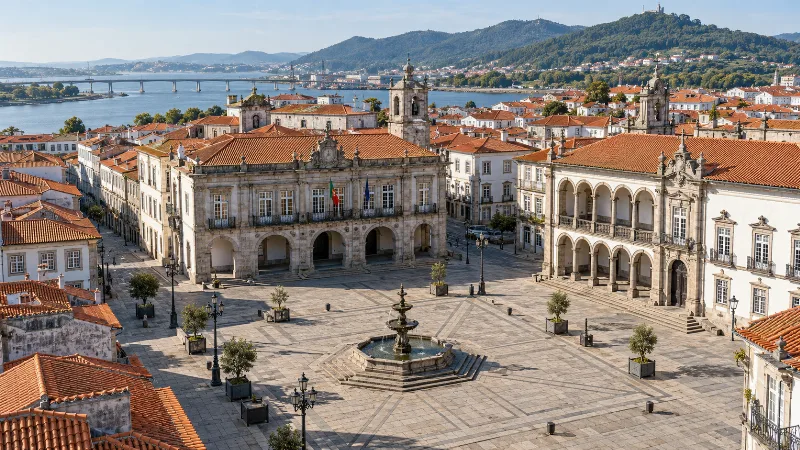
Viana do Castelo
Viana do Castelo combines historic squares, maritime heritage, Atlantic beaches and hilltop views over the Lima River estuary.
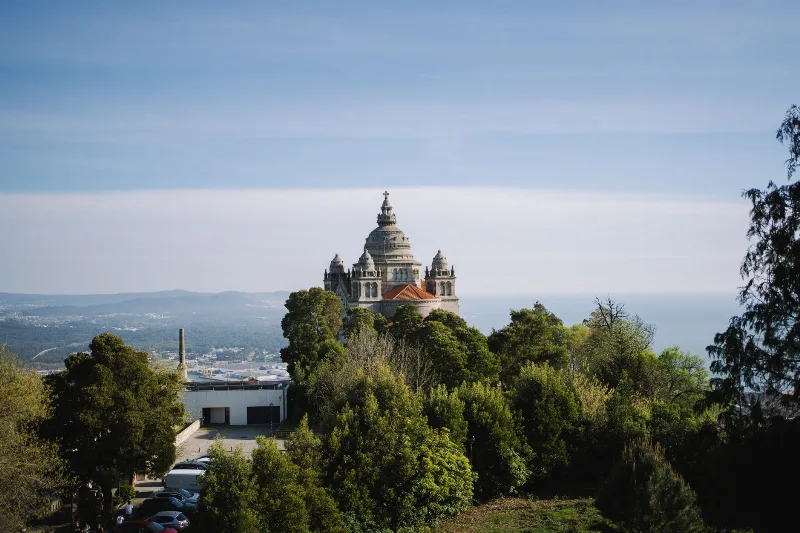
Viana do Castelo
A compact Atlantic city at the mouth of the Lima in northern Portugal, known for its medieval streets, its seafaring past, the sanctuary on Monte de Santa Luzia and the gold-embroidered costumes paraded each August.
Things to See in Viana do Castelo
Explore things to see in viana do castelo with a practical guide to notable places, regional landscapes, local heritage and travel planning in Portugal.
Viana do Castelo Filigree and Costume Traditions
Viana do Castelo is celebrated for two intertwined traditions: intricate gold filigree jewellery and a richly ornamented regional costume that together express the identity of Portugal's Minho region.
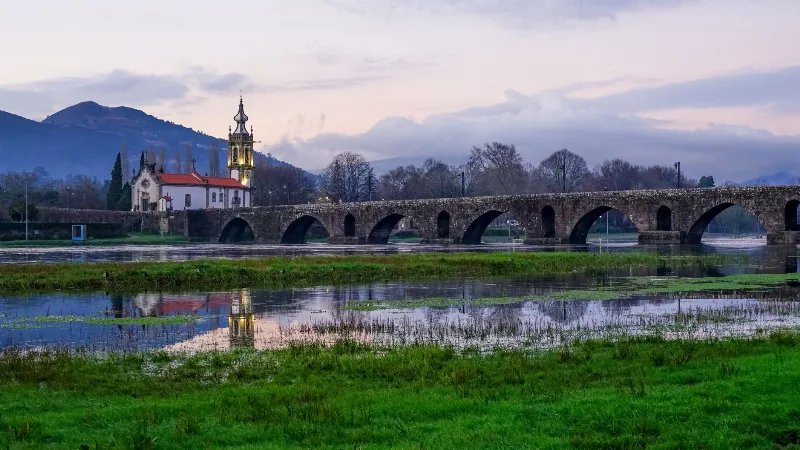
Ponte de Lima
Ponte de Lima straddles the River Lima in Portugal's Minho, where a Roman and medieval bridge, granite streets and riverside gardens shape one of the north's oldest settlements.
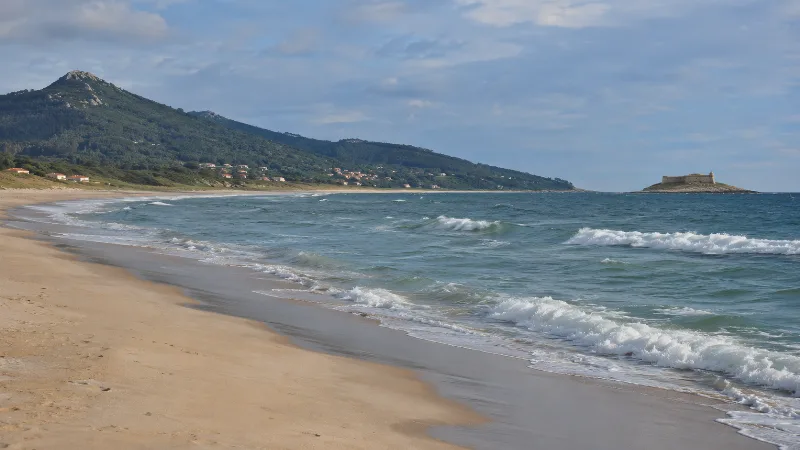
Praia de Moledo – Sandy Shores at Portugal’s Northern Edge
Praia de Moledo is a sandy beach near Caminha, with Atlantic views, surrounding hills and the offshore Ínsua fortress.