
Aljezur
Aljezur is a small town in the western Algarve, set just inland from the Atlantic on the Ribeira de Aljezur and watched over by the remains of a Moorish castle. Its quiet streets, farming hinterland and wild coastline give it a character quite unlike the resort towns further east.
Aljezur is a small town in the western Algarve, standing a short way inland from the Atlantic on the banks of the Ribeira de Aljezur. It is the seat of a large, sparsely populated municipality that reaches from the wooded hills behind the town down to a rugged stretch of coast on the borderland between the Algarve and the Alentejo. Long dependent on farming and fishing, it has more recently become a base for walkers and surfers, without losing the unhurried rhythm of a country town.
Location and general character
The town occupies a sheltered valley where the Ribeira de Aljezur widens before turning towards the sea. The historic core climbs a slope on one side of the river, its whitewashed houses and narrow lanes gathered beneath the castle hill; later building has spread along the valley floor and out towards the coast road. Because the municipality is one of the least densely populated in the Algarve, the area around the town feels open and agricultural, with smallholdings, cork oak and scrub-covered hills between the settlements.
Aljezur is not a resort in the conventional sense. There are few large buildings, no high-rise front and no promenade. Its streets serve a working community as much as visitors, and the atmosphere changes with the seasons: busier in summer and at weekends, very quiet in the winter months when rain sweeps in from the Atlantic.
History
The name is usually traced to the Arabic al-jazīra, meaning island, a reference either to a former islet in the river mouth or to land that once stood isolated among marshes. Settlement in the valley is older still, but the town's documented story is closely bound to the Islamic period, when a fortified enclosure was established on the hill above the river, probably in the tenth century. Aljezur remained a Moorish stronghold until the middle of the thirteenth century, when it was taken during the Christian advance through the south under Paio Peres Correia, and the castle was subsequently granted to the Order of Santiago.
The town later became the centre of a wide rural municipality, its economy built on cereals, fruit and fishing at the small coastal harbours. The earthquake of 1755 caused serious damage here as elsewhere in the region, and traces of reconstruction from the later eighteenth century are visible in several of the town's churches.
Architecture and the castle
The castle ruin is the town's defining landmark. Its walls, built largely of stone and rammed earth, follow the contour of the hill and enclose a cistern and the footings of former buildings; parts of the perimeter and a gate have been consolidated, and the walk around the circuit gives a clear view of the river valley and the plain towards the sea. Below it, the old town is a compact network of stepped streets lined with low houses, some still showing traditional construction methods and chimneys of local design.
Among the churches, the Misericórdia contains a carved portal in the late Gothic style, while the larger parish church dedicated to Nossa Senhora da Alva was rebuilt after the earthquake and stands slightly outside the oldest quarter. A small municipal museum holds archaeological finds from the castle and the surrounding area alongside material on rural life.
Natural surroundings
The coastline within the municipality lies largely inside the natural park that protects the south-west of Portugal. Cliffs of schist and greywacke alternate with sandy bays, dunes and patches of pine, and the Ribeira de Aljezur forms a small estuary where it meets the sea at Praia da Amoreira. Beaches such as Monte Clérigo, Arrifana and Vale dos Homens are backed by steep slopes and exposed to the full force of the Atlantic swell, which is why the area has become well known among surfers. Inland, the land rises towards scrubby hills where holm oak, strawberry tree and cistus grow, and where birds of prey and small mammals are common.
Local culture and everyday life
Agriculture still shapes the calendar. The sandy soils near the coast are used for sweet potatoes, a crop that carries a protected geographical indication, and fields of maize, peanuts and vegetables are worked alongside sheep grazing and small-scale beekeeping. Fishing continues from the slipways at Arrifana and Monte Clérigo, though on a modest scale compared with the past. Markets, the parish festas and the annual pilgrimage in honour of Nossa Senhora da Alva remain important social occasions, and the town's cafés and tascas serve a local clientele throughout the year.
Notable places
South of the town, the headland at Arrifana holds the excavated remains of a ribat, a fortified religious retreat founded in the twelfth century by the mystic Ibn Qasi and investigated by archaeologists since 2001. The site, with an interpretation centre nearby, is one of the few of its kind in Portugal. Also worth noting are the old bridge over the ribeira, the viewpoints on the road down to Amoreira, and the fishing hamlet above the sands at Monte Clérigo.
Nearby destinations
Odeceixe, at the northern edge of the municipality, sits above a river mouth popular with bathers and marks the beginning of the long-distance walking route that follows the coast southwards. Further south lie Carrapateira and the broad dune-backed beach at Bordeira, while inland the wooded heights of the Serra de Monchique offer a complete change of scenery. Lagos, with its larger historic centre, and Sagres and Cabo de São Vicente at the south-western tip of the continent are both within reasonable driving distance.
Related content
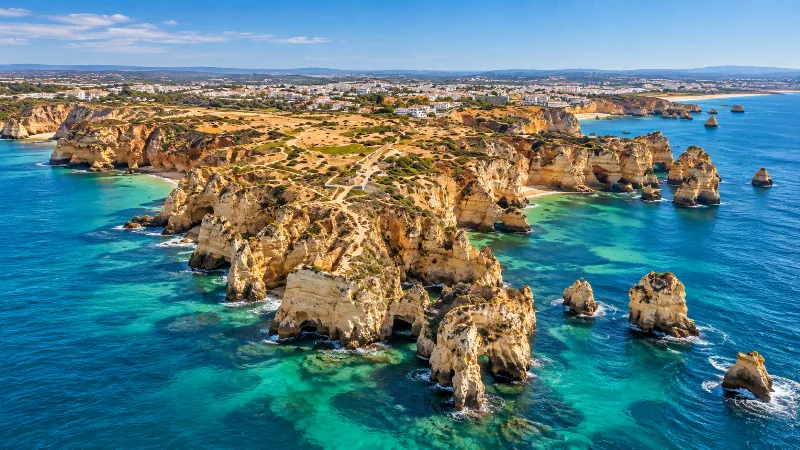
Algarve
Explore the Algarve through sandy beaches, limestone cliffs, Faro, Ria Formosa, coastal trails, historic towns and southern Portuguese landscapes.
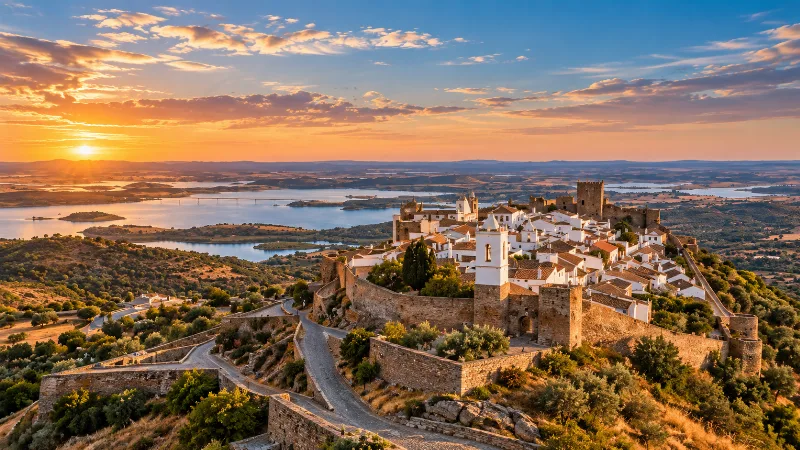
Alentejo
Discover Alentejo through Évora, whitewashed towns, cork-oak landscapes, vineyards, regional food and the broad rural interior of southern Portugal.
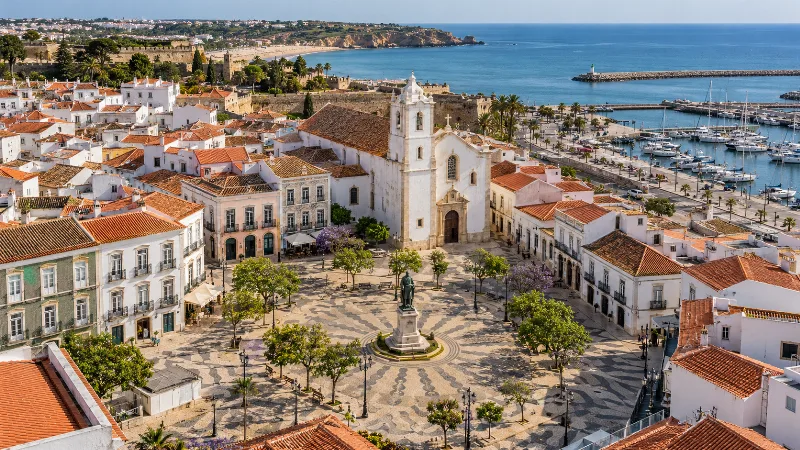
Lagos
Lagos combines a historic Algarve centre, small sandy beaches, coastal cliffs and the rock formations of Ponta da Piedade.
Costa Vicentina Coastal Path and Atlantic Cliffs
The Costa Vicentina is a wild Atlantic shoreline of dark schist cliffs, broad beaches and waymarked trails, where walking routes link quiet Alentejo fishing villages with protected natural parkland.
Ponta da Piedade Clifftop Paths in the Western Algarve
The limestone headland of Ponta da Piedade, just south of Lagos, is threaded with clifftop paths above sea stacks, arches and hidden grottoes. This guide explains the geology, the walking routes and the natural detail that make the headland distinctive.
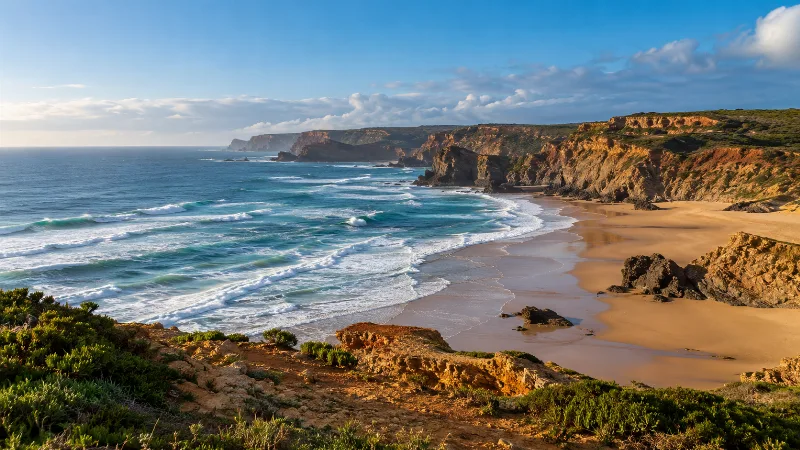
Praia do Amado – Atlantic Waves and Rugged Coastal Scenery
Praia do Amado is an Atlantic-facing beach in the Aljezur area, distinguished by powerful surf and wild coastal scenery.