
Palmela
A hilltop town in the Setúbal district, Palmela combines a long medieval castle wall, sandy-soil vineyards and wide views over the plain between the Tagus and the Sado estuary.
Palmela is a hill town in the Setúbal district of Portugal, standing on a limestone ridge about 40 kilometres south-east of Lisbon. Its outline is easy to read from the surrounding plain: a long curtain of castle walls along the crest, a huddle of white houses just below, and then vineyards and stone pines running down towards the Sado estuary. The centre is small enough to cross on foot in half an hour, yet the place has mattered for centuries because it overlooks the flat land between two of the country's largest rivers.
Location and general character
The town gives its name to a large municipality that spreads over the northern half of the Setúbal peninsula, from the edge of the Tagus marshes to the rice fields beside the Sado. It is divided into four civil parishes and mixes very different landscapes: the walled hill town, scattered hamlets, farmland, pinewoods and an industrial belt at the foot of the hill, where a large vehicle assembly plant provides work for thousands of people from across the region.
The historic centre occupies the summit and upper slopes, at roughly 230 metres, and is still partly enclosed by its defences. Below it, the modern town has grown along the roads that lead towards Setúbal, the motorway and the river crossings, so Palmela now functions partly as a commuter settlement for Lisbon and Setúbal while keeping a separate identity as a market and wine town. The streets are narrow and often steep, many of the houses are whitewashed, and the hilltop position means that almost every open space ends in a view.
From hillfort to fortified town
The ridge has been occupied for a very long time. A short distance from the town, the fortified site of Castro de Chibanes on the Serra do Louro was inhabited from prehistoric times into the Roman period, and its excavation has produced pottery and structures that trace contacts with Mediterranean traders. Other prehistoric remains, including rock-cut burial chambers at Quinta do Anjo, show that the limestone slopes were settled and used for burials long before any town existed.
The origin of the name is uncertain; one long-standing explanation links it to a Latin personal name, suggesting a Roman estate in the area. What is clear is that the hill was fortified in the Islamic period, and that it was taken in 1148 by Afonso Henriques, the first king of Portugal, in the wave of conquest that followed the fall of Lisbon. The crown soon passed the castle to the Order of Santiago, which made Palmela one of its Portuguese headquarters and rebuilt much of the defences. A royal residence stood inside the walls, and the town received charters and privileges that tied it to the military order and to the monarchy.
The eighteenth century brought decline. The earthquake of 1755 damaged the castle and several churches, and the walls lost their military purpose. Restoration work carried out from the twentieth century onwards, when the castle was classified as a national monument, gave the site much of the appearance it has today.
Architecture of the old town
The castle is the town's defining structure: a long, irregular enclosure of walls and towers following the shape of the rock, entered through old gateways and enclosing a courtyard, a palace range and a church. The church of São Tiago, built in the fifteenth century, has a plain Gothic character, and the adjoining former convent of the same order now serves civic and cultural purposes. From the upper walls the whole peninsula opens up, with the Sado estuary on one side and the wooded hills of the Arrábida on the other.
Outside the castle, the parish church of São Pedro, the Misericórdia church and the town hall form the core of the lower town. The town hall is faced with panels of azulejos, the glazed tiles that appear on many Portuguese public buildings, and a stone pelourinho, the old symbol of municipal authority, stands nearby. Houses are generally low, with stone-framed doorways and windows, tiled roofs and occasional carved details kept from earlier rebuildings. The overall effect is modest rather than monumental, and it is the contrast between the heavy walls above and the domestic scale below that gives Palmela its character.
Hills, estuary and woodland
Much of the land around the town falls within the Serra da Arrábida Natural Park, created in 1976 to protect a band of limestone hills that runs towards the sea. Close to Palmela the ridges of the Serra do Louro and São Luís are covered in dense Mediterranean scrub, with kermes oak, strawberry tree, juniper and cistus, interspersed with smallholdings and old stone terraces. The hills are dry and hot in summer and are best walked in spring, when the scrub is in flower.
To the south and east, the municipality reaches the Sado estuary, a wide expanse of mudflats, channels, salt pans and rice fields that is protected as a nature reserve. The estuary holds a resident population of bottlenose dolphins, and its shallows attract large numbers of wading birds and waterfowl on migration. Between the hills and the estuary lie extensive pinewoods and sandy soils, and it is this pale, poor sand that has shaped the local agriculture.
Wine, work and local life
Because these sandy soils were never reached by the vine pest that devastated European vineyards in the nineteenth century, some vines here grow on their own roots, and the area became known for both table wines and fortified ones. The Palmela denomination covers reds and rosés made mainly from Portuguese varieties such as Castelão, while the surrounding Setúbal peninsula is famous for Moscatel, a sweet fortified wine made from the Muscat grape and aged in wood. A growers' cooperative founded in the middle of the twentieth century still vinifies much of the harvest, and several private estates on the slopes below the town open their cellars for tastings.
The grape harvest is marked each September with a festival that mixes wine tasting with music and street food, and it remains the main date in the local calendar. Day to day, life follows a familiar Portuguese pattern: a market in the morning, long lunches in small tascas, children in the squares in the evening. Fish and shellfish come up from Setúbal, cuttlefish is cooked in several ways, and the neighbouring parish of Azeitão supplies the sheep's cheese and small almond-and-egg pastries that appear on most local tables.
Places to seek out
The castle complex is the obvious starting point, and it deserves more time than the view alone. Below the hill, the Castro de Chibanes can be visited by arrangement with the municipal museum, which also holds archaeological material from the surrounding sites. The prehistoric tombs at Quinta do Anjo are a short drive away, cut into soft limestone and impressive for their age. In the town itself, the viewpoints on the northern edge, the small museums and the parish churches repay a slow morning, and the market is a good place to see the produce of the plain.
Nearby destinations
Setúbal, ten minutes away, is the natural next stop, with its riverfront, fish market and ferries across to the Tróia sand spit. South of Palmela the road climbs into the Arrábida hills towards Portinho da Arrábida, where a small beach sits beneath wooded slopes, and on to Sesimbra and the clifftop sanctuary at Cabo Espichel. Inland, Alcácer do Sal sits above the Sado with a castle of its own, while the beaches and rice fields around Comporta lie further down the estuary. Lisbon is within an hour by road or rail, which helps explain why a town of this size retains a working castle, a wine industry and a functioning local community all at once.
Related content
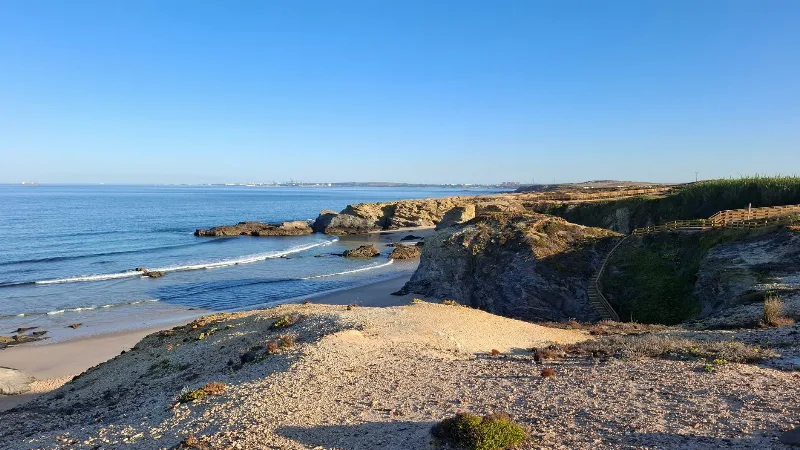
Setúbal
A working port on the north bank of the Sado estuary, Setúbal combines a long maritime history, Manueline architecture and the limestone hills of Arrábida. Ferries, a renowned fish market and a resident dolphin population are part of everyday life there.
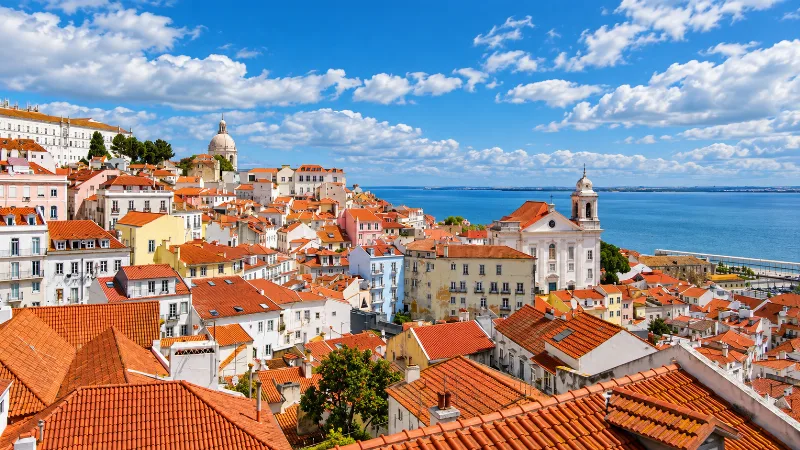
Lisbon
Portugal’s capital combines historic neighbourhoods, river views, tiled façades, viewpoints and an energetic everyday city life.
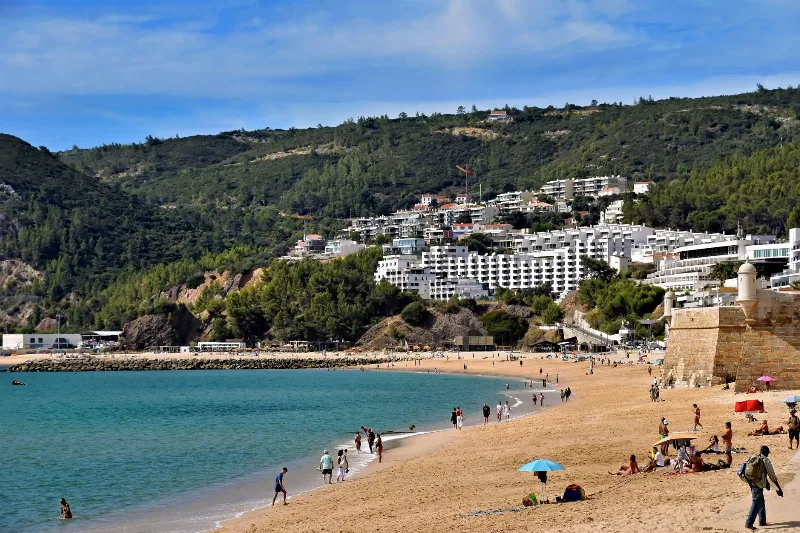
Sesimbra
A sheltered Atlantic bay at the foot of the Serra da Arrábida, Sesimbra remains a working fishing town whose castle, harbour and beaches shape everyday life.
Azeitão Sheep's Cheese and the Setúbal Peninsula
Azeitão cheese is a soft sheep's milk cheese from the villages below the Serra da Arrábida, set with cardoon thistle and made by small dairies on the Setúbal Peninsula.
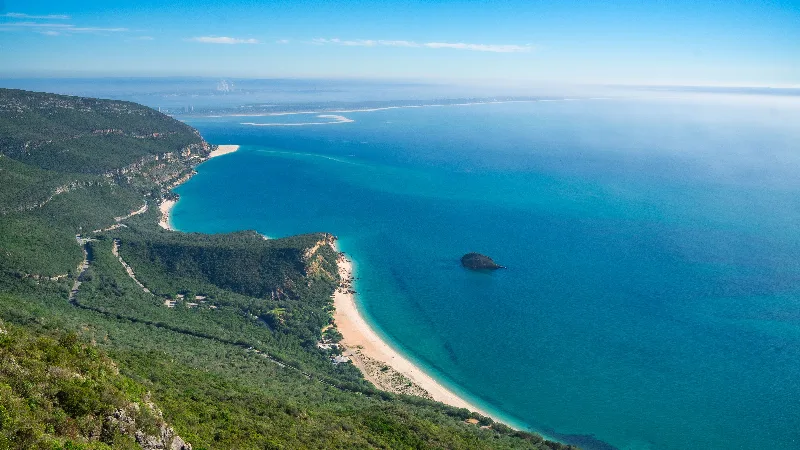
Arrábida Natural Park – Green Hills and Sheltered Bays
Arrábida Natural Park combines limestone hills, Mediterranean vegetation and sheltered beaches along the coast near Setúbal.
Arrábida Natural Park Limestone Hills and Coves
Arrábida Natural Park stretches along the Setúbal peninsula, where pale limestone hills fall sharply to a coast of sheltered coves and clear water. The park combines Mediterranean vegetation, a protected marine area and long views across the Sado estuary.