
Sesimbra
A sheltered Atlantic bay at the foot of the Serra da Arrábida, Sesimbra remains a working fishing town whose castle, harbour and beaches shape everyday life.
Sesimbra lies on Portugal's Atlantic coast in the district of Setúbal, roughly forty kilometres south of Lisbon and directly beneath the limestone hills of the Serra da Arrábida. The town curls around a sheltered bay where the fishing harbour splits the seafront into two contrasting beaches, and the old centre climbs the slope towards a medieval castle. It is a municipality of several distinct parishes, ranging from the dense inland sprawl of Quinta do Conde to the small coastal settlements of Azóia and the hamlet beneath the castle walls. Despite steady visitor numbers in summer, the town's rhythm is still set largely by the fishing fleet and the fish auction rather than by tourism.
Location and general character
The bay faces south and south-west, protected from the prevailing swell by headlands on both sides, which is the main reason a settlement and a port developed here at all. The coastline runs east towards the mouth of the Sado estuary and west towards Cabo Espichel, alternating sandy coves with steep, rocky stretches. Sesimbra's centre is compact: the harbour, the market, the parish church and the main square sit within a few minutes' walk of one another, while the castle stands on a separate hill just inland, visible from much of the town. The surrounding municipality is predominantly rural and wooded, with pine and scrub covering the hills behind the coast.
History
The area has been occupied since prehistoric times, and Roman activity is attested along the coast and in the Sado hinterland. The castle hill was fortified in the Islamic period, and the site was taken during the twelfth-century expansion of the Portuguese kingdom, changing hands more than once before being securely held by the crown. It was subsequently granted to the Order of Santiago, whose influence shaped the town's early administration and church life. As the threat of raids receded, the population moved down from the hill to the shoreline, and by the fifteenth and sixteenth centuries a linear settlement had grown between the castle foot and the beach.
Attacks by privateers in the seventeenth century prompted the construction of coastal defences, including a fortress at the eastern end of the bay, built in the 1640s during the war of restoration. In the late nineteenth and twentieth centuries, sardine canning and the export of fish brought relative prosperity, and the harbour was progressively enlarged. Since the 1970s, holiday use of the beaches and the proximity of the Arrábida hills have added a second economic strand to a town that had previously depended almost entirely on the sea.
Architecture and townscape
The old town is a tight grid of whitewashed houses, many with painted skirting bands in blue or ochre and small tiled roofs. Streets are narrow, often steep, and paved in traditional stone, opening unexpectedly onto small squares or views over the water. The castle enclosure preserves stretches of wall, gates and the church of Nossa Senhora do Castelo, whose interior is lined with figurative tiles. At the water's edge, the fortress of Santiago stands on the sand, its ramparts now enclosing cultural and civic uses rather than artillery. The parish church of São Tiago, remodelled after earthquake damage in the eighteenth century, anchors the lower town, while the harbour front is dominated by functional buildings: warehouses, ice stores, net sheds and the fish market.
Natural surroundings
Most of the landward horizon is taken up by the Serra da Arrábida, a limestone ridge protected since the 1970s as a natural park. Its vegetation is Mediterranean in character, with dense maquis, carob, olive and scattered umbrella pines, and its southern slopes fall in cliffs to clear, cold water. To the north-west of town, the shallow lagoon of Lagoa de Albufeira is separated from the ocean by a sand barrier that opens and closes with winter storms, and it supports wading birds and migratory species. Further west, Cabo Espichel forms a bleak, wind-scoured promontory of vertical cliffs, with fossil-bearing rock layers exposed along the shore.
Local culture and everyday life
Fishing continues to define the town's calendar. The fleet lands sardine, mackerel, horse mackerel and black scabbardfish, the last of which is a local speciality, usually grilled or fried and served with vegetables. Beach seining with hauled nets has long been practised on these sands and survives through a small number of crews who still work from the shore. Religious observance is visible and well attended: Holy Week processions pass through the streets, and the spring pilgrimage to the sanctuary at Cabo Espichel draws families with strong local ties. Sesimbra also maintains its own musical tradition, the chulas, short sung and danced pieces accompanied by small stringed instruments and harmonicas, performed at festivals and informal gatherings. Outside the summer months, life is quiet, centred on the auction, the cafés near the market and the schoolyards.
Notable places
The castle hill offers the clearest view of the bay and the hills behind it, and the church within the walls is one of the town's most distinctive interiors. The fortress of Santiago, the two town beaches of Ouro and Califórnia, and the maritime museum, which documents local boatbuilding and fishing techniques, are all within easy reach of the centre. West of town, the sanctuary of Nossa Senhora do Cabo at Cabo Espichel is a large pilgrimage complex of the early eighteenth century, with an austere façade, pilgrim lodgings and a dramatic cliff-top position.
Nearby destinations
The city of Setúbal, fifteen kilometres to the east, offers a larger port, a historic centre and ferry connections across the Sado estuary. The road west along the coast leads to the small beach settlement of Portinho da Arrábida, squeezed between the hills and the sea, and on to the long Atlantic sands at Meco. Lisbon can be reached by road in under an hour outside peak periods, making Sesimbra feasible as a day trip, though the town rewards a longer stay.
Related content
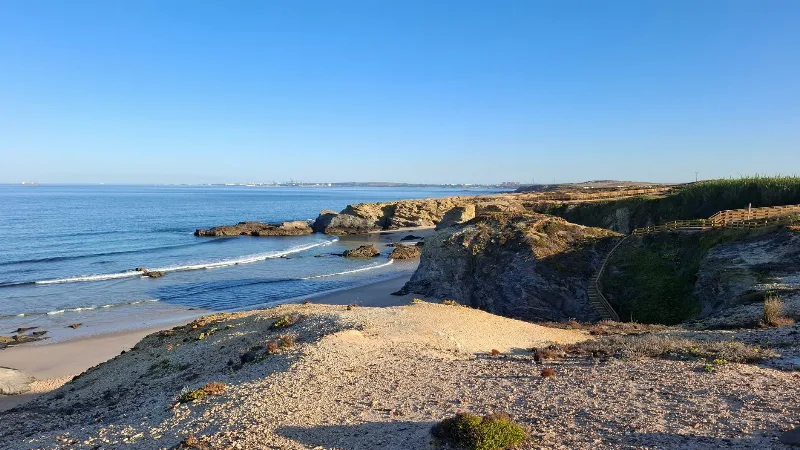
Setúbal
A working port on the north bank of the Sado estuary, Setúbal combines a long maritime history, Manueline architecture and the limestone hills of Arrábida. Ferries, a renowned fish market and a resident dolphin population are part of everyday life there.
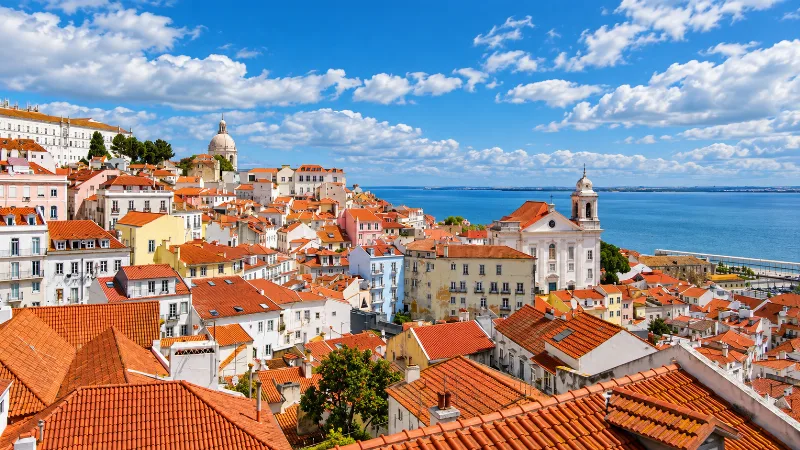
Lisbon
Portugal’s capital combines historic neighbourhoods, river views, tiled façades, viewpoints and an energetic everyday city life.
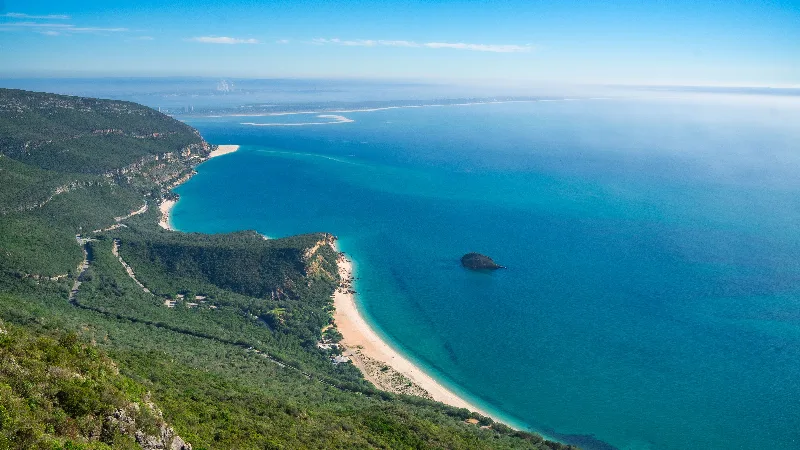
Arrábida Natural Park – Green Hills and Sheltered Bays
Arrábida Natural Park combines limestone hills, Mediterranean vegetation and sheltered beaches along the coast near Setúbal.
Azeitão Sheep's Cheese and the Setúbal Peninsula
Azeitão cheese is a soft sheep's milk cheese from the villages below the Serra da Arrábida, set with cardoon thistle and made by small dairies on the Setúbal Peninsula.
Arrábida Natural Park Limestone Hills and Coves
Arrábida Natural Park stretches along the Setúbal peninsula, where pale limestone hills fall sharply to a coast of sheltered coves and clear water. The park combines Mediterranean vegetation, a protected marine area and long views across the Sado estuary.
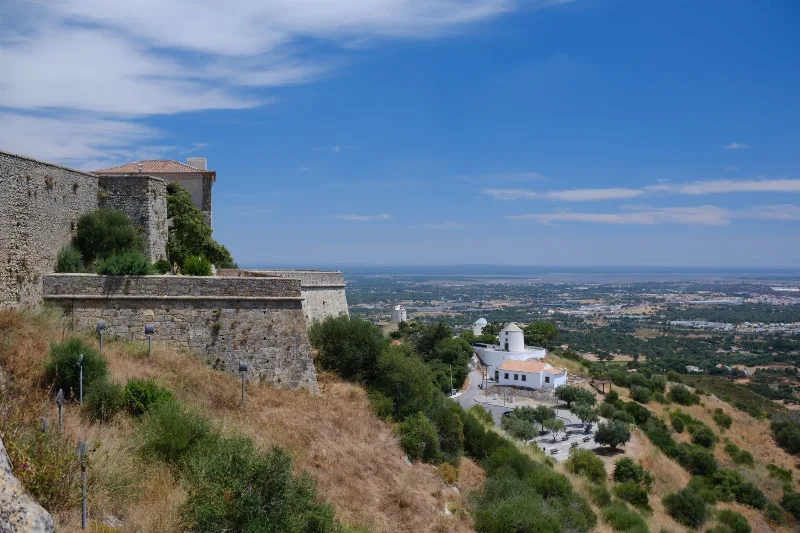
Palmela
A hilltop town in the Setúbal district, Palmela combines a long medieval castle wall, sandy-soil vineyards and wide views over the plain between the Tagus and the Sado estuary.