
Setúbal
A working port on the north bank of the Sado estuary, Setúbal combines a long maritime history, Manueline architecture and the limestone hills of Arrábida. Ferries, a renowned fish market and a resident dolphin population are part of everyday life there.
Setúbal is a city and municipality in southern Portugal, sitting on the north bank of the Sado estuary roughly fifty kilometres south of Lisbon. It is the administrative centre of its district and one of the country's more substantial secondary cities, with a population of around 120,000 across the municipality. Fishing, canning and port activity shaped the town for centuries, and although those industries are much reduced, the waterfront still functions as a working harbour rather than a decorative one. The Serra da Arrábida rises immediately to the south-west, and the broad estuary opens eastwards towards the Atlantic, giving the city a geography that is half urban and half natural.
Location and general character
The city occupies a narrow coastal plain between the estuary and the hills, which keeps it compact and walkable in the centre. Its older quarters climb gently from the river towards the castle, with the Baixa district around the Praça do Bocage acting as the commercial heart. Setúbal feels distinctly Portuguese in its daily rhythm: cafés open early for workers from the port and the industrial estates on the eastern edge, the market is busiest before midday, and the ferries across the water run to a timetable tied to commuters and day visitors. It is not a resort town, and its character owes more to fishing families, dock labour and the small businesses that served them than to tourism.
History
The estuary has been settled since antiquity. On the opposite bank at Tróia lie the remains of Cetóbriga, a Roman settlement whose fish-salting workshops and bath complex produced garum for export across the empire. The town itself developed under Moorish rule and was formally chartered by Afonso III in 1249, an event that marks the beginning of its recorded municipal life. Its position at the mouth of a navigable river made it a useful port during the Portuguese expansion of the fifteenth and sixteenth centuries, when salt, wine and dried fish moved through its wharves. Later centuries brought a different kind of industry: sardine canning, fish curing and, in the twentieth century, shipbuilding and repair yards on the estuary's southern shore, which at their height employed thousands. Deindustrialisation from the 1970s onwards cost the area many of those jobs, and the city has since become a commuter base for Lisbon as well as a service centre for the surrounding peninsula.
Architecture
Setúbal's most significant building is the Convento de Jesus, founded in 1490 and now housing the municipal museum. Its church is an early and influential example of Manueline design, with twisted rope-like columns in the nave that anticipate work elsewhere in Portugal. The Igreja de Santa Maria da Graça and the seventeenth-century Igreja de São Julião stand closer to the centre, the latter rebuilt after the 1755 earthquake and fronted by a broad flight of steps that functions as an informal meeting place. Above the town, the Castelo de São Filipe was constructed in the 1590s under Philip I of Portugal to a design associated with the Italian military architect Filippo Terzi; its star-shaped walls now enclose a hotel, but the ramparts and chapel are open to visitors and give the clearest view of the estuary's scale. Elsewhere the streetscape is a mix of eighteenth- and nineteenth-century townhouses, many faced with azulejo tiles, and plain working buildings around the docks.
Natural surroundings
The Serra da Arrábida forms the backdrop to the city and was protected as a natural park in 1976. The limestone ridge reaches 501 metres at its highest point and is covered in Mediterranean scrub, with carob, olive and strawberry trees giving way to bare rock on the upper slopes. Small coves and beaches lie at the foot of the cliffs along the road towards Portinho da Arrábida, where the water is sheltered and unusually clear. The estuary itself holds a separate designation, the Reserva Natural do Estuário do Sado, established in 1980. Its mudflats, sandbanks and old salt pans support large numbers of wading birds and wintering waterfowl, and the channel is home to a small resident community of bottlenose dolphins, one of the few in Europe that stays in the same estuary year round. Rice fields and salt works continue on the southern bank, maintaining a landscape that has changed little in outline for generations.
Local culture and everyday life
Food in Setúbal is closely tied to the water. Fried cuttlefish, choco frito, is the dish most associated with the city and appears on menus from simple tascas to smarter restaurants, usually served with chips or salad. The local fortified wine, Moscatel de Setúbal, is produced from vineyards around Azeitão and Palmela and is drunk as an aperitif or with dessert. Fish is bought fresh from the market and grilled simply, and the Saturday trade at the Livramento market is as much a social occasion as a shopping trip. The poet Manuel Maria Barbosa du Bocage, born in the city in 1765, is commemorated with a statue in the square that bears his name. Sporting life centres on Vitória de Setúbal, the football club founded in 1910, whose supporters follow the team from the Estádio do Bonfim. The Feira de Sant'Iago, held in late July and August, is the largest annual gathering, combining livestock, food stalls and entertainment.
Notable places
The Mercado do Livramento, opened in 1930, is the city's best-known interior. Its iron frame and tiled panels depicting fish and market scenes make it an attractive building, but its reputation rests on the produce: stallholders sell whatever has come off the boats that morning, and the range of species on display is unusually wide. The Museu de Setúbal, housed in the Convento de Jesus, holds painting, archaeology and religious artefacts alongside the building's own architecture. The Castelo de São Filipe is worth the climb for the views alone. Nearer the water, the Praia de Albarquel provides a small sandy beach within walking distance of the centre, and the ferry terminal at Doca do Comércio connects the city with the Tróia peninsula on the far side of the estuary, a crossing of roughly half an hour.
Nearby destinations
Inland from Setúbal, Palmela occupies a hill topped by a medieval castle and a church with a Manueline portal, with views across the estuary and the plains beyond. To the west, Sesimbra remains a fishing town with a working harbour and a clifftop castle, popular for its beaches and seafood. Azeitão, a cluster of villages among vineyards and estates, is known for its wine cellars and for the azulejo panels of the Quinta da Bacalhoa. Across the water, Tróia is a long sand peninsula with Roman ruins and extensive beaches, reached by ferry from the city. Further east, Alcácer do Sal sits on the upper reaches of the Sado, and Lisbon is within easy reach by train or motorway.
Related content
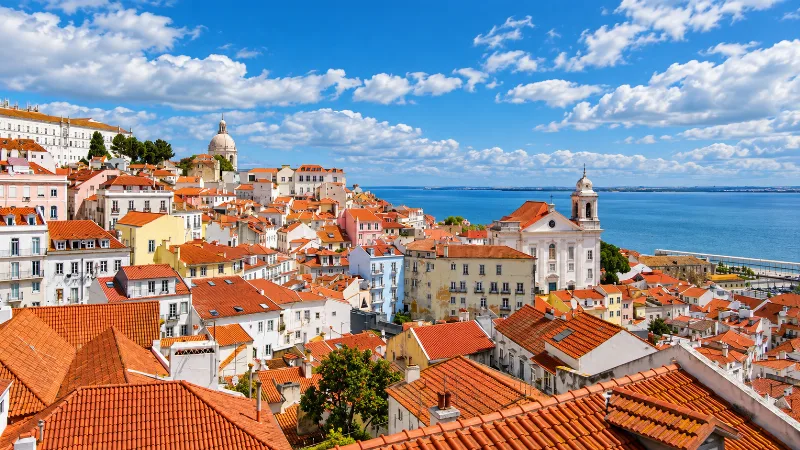
Lisbon
Portugal’s capital combines historic neighbourhoods, river views, tiled façades, viewpoints and an energetic everyday city life.
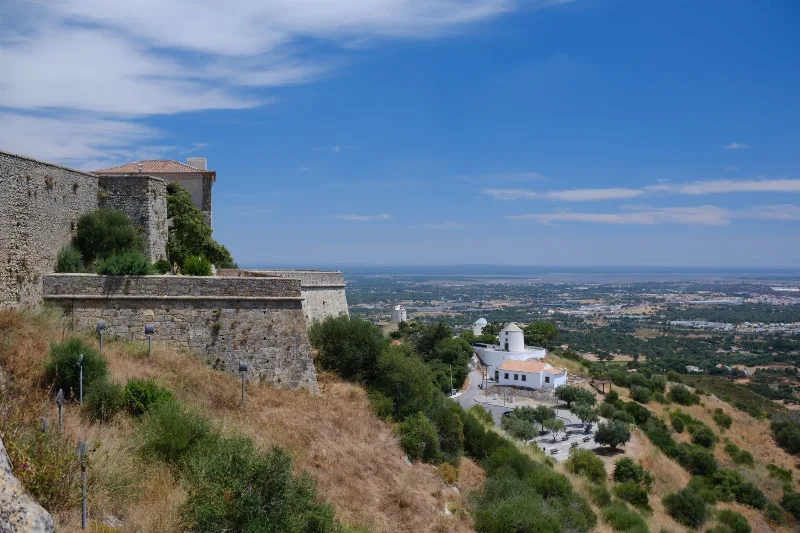
Palmela
A hilltop town in the Setúbal district, Palmela combines a long medieval castle wall, sandy-soil vineyards and wide views over the plain between the Tagus and the Sado estuary.
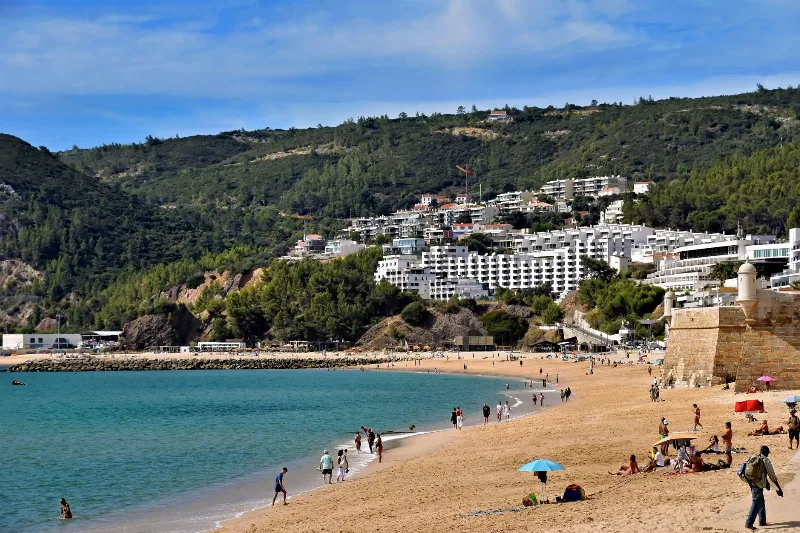
Sesimbra
A sheltered Atlantic bay at the foot of the Serra da Arrábida, Sesimbra remains a working fishing town whose castle, harbour and beaches shape everyday life.
Azeitão Sheep's Cheese and the Setúbal Peninsula
Azeitão cheese is a soft sheep's milk cheese from the villages below the Serra da Arrábida, set with cardoon thistle and made by small dairies on the Setúbal Peninsula.
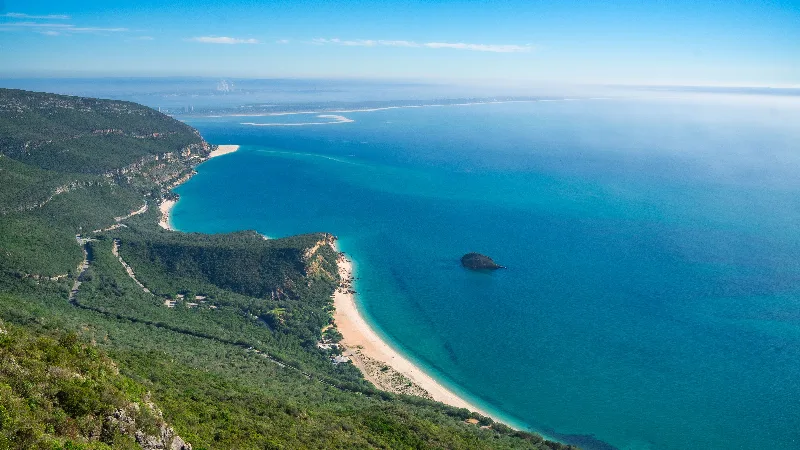
Arrábida Natural Park – Green Hills and Sheltered Bays
Arrábida Natural Park combines limestone hills, Mediterranean vegetation and sheltered beaches along the coast near Setúbal.
Arrábida Natural Park Limestone Hills and Coves
Arrábida Natural Park stretches along the Setúbal peninsula, where pale limestone hills fall sharply to a coast of sheltered coves and clear water. The park combines Mediterranean vegetation, a protected marine area and long views across the Sado estuary.