
Sines
A working Atlantic port on the Alentejo coast, Sines combines a small whitewashed old town, a castle linked to Vasco da Gama and long stretches of dune-backed beach within a municipality shaped by heavy industry.
Sines is a town of roughly 14,000 people on the Atlantic coast of the Alentejo, in the district of Setúbal and about 150 kilometres south of Lisbon. Its older streets rise over a low rocky headland above a broad, sheltered bay, while the northern part of the municipality belongs to one of Portugal's largest deep-water ports. The whitewashed fishing quarter and the tanker terminals stand in full view of each other, and that contrast between small-scale coastal life and heavy infrastructure is one of the first things a visitor notices.
Location and general character
The town occupies the northern side of Cabo de Sines, the point where the Portuguese west coast bends and forms the only natural bay of any size between the Tagus estuary and the Algarve. Deep water lies close to the shore, which is precisely why the modern harbour was sited here. Inland, the land rises into gentle rolling hills of cork oak, olive and pine, and the municipality stretches south along the coast to include Porto Covo. The climate is mild and Mediterranean in character but strongly influenced by the ocean: winters are wet and rarely cold, summers are dry, and north-westerly winds blow steadily for much of the year, keeping the air fresh and making the beaches popular with surfers and windsurfers.
A maritime history
The bay has been used as a harbour since antiquity. Carthaginian traders passed through in the third century BC, and the Romans established fish-salting tanks on the Ilha do Pessegueiro, using the sheltered channel as an anchorage. The town itself was taken from Moorish rule in 1217 and granted to the Order of Santiago; its charter of 1362 came with the condition that a fortress be built, and the castle dates from the first half of the following century. Sines is best known as the birthplace of Vasco da Gama, born here around 1469 to Estêvão da Gama, the local alcaide-mor. The navigator's attempts to exercise seigneurial rights over the town after returning from India brought him into conflict with the Order, and he was effectively expelled in 1507.
Fishing and small coastal trade sustained the town for centuries. From the 1970s, however, the construction of the industrial port, petrochemical plant and later a container and gas terminal transformed the local economy and brought in workers from elsewhere in Portugal.
Architecture of the old town
The historic centre is compact and steep, a knot of narrow streets lined with low houses painted white and trimmed in blue, grey or yellow, many of them finished with traditional tiled roofs. Above them stand the battlements and keep tower of the castle, which incorporates carved stones taken from a Visigothic building of the seventh century and now houses a contemporary arts centre and a small display on the navigator. Immediately against the eastern wall is the parish church of São Salvador, heavily remodelled in the eighteenth century in a restrained Baroque manner. West of the centre, close to the fishing harbour, the church of Nossa Senhora das Salas was rebuilt on Vasco da Gama's orders in the sixteenth century and keeps a late Gothic interior with a Manueline portal and a collection of votive silver and vestments. A bronze statue of Vasco da Gama, unveiled in 1970, faces the Atlantic beside the castle's western tower.
Coast, dunes and countryside
South of the built-up area the shoreline becomes a succession of cliffs, coves and dune systems. Praia Vasco da Gama sits directly below the old town, while Praia Grande and Praia do Morgável, further south, are broad and backed by low vegetation and pine. São Torpes, named after a Roman martyr whose body is said to have drifted to this coast in a boat, marks the mouth of a small stream and the beginning of a long, exposed beach much used by surfers. Behind the sand lies a patchwork of dunes, scrub and stone pine, crossed by waymarked footpaths, and the cliffs provide nesting sites and resting points for gulls, cormorants and migratory waders.
Local culture and everyday life
Sines remains a fishing town at heart. Small boats still land their catch at the western harbour, and the daily rhythm of the quay, the auction and the cafés around it continues largely unaffected by tourism. Nossa Senhora das Salas is the patron of the fishermen, and her summer festival brings processions both on land and on the water. Since the late 1990s the town has also hosted the Festival Músicas do Mundo in July, when concerts are staged inside the castle walls and elsewhere in the municipality, including Porto Covo. Local cooking follows Alentejo and coastal traditions: grilled fish, seafood rice, stews of dogfish and eel, and the robust bread and olive oil of the interior.
Notable places
Most of the points of interest are within walking distance of one another, with the beaches and the industrial shoreline a short drive beyond.
- The castle and keep tower, with its viewpoint over the bay and its arts programme.
- The church of São Salvador, where Vasco da Gama received the tonsure as a boy in 1480.
- The church and treasury of Nossa Senhora das Salas, above the fishing port.
- The municipal museum, which holds archaeological finds from the region alongside the Vasco da Gama collection.
- Praia Vasco da Gama, Praia Grande, Praia do Morgável and Praia de São Torpes.
- The Ilha do Pessegueiro and its ruined star-shaped fort, reached by boat in summer.
Nearby destinations
Porto Covo, some 15 kilometres south, is a former fishing village rebuilt in the eighteenth century after the Lisbon earthquake, with a grid of small white houses set back from a chain of sheltered beaches; the Fishermen's Trail long-distance path begins there. The Ilha do Pessegueiro lies just offshore, and the coast around it is popular for diving and canoeing. Inland, Santiago do Cacém holds the Roman ruins of Miróbriga, with its forum, baths and hippodrome, and the hilltop castle of the Order of Santiago. Further south, Vila Nova de Milfontes guards the mouth of the Mira, and the lagoons and pine woods around Santo André offer quieter walking country. Northwards, the road towards Alcácer do Sal crosses cork oak country and the rice fields of the Sado valley.
Related content
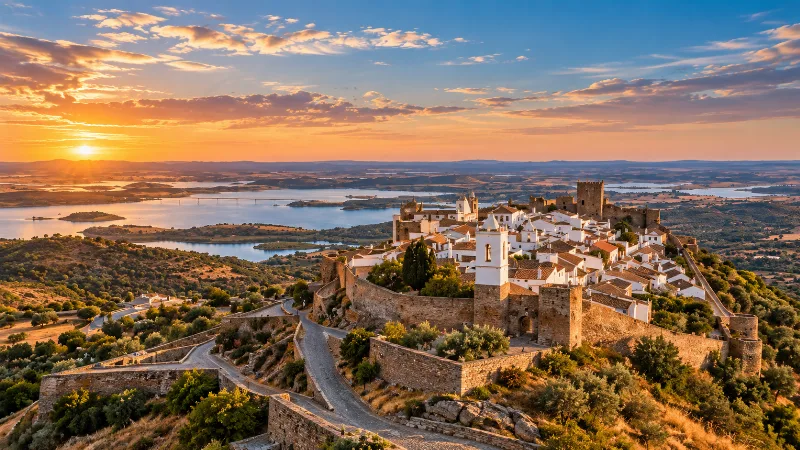
Alentejo
Discover Alentejo through Évora, whitewashed towns, cork-oak landscapes, vineyards, regional food and the broad rural interior of southern Portugal.
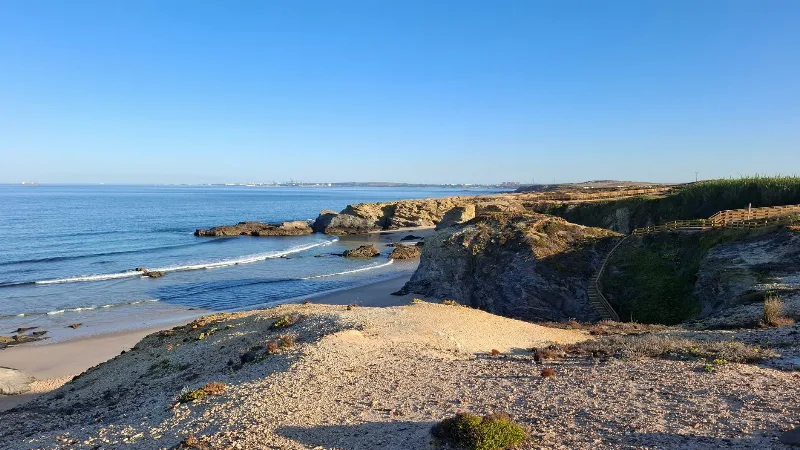
Setúbal
A working port on the north bank of the Sado estuary, Setúbal combines a long maritime history, Manueline architecture and the limestone hills of Arrábida. Ferries, a renowned fish market and a resident dolphin population are part of everyday life there.
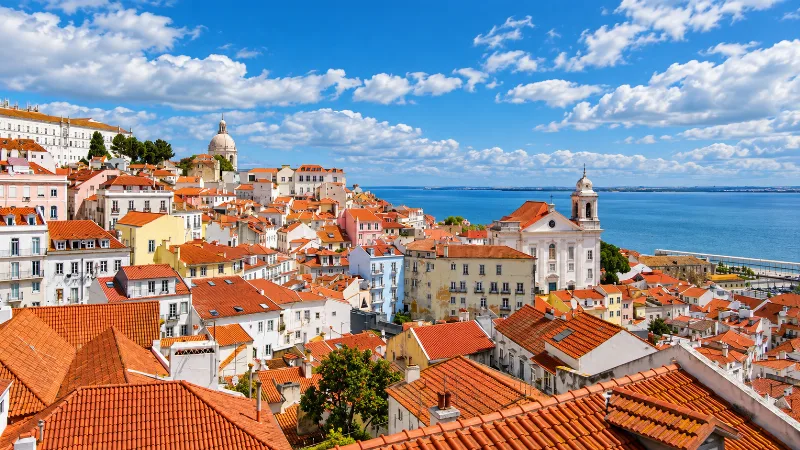
Lisbon
Portugal’s capital combines historic neighbourhoods, river views, tiled façades, viewpoints and an energetic everyday city life.
Grândola
A small Alentejo town in the Setúbal district, Grândola sits between cork oak plains and the wooded hills of the Serra de Grândola, and is bound up with the song that signalled the 1974 revolution.
Alcácer do Sal
A hilltop town above the Sado river in Portugal's Alentejo, Alcácer do Sal combines a walled historic centre with rice fields, salt pans and a long trading past.
Azeitão Sheep's Cheese and the Setúbal Peninsula
Azeitão cheese is a soft sheep's milk cheese from the villages below the Serra da Arrábida, set with cardoon thistle and made by small dairies on the Setúbal Peninsula.