
Elvas Star Fort and Amoreira Aqueduct
The border town of Elvas in Portugal's Alentejo preserves one of Europe's largest star-fort systems, together with the long Amoreira Aqueduct that once carried its water across the valley.
Elvas lies on a low hill in the Alto Alentejo, a short distance from the Spanish frontier at Badajoz. Its silhouette is unmistakable: a compact whitewashed town wrapped in ramparts, crowned by outlying forts, and crossed by the tall arches of the Amoreira Aqueduct. Few places in Portugal show so clearly how geography and defence shaped a settlement. Because the town commanded the main route between Lisbon and Madrid, it grew into a garrison of strategic importance, and the engineering that protected and supplied it has survived almost intact. The star fort of Elvas and the aqueduct were jointly inscribed on the UNESCO World Heritage list in 2012, as the Garrison Border Town of Elvas and its Fortifications.
A Garrison Town on the Frontier
Elvas changed hands several times in the Middle Ages and only settled firmly under Portuguese rule in the thirteenth century. Its real military career began after 1640, when Portugal recovered its independence from Spain and the long War of Restoration turned the Alentejo border into a fortified frontier. From the 1640s onwards the town was rebuilt as a bulwarked stronghold in the Dutch style, with the Flemish Jesuit engineer known as Father Cosmander among those who advised on the works. Later generations added outer forts, magazines and barracks, and the system was still being extended at the end of the eighteenth century. It is often described as the largest surviving bulwarked, dry-ditch fortress complex in the world.
Bastions, Ravelins and the Medieval Castle
The inner town keeps two distinct rings of defence. The older is the medieval wall of the fourteenth century, of which stretches and gateways remain, along with the castle on the highest point, a Moorish-origin stronghold with a square keep and a small inner yard. Around it runs the later enceinte: thick, low walls with angular bastions, a wide dry moat, ravelins and outworks designed to sweep attackers with crossfire rather than to resist bombardment from a height. Walking the ramparts gives a clear sense of how the system worked, with the town's churches and rooftops visible on one side and the open Alentejo plain on the other.
The Forts of Graça and Santa Luzia
Two detached forts complete the defences. The Forte de Nossa Senhora da Graça stands on a hill above the town; it was begun in 1763, after the Spanish invasion of the previous year, and finished in the 1790s. Its plan is a classic star, with four bastions, a deep ditch and long vaulted bomb-proof galleries and barracks cut into the rampart, all arranged around a small chapel. To the south-west, the Forte de Santa Luzia was built between 1641 and 1648 and is one of the earliest Portuguese works laid out on the Dutch system, smaller and simpler, with a square of vaulted casemates within its walls.
The Amoreira Aqueduct
Water was Elvas's weak point, and the answer was the Amoreira Aqueduct. Work began in 1537 under King João III, to designs attributed to Francisco de Arruda, and the structure was finally completed in 1620. The conduit runs for roughly seven kilometres from its springs, mostly underground or at ground level, before crossing the Amoreira valley on a long arcade of arches. In its central section the aqueduct rises in four tiers to a height of about thirty-one metres, an elegant stack of round arches in stone that is visible from much of the surrounding countryside. Altogether the aqueduct is carried on more than eight hundred arches, and it served the town for some three centuries, ending at a fountain in the lower part of Elvas.
Water, Walls and Everyday Life
The two monuments complement each other. The aqueduct made it possible to hold a crowded garrison town through long sieges, while the fortifications existed to protect the water supply and the crossing it guarded. Inside the walls, Elvas retains a quiet grid of narrow streets, arcaded squares and whitewashed houses, with the former cathedral, churches and the pelourinho of the Praça da República among its notable buildings. The aqueduct is treated less as a monument than as part of the landscape: its arches frame fields and orchards in the valley below the town.
Walking the Defences and the Valley
The fortifications are best understood on foot. A circuit of the ramparts shows the bastions and moats at close range, while the climb to the Forte da Graça opens a wide panorama over the town, the aqueduct and, on clear days, the Spanish city of Badajoz beyond. A path follows the aqueduct through the valley, allowing the scale of the arcade to be appreciated from below, where the arches tower over scrub and farmland. Together these walks set out the story of Elvas in a single afternoon: a border town that answered the demands of war with geometry, and the demands of daily life with water.
Related content
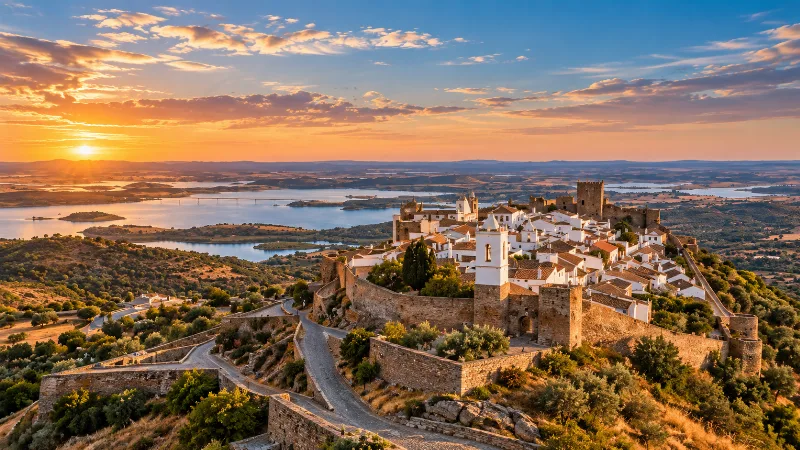
Alentejo
Discover Alentejo through Évora, whitewashed towns, cork-oak landscapes, vineyards, regional food and the broad rural interior of southern Portugal.
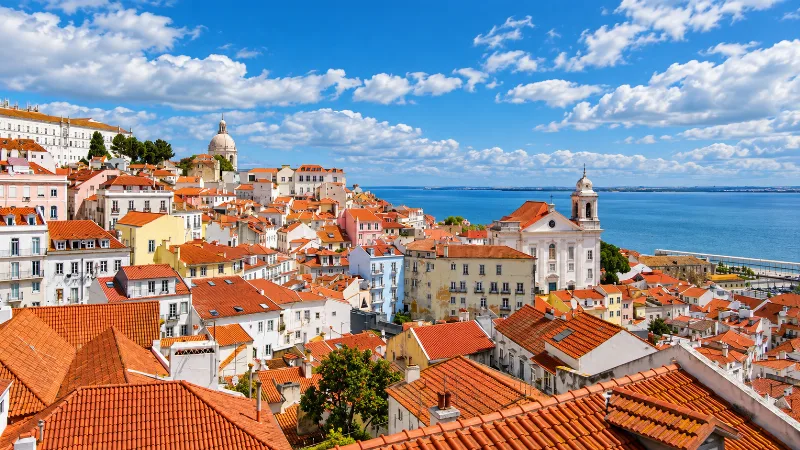
Lisbon
Portugal’s capital combines historic neighbourhoods, river views, tiled façades, viewpoints and an energetic everyday city life.
Exploring the Historic Town of Elvas
Explore exploring the historic town of elvas with a practical guide to notable places, regional landscapes, local heritage and travel planning in Portugal.
Évora's Roman Temple and Historic Aqueduct
Évora's first-century Roman temple and its sixteenth-century aqueduct are two of the Alentejo's most enduring monuments. Together they show how a provincial city was built, supplied and defended across many centuries.
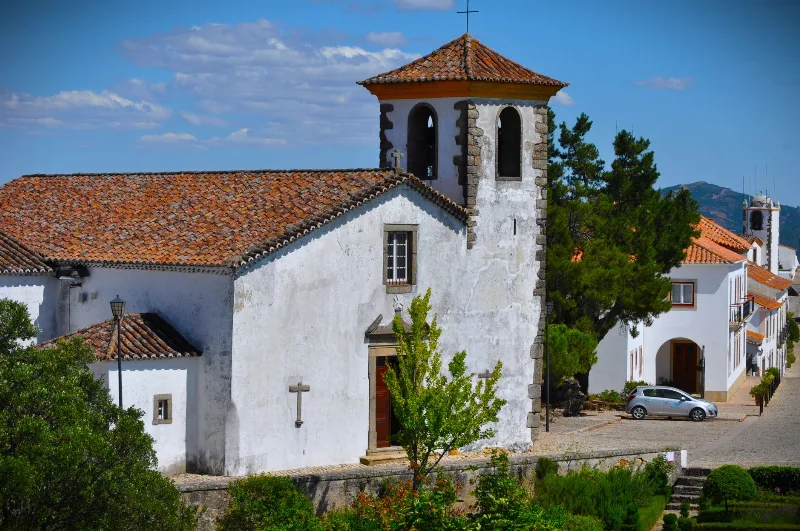
Portalegre
A hill town in the Alto Alentejo where the plains meet the Serra de São Mamede, Portalegre is known for its medieval walls, Baroque churches and handwoven tapestries.
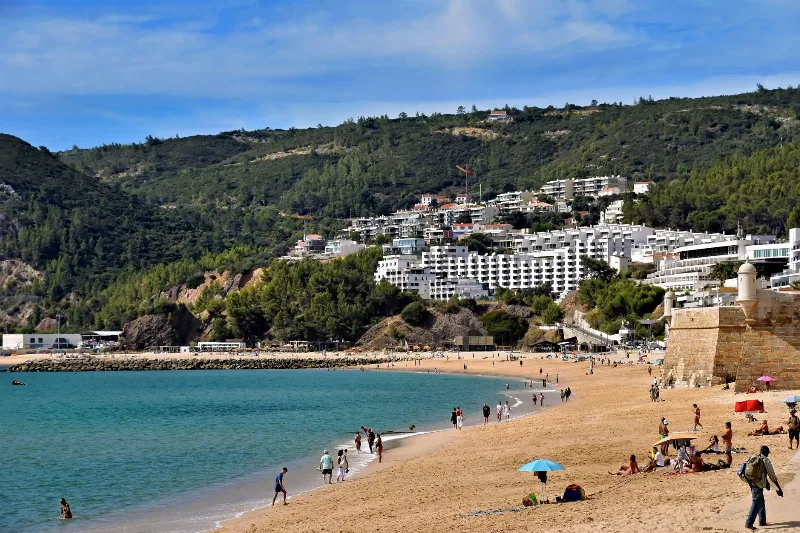
Best Regions to Visit in Portugal
Discover Portugal's most popular travel regions, from the historic cities of Lisbon and Porto to the beaches of Algarve, the countryside of Alentejo and the Atlantic islands.
Marvão Hilltop Fortress and Schist Village
Perched on a rocky ridge in the Serra de São Mamede, Marvão combines a hilltop fortress, schist-built lanes and wide views over the Alentejo borderlands.
Alcácer do Sal
A hilltop town above the Sado river in Portugal's Alentejo, Alcácer do Sal combines a walled historic centre with rice fields, salt pans and a long trading past.