
Bragança
Bragança is a granite-built city in north-east Portugal whose walled citadel, medieval castle and Romanesque civic hall stand above the surrounding Trás-os-Montes plateau, close to the Montesinho hills.
Bragança is a city of roughly 35,000 people in the far north-east of Portugal, laid out on a granite plateau about 700 metres above sea level and some 25 kilometres from the Spanish frontier. It is the capital of its district and the principal town of eastern Trás-os-Montes, a thinly populated, mountainous part of the country where settlement has always followed the river valleys. What gives Bragança its particular shape is the walled citadel that still occupies the highest ground of the old town: the modern city has grown around that enclosure rather than over it, so the medieval core remains legible as a separate place.
A frontier city on a granite plateau
The city sits between the valleys of the Sabor and the Tuela, on the edge of the mountains that continue north into Galicia and east into Castile and León. The small river Fervença runs below the old town, and the terrain rises quickly on most sides, which is one reason the site was chosen for defence. Winters here are long and genuinely cold, with frost and occasional snow, while summers are hot and dry; the climate is continental rather than Atlantic, and the vegetation reflects it. Road access is straightforward: the A4 motorway connects Bragança with Porto, roughly 200 kilometres to the west, and continues to the Spanish border, where it joins the network heading towards Zamora. The city has no railway station, so buses and cars carry almost all arrivals.
Because it is both a district capital and a university town, Bragança has a working year-round life that many small Portuguese cities lack. The Polytechnic Institute brings several thousand students into the centre, and administrative offices, a hospital and regional services keep the streets busy on weekdays. Away from the main avenues, however, the pace is quiet, and the old quarters are still largely residential.
From Brigantia to the House of Braganza
The site was occupied in antiquity, when the Celtic tribe known as the Brigantes gave the place a name that later became Bragança. The Romans, and after them the Suevi and the Visigoths, held the district before it passed into the long contest between the kingdoms of León and the emerging Portugal. Bragança changed hands repeatedly during the twelfth century and was secured for Portugal in the 1180s, when Sancho I is credited with granting the town a charter and beginning the fortifications. The castle was subsequently strengthened more than once, and the great keep that dominates the skyline today belongs largely to the fifteenth century.
The town's national importance came in 1442, when Afonso, Count of Barcelos, an illegitimate son of João I, was created Duke of Braganza. The title made the town the seat of one of the most powerful noble houses in Iberia, and the dukes held lands and offices far beyond Trás-os-Montes. In the sixteenth century the family's main residence moved south to Vila Viçosa, and Bragança settled into the role of a provincial capital. Its place in Portuguese history was nevertheless assured in 1640, when the eighth Duke was proclaimed King João IV and founded the dynasty that ruled until 1910. The castle and the surrounding enclosure were later adapted for military use, and much of the old town inside the walls was given over to barracks, churches and episcopal buildings.
Inside the citadel walls
The citadel is the reason most travellers come, and it repays slow walking. Its granite curtain walls enclose a small knot of streets and buildings that have never been cleared or rebuilt as a monument. At the centre stands the castle, whose square keep rises to about 33 metres and can be climbed for a view across the roofs and out to the hills. Beside it is the Domus Municipalis, a pentagonal Romanesque building of the twelfth or thirteenth century that is believed to have housed the town council; it is one of the very few surviving examples of civil Romanesque architecture in the Iberian Peninsula, and a vaulted cistern lies beneath it.
The church of Santa Maria do Castelo, rebuilt in the sixteenth century, faces the pelourinho, a carved stone pillar that marks the town's old judicial authority. The former episcopal palace now holds museum collections, and the keep contains a military museum with displays on the region's frontier history. Just outside the walls, the cathedral reflects the creation of the diocese in 1545, and the streets of the old Jewish quarter, with their low doors and narrow passages, are still visible near the main gate. The wider town mixes sixteenth- and seventeenth-century churches with sober nineteenth-century civic buildings and a certain amount of recent construction, but granite remains the dominant material throughout.
Montesinho and the countryside around the city
To the north and west of Bragança lies the Montesinho Natural Park, established in 1979 and covering around 75,000 hectares of granite hills, oak woods, chestnut groves and small farming villages. It is one of the largest protected areas in Portugal and one of the least visited. The park shelters roe deer, wild boar and otters, and it forms part of the range of the Iberian wolf, whose presence is monitored rather than advertised. Walking routes follow old paths between hamlets such as Rio de Onor, on the Spanish border, where houses on either side of the stream belong to different countries.
Closer to the city, the Serra da Nogueira provides a belt of Pyrenean oak and chestnut woodland, and the surrounding plateaus are farmed for rye, potatoes and pasture. Rivers and reservoirs, including the Sabor and the Maçãs, offer fishing and quiet banks in summer. The landscape is not dramatic in the alpine sense; its character comes from stone terraces, scattered granaries raised on granite legs, and the sense of space that comes with high, open ground.
Local culture: masks, music and smoked meats
Trás-os-Montes has a strong culture of its own, and Bragança is a convenient base for meeting it. Winter masquerade traditions, in which young men wear carved or fringed masks and roam the villages, survive across the region and are documented in the city's Iberian mask and costume museum. The rural bagpipe known as the gaita transmontana is still played, often alongside drums and tambourines, and the region's vocal music is plain and unhurried.
Mirandese, a Romance language related to Asturian and Leonese, is spoken in villages east of the city and has had official recognition since 1999. Food follows the climate: cured and smoked pork, the thin sausage called alheira, oven-roasted kid and lamb, chestnuts, honey and robust red wines from the Douro further south. Everyday life still includes weekly markets, the autumn chestnut harvest and the pig-killing season in the colder months, when smoke drifts from the chimneys of village houses.
Buildings and collections worth seeking out
Beyond the citadel, the Museu do Abade de Baçal brings together archaeology, religious art, painting and rural ethnography in a former bishop's palace, and the Graça Morais contemporary art centre shows modern Portuguese work in a purpose-built space. The cathedral and the sixteenth-century churches of the lower town contain gilded retables and azulejo panels that reward an unhurried hour. The old bridge over the Fervença, the public gardens and the belvederes on the edge of the plateau all give views back towards the castle, which looks most solid in low evening light.
Nearby destinations
Vinhais, around 30 kilometres to the north-west, is a small market town known for its smoked meats and for the chestnut woods that surround it. Miranda do Douro, to the south-east, sits on cliffs above the Douro gorge and is the heartland of the Mirandese language, with a ruined castle and a cathedral. Mogadouro and Torre de Moncorvo continue the pattern of hilltop castles and Douro vineyards, while Macedo de Cavaleiros, west of Bragança, has the Azibo reservoir and its sandy shores. Across the border, the Zamora province offers Romanesque churches and the Sanabria lake, both reachable in a day.
Related content
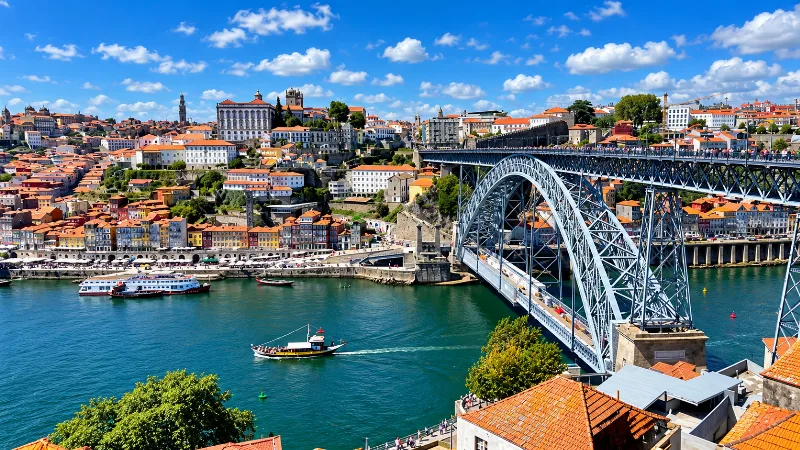
Porto
Porto is a compact northern city of steep streets, granite architecture, riverfront views, historic districts and strong local character.
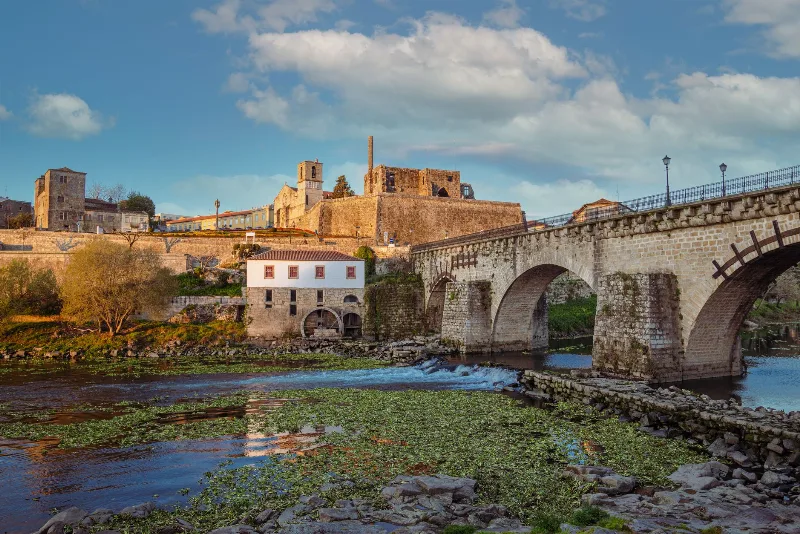
Barcelos
A Minho town built around a medieval bridge and a long-running Thursday fair, Barcelos is the home of Portugal's rooster legend and a living centre of popular craft.
Barcelos Rooster and Portuguese Folk Art
The painted clay cockerel from northern Portugal is more than a souvenir: it carries a medieval legend, a living pottery tradition and a widely shared message of good fortune.
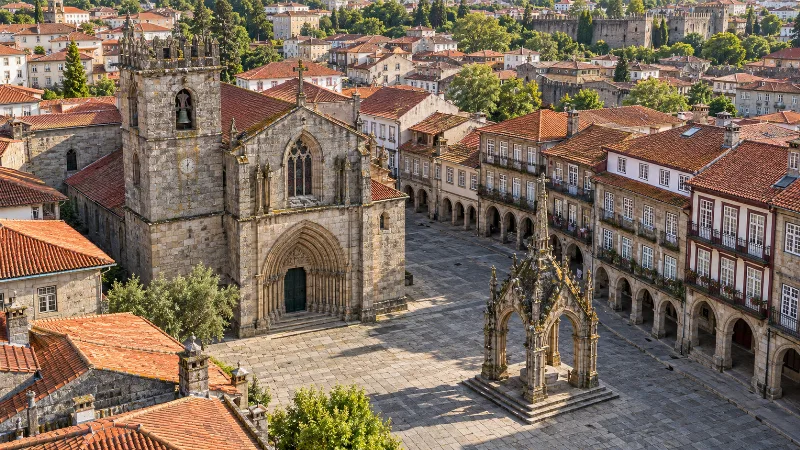
Guimarães
Guimarães combines a medieval castle, traditional squares and a UNESCO-listed historic centre closely linked to the early history of Portugal.
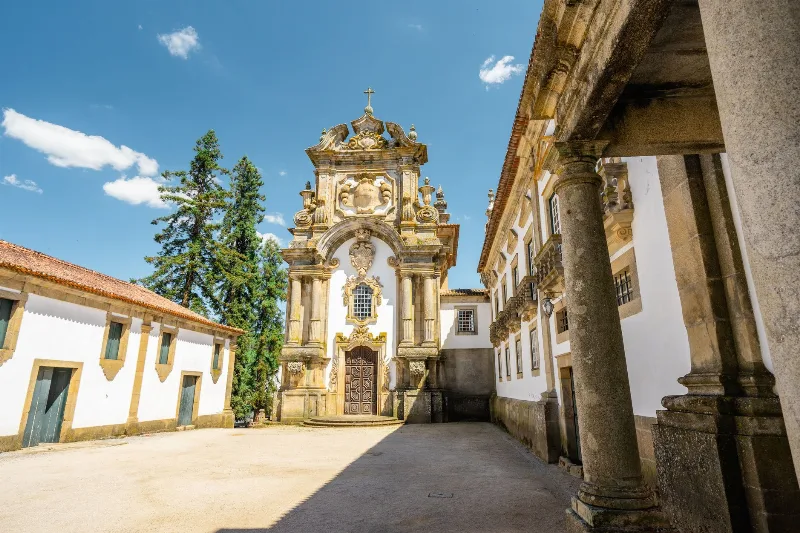
Vila Real
Vila Real is the district capital of northern Portugal's Trás-os-Montes, a granite town set above the Corgo gorge, with a noble old quarter, a university and the Baroque Palace of Mateus a short drive away.
Guimarães Castle and the Birthplace of Portugal
Guimarães Castle is a granite stronghold in northern Portugal whose walls, keep and neighbouring Romanesque chapel are tied to the emergence of the Portuguese kingdom.