
Piódão: The Schist Village of Serra do Açor
Piódão is a mountain village of dark schist houses stacked in a natural amphitheatre in the Serra do Açor, known for its steep lanes, blue doors and terraced slopes.
Piódão is a compact mountain village in the Serra do Açor, in the interior of central Portugal, where houses of dark schist are packed tightly onto a steep hillside. Administratively it belongs to the municipality of Arganil in the Coimbra district, close to the boundary with the Castelo Branco district, and it forms part of the Aldeias do Xisto network of schist villages. Its setting is remarkable: the settlement faces across a bowl-shaped valley, so the houses appear to rise in tiers, an arrangement that has earned Piódão the nickname aldeia-presépio, the nativity village. Despite its fame, it remains a small place with a resident population of only a few hundred, and the journey there follows winding mountain roads that make the arrival feel deliberate rather than incidental.
Where the Village Sits in the Serra do Açor
The Serra do Açor is a granite and schist massif between the valleys of the Mondego and the Zêzere, and Piódão occupies a sheltered fold on its western flank. The position explains much about the village's character: slopes fall away sharply, water runs in small streams below the houses, and the horizon is closed by ridges rather than open sky. Winters can be cold and misty, with cloud sitting in the valley for days, while summers are dry and warm. The surrounding land is worked in narrow terraces, a practical response to gradients too steep for large fields, and these terraces give the landscape around Piódão its distinctive stepped profile.
A Village Built in a Natural Amphitheatre
The layout follows the geology. Lanes are steep, paved with rough stone, sometimes reduced to stepped footpaths that pass between houses and under overhanging roofs. Because building space was scarce, houses were raised in tight rows, each gaining a view over the roof of the one below. There are few open squares; instead the village opens out at viewpoints and small terraces where residents once dried produce and where visitors now pause. Walking through Piódão is a matter of constant small ascents and descents, and the village reveals itself gradually rather than all at once.
Schist Architecture and the Painted Doors
Schist is a layered metamorphic rock that splits into flat slabs, and locally it supplied both walling stone and roofing material. The houses are built from irregular blocks set with mortar, often left unrendered, and topped with heavy slate or schist roofs. The result is a near-monochrome village of greys and browns, which makes the painted woodwork stand out sharply. Piódão is particularly associated with doors and window frames in a deep, bright blue, a colour said to have been introduced when only a limited range of paint was available locally. Whatever its origin, the contrast between blue joinery and dark stone has become the village's visual signature. Small details reward attention: stone steps built into walls, chimneys of varied shapes, wooden balconies and the occasional whitewashed façade breaking the pattern.
The Parish Church and the Village Museum
The parish church, dedicated to Nossa Senhora da Conceição, stands at the upper edge of the village and is recognisable from afar by its solid tower. Inside, the walls and ceiling are covered with blue-and-white azulejo tiles that form a striking contrast with the plain stone exterior. The village also has a small ethnographic museum, which documents rural life in the Serra do Açor through agricultural tools, textiles, furniture and objects connected with domestic work and religious practice. Together these two buildings give context to the lanes outside, explaining how a community survived on thin soils and steep ground.
Walking the Terraced Slopes
The paths around Piódão are among the main reasons to linger. Trails lead out from the village across the terraces, past dry-stone retaining walls, olive trees, chestnut groves and patches of rye, and along watercourses shaded by alder and oak. A well-known route connects Piódão with Foz d'Égua, a smaller schist hamlet set where two streams meet, with a river beach and old stone bridges in a wooded valley. The walking is short in distance but demanding in gradient, and the rewards are quiet: views back to the amphitheatre of houses, glimpses of shepherds' shelters and the sense of a landscape shaped entirely by hand.
Local Produce and Traditional Cooking
Farming here has always been small-scale and mixed. Terraces produce olives and chestnuts, goats and sheep graze the higher slopes, and beekeeping is well suited to the flowering scrub of the mountains. Chestnuts appear in soups, breads and stuffings, and honey from the region is highly regarded. Local cooking is hearty and based on what the land provides: cured pork, smoked sausages, goat's cheese, greens and potatoes, with slow-cooked goat stews of the kind associated with the wider Beira region. Sweet pastries made with eggs, sugar and almonds reflect the conventual traditions of central Portugal.
Nearby Places Worth Combining with a Visit
Piódão sits within a wider cluster of schist settlements, including Foz d'Égua, Chãs de Égua, Mata and Côja, each with its own character and its own pattern of lanes. The mountain scenery of the Serra do Açor, including the protected forest of the Mata da Margaraça, offers an insight into the original woodland cover of the massif. Visitors travelling between the coast and the interior will find Piódão a natural stopping point, best appreciated slowly and on foot, with time allowed for the silence that settles over the valley in the early morning and at dusk.
Related content
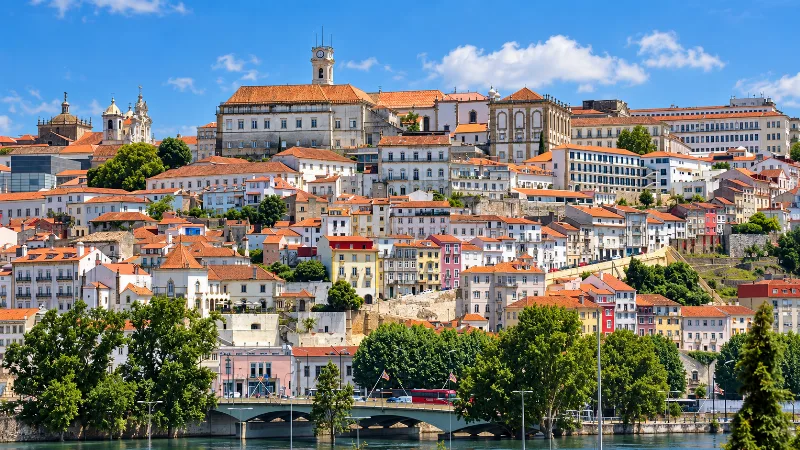
Coimbra
Coimbra combines Portugal’s oldest university traditions with a compact historic centre, river views, medieval streets and a student atmosphere.
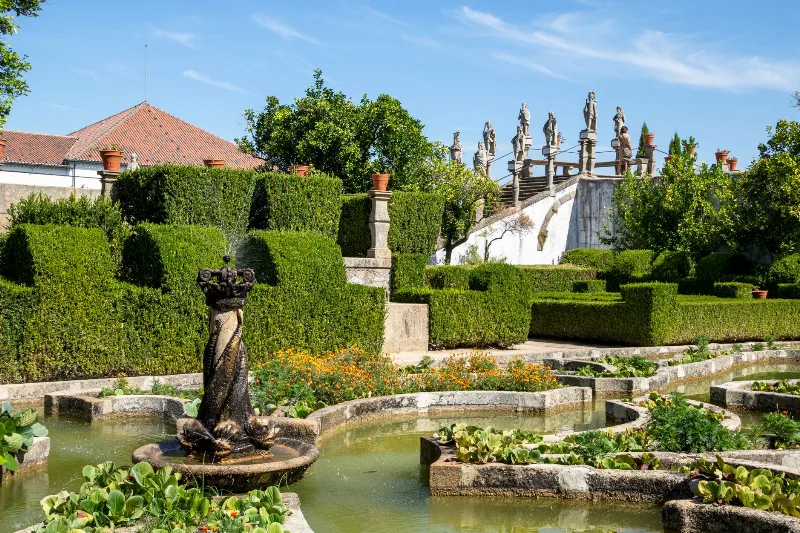
Castelo Branco
Castelo Branco is the district capital of Portugal's Beira Baixa, a hill town known for its Templar castle ruins, a baroque episcopal garden and a long tradition of silk-on-linen embroidery.
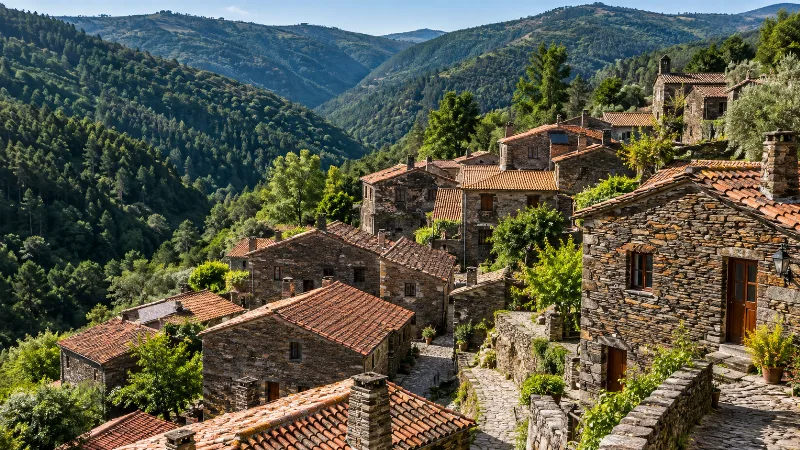
Explore the Schist Villages of Central Portugal
Discover central Portugal’s schist villages through stone lanes, traditional houses, wooded slopes and carefully chosen walking routes.
Marvão Hilltop Fortress and Schist Village
Perched on a rocky ridge in the Serra de São Mamede, Marvão combines a hilltop fortress, schist-built lanes and wide views over the Alentejo borderlands.
The Terraced Vineyards of the Douro Valley
The Douro Valley is defined by vineyards cut into steep schist slopes above a winding river, a landscape shaped by centuries of wine growing. Its terraces, villages and seasonal colour make it one of Portugal's most distinctive rural regions.
The Mondego River Valley from Serra da Estrela to Coimbra
The Mondego is Portugal's longest river to rise and finish entirely within the country, linking the granite heights of Serra da Estrela with the Atlantic at Figueira da Foz. Its valley passes through mountain scenery, wooded gorges, historic towns and a wide agricultural plain.
Covilhã
Covilhã grew wealthy on wool combed from the Serra da Estrela and now stands as the mountain city of Portugal's Beira Interior, with a steep old quarter, a university in converted mills and the high summits close at hand.
Côa Valley Palaeolithic Rock Art and Archaeological Park
Along the Côa river in north-east Portugal, thousands of animals were incised into open schist panels during the Upper Palaeolithic. The valley is now a protected archaeological park with guided access to its most celebrated rocks.